April 6, 202210 min readJérôme Dard
Project communication plan: how to avoid failure?


Contents
99% of project failures are due to a bad communication plan!

A CIO after a communication crisis... discovering that AirSaas existed ;-)
This statistic from the "Totally Subjective Institute" is unverifiable, but experienced CIOs do tell us that effective communication actions are a central aspect of project management. Because, as the saying goes, "if it's ambiguous, it's suspicious"!
Project management is above all about leading a group of men and women. To succeed in this mission, the project manager must be heard and must listen. And must make sure that, at every stage, their key messages get through! All while avoiding "backlash" around the project.
Welcome to a pragmatic and strategic article on the art of designing a project communication plan tailored to your context and your goals. We'll review the fundamental principles, advanced practices, the best communication strategies, the practices and the common mistakes in this field.
As usual, you won't find a magic recipe here for succeeding every time! Instead you'll discover strong convictions, key principles and a few proven templates to shape your generic project communication plan, ready to be customized for your context.
Why communicate around your project?
According to its etymology, the word "communication" comes from the Latin "communicare," which means "to share."
In practice, sharing burdens and difficulties 😱 won't motivate teams! And yet, when well-framed and then well-executed, an effective internal communication plan is a "change manager" in its own right, one that helps you steer your projects better.
Communicating (appropriately) reduces pressure and motivates stakeholders
🥊 99% of friction comes from a lack of understanding of the IT department's set of constraints and a failure to account for the business teams' expectations.
Yet communicating at regular intervals about progress, the problems encountered and the milestone successes helps reduce the frustration and impatience of those in need of updates.
Less friction lets your project team move forward more calmly!
It's the virtuous cycle: Trust + Respect = Engagement!
Where do we start? How do we go about it?

You need a project communication strategy!
Before trying to play the "black belt" of corporate communication, you need to master the fundamentals of planning!
Generally speaking, the methodological approach consists of framing your action plan from every angle: "Who says what, to whom, why, when, where? By what means and with what effect?".
This approach is inspired by the Lasswell matrix, named after a 20th-century American political scientist who worked on mass communication.
The "5W2H" method: for building "all-terrain" communication plans
Who?
You're not the only one responsible for communication around your project!
Get help with this task from all the contributors. Announced from the framing phase onward, this communication "workload" will be shared within the group. A communication circle/committee can be created.
Be careful, however, to clearly define the review process and the person who will have the "final cut" on collective messages. Just like an editorial team, where journalists rely on a chief editor who guarantees the editorial line.
What?
Based on your communication goals, define "template" formats in your project communication plan, to create reference points
- An automatic decision report with a short, precise email once a week, so as not to drown people in information.
- A lighter "behind-the-scenes" communication about anecdotes and the making-of...
To whom?
One message, several versions depending on your target audience
List the stakeholders in the project, and see what their stakes and expectations are.
Are all the targeted groups homogeneous? Or should a particular targeted group be subdivided (by importance, by involvement in the project, by IT skills, by location, etc.)?
Why?
Serve your direct and indirect goals in each communication campaign
- Reinforce the decisions that were made
- Alert about difficulties
- Inform about the progress of a project
- Secure support and additional resources
When?
Internal communication follows the project's rhythm, adapts and evolves along with its stages
- At the start, middle and end of the project: you prepare a more "editorialized" package, with interviews, infographics, in the newsletter, in Teams...
- At each milestone, to users and stakeholders: an article, a simple post, a general announcement in Teams...
- Every week, to stakeholders: an automatic decision report with a short, precise email, so as not to drown your readers in information.
How? By what means?
There are three criteria to keep in mind when creating the content you'll communicate: usefulness, clarity and conciseness.
- Usefulness? Center your communication on value! Talk about the expected gains, about what will change in everyone's day-to-day.
- Clarity? We very often forget that, beyond what the project will "deliver," it's essential to clearly point out what it will not deliver. Acting by the "roundabout way" is often a very powerful lever in communication. Teams appreciate authentic communication!
- Conciseness? Less is more! And an image is worth a thousand words!
Where?
One channel = one use
With the proliferation of communication channels, it's more worthwhile than ever to agree on and choose your best "media," your communication methods, according to the desired impact, and to set guidelines for your exchanges.
Beyond the basics: the five hacks🔥 for building a modern project communication plan
1. The weekly flash report: or the art of continuous communication
An ideal communication support, "flash reports" are crucial for better involvement of the company's stakeholders and, consequently, for the success of your projects. They complement good steering and schedule tracking.
Sending a weekly flash report addresses three key issues:
- Sharing information in a structured way with stakeholders.
- A "hidden" issue: protecting yourself from hearing "Oh? I didn't know!"
- And finally, having a fixed frequency sets the "tempo" and helps keep teams mobilized.
👩🍳 Chef's tip: after a few iterations of this "routine," go back to the stakeholders to confirm that the project communication suits them. Using a simple open question: "Does the way we communicate match your need for information?"
🕵️♂️ This notion of continuous communication was mentioned in our article on the steering committee: "The best way to avoid catching the steering committee members off guard is to communicate continuously about the project's progress."
2. Have well-identified channels, targets and frequencies
To avoid the trap of a too-restricted key-user group, remember to address, beyond those inside the project, all the future users who will be impacted. For example, share the key information every 15 days on your Teams platform or another channel. To be sure you really reach the target. ✅
You can, for example, break down your communication plan with:
- On Teams, communication of "broad" information to everyone who will be concerned by the project's results.
- And for the project team, regularly sending all stakeholders a flash report in PowerPoint format using a dedicated tool like AirSaas.
☝️ Be careful to set guidelines for your channels and announce your terms of use, to avoid conversations drifting off track.

Left "un-charted," your Teams platform can turn into the local pub!
☝️ And be careful to vary the pleasures: project poster, info flyer, teaser emails, "Loom" demo video, an insert in the company newsletter, project-branded goodies, a collective info webinar, messages in Slack/Teams, a launch event... Each project communication tool has its advantages and disadvantages.
3. Spread the good news with attractive communication
"Form is the content that rises to the surface."
Form matters as much as content. Remember the wrapping of the toy boxes at Christmas, which sometimes appeals more than the gift itself! Take care with the form, use simple images and infographics as communication tools.
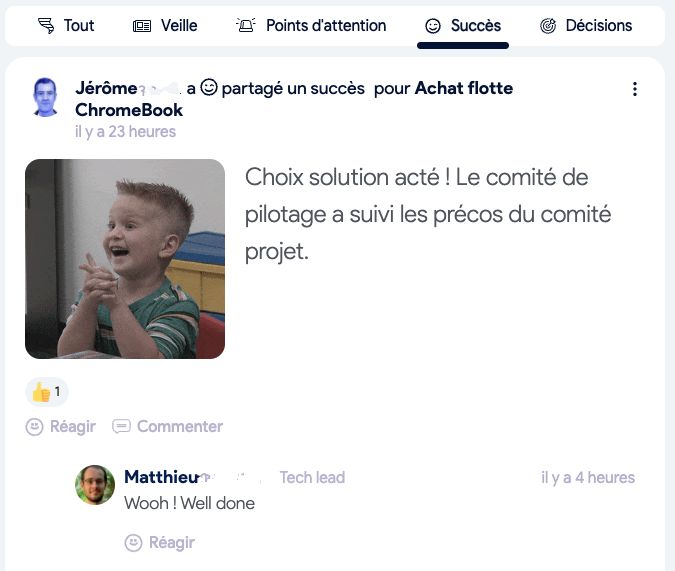
Highlighting what works, what has succeeded, is a key focus of your project communication plan. This also runs through project managers who post, and sponsors who "like" and comment.
Sharing a success with an image is good, highlighting a success point in a message that will be seen is better! For that, there's nothing like making good use of a simple animated GIF, for example. To make sure your message is seen and appreciated, a GIF catches the eye!
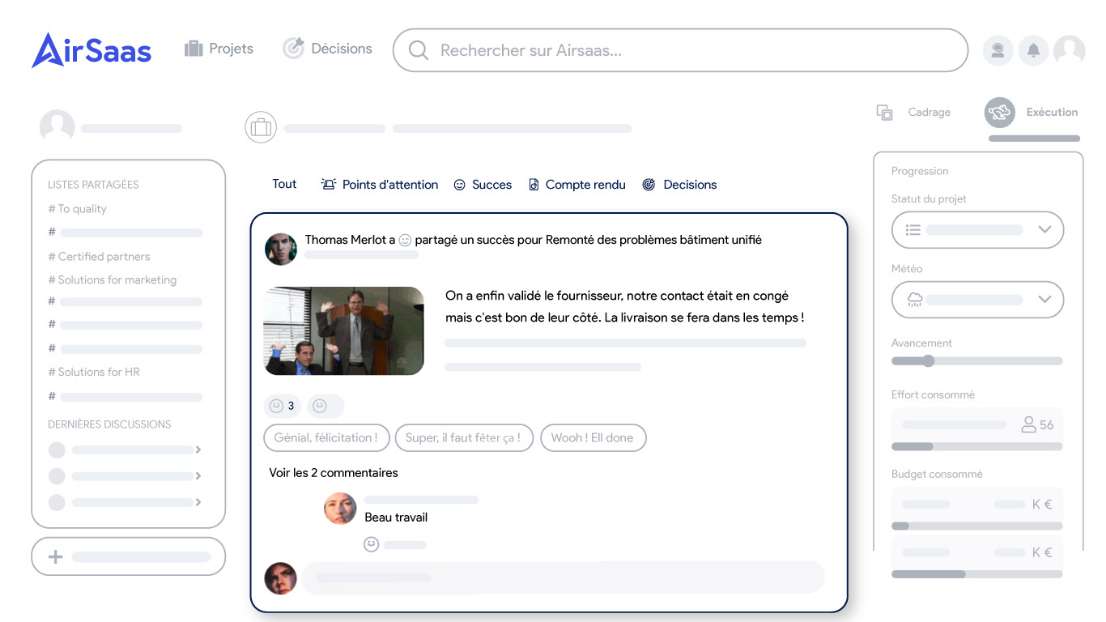
An AirSaas feature that's very popular :-)
In the project discussion thread on AirSaas, you can add a GIF to share a success, congratulate a colleague... it makes all the difference!
Varied, even "offbeat," communication will surprise people and help avoid everyone losing motivation.

Mixing seriousness and humor: yes, and always with moderation and discernment
4. Use each project milestone as a success point
Milestones are what set the rhythm of projects; they help align teams on the goals and break projects down into several key stages.
So it's the ideal communication opportunity to provide reference points. Don't forget that we're all more or less drowning in the flood of information. In some cases it even goes as far as "infoxication"!
In short, communicating about milestones will help guide your "readers". It's the famous 📍 "You are here!" that reassures and gives an overview of the projects.
5. Maintain authentic and transparent communication
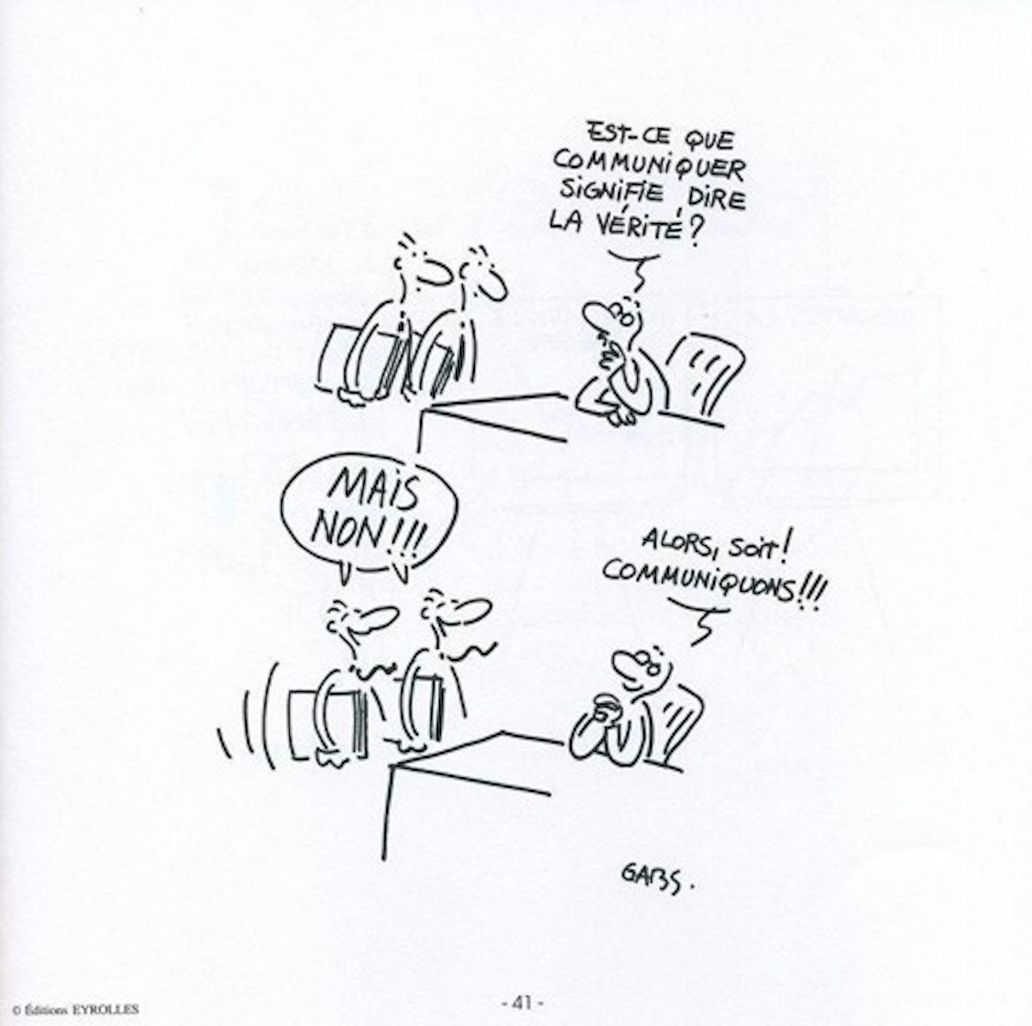
Excerpt from the book "Communication? je me marre!" Ed. Eyrolles.
A final challenge for building a good project communication plan: transparency. Indeed, during the project team's sync-up meetings, many micro-decisions are made.
The project team must take responsibility for communicating about these. Because they sometimes fall outside their scope of responsibility. It's therefore important to properly organize the flow of all information, attention points and decisions made.
Because yes, every one of us has experienced it:
There's no project that goes exactly as planned! Executive leadership appreciates transparency. What they don't appreciate is when you hide something and, three years later, they discover there was a deviation in the trajectory.
Do's & Don'ts of a project communication plan
The 7 ingredients of a project communication that has impact!
- Authentic: for people to follow you, it has to ring true!
- Semi-automatic: let the robots do the work, the flash report is there for that :-)
- Collaborative: everyone's a communicator! it's a workload to share.
- Continuous: short, frequent iterations... does that remind you of something?
- Varied: even within a template format, the idea is to surprise.
- Useful: Center your communication on value. Talk about the expected gains, about what will change in everyone's day-to-day. One rule: talk to me about me, that's the only thing I'm interested in!
- Respectful: put yourself in the reader's shoes. It's sometimes hard to understand the technology, its jargon! If you're not careful, don't complain about working alone...
The 7 common mistakes of the project communication plan
- The trap of a too-restricted key-user group!
- The goal of the project communication plan must be clarified before undertaking the process
- The writer must be internal to the project
- The writer isn't necessarily the approver
- The communication plan can't be drawn up in a rush
- Drafting a plan must be done in a spirit of transparency and openness
- Forgetting to say what the project will not deliver!
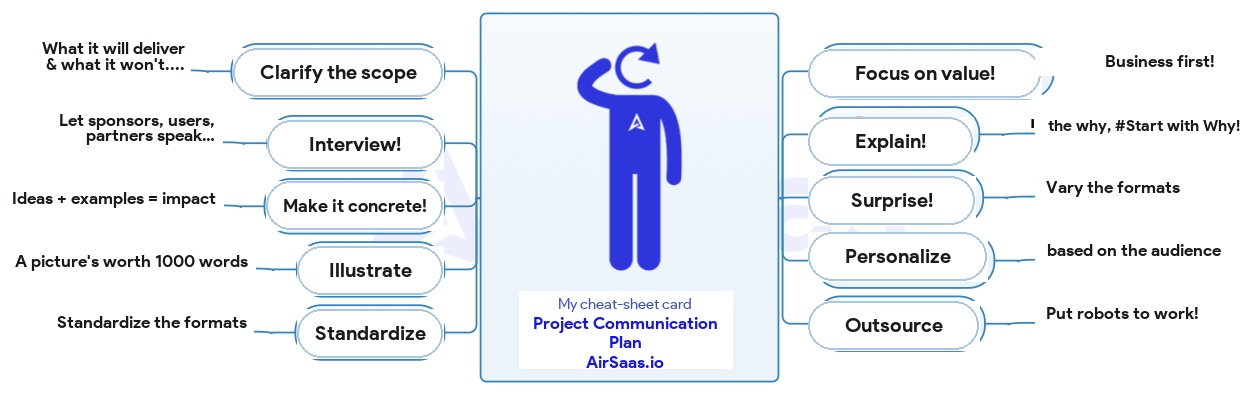
A "memory card" of the project communication plan to take with you
The simplest tool for communicating the health of your projects is the weather report! We tell you everything in How to make a clear, understandable project weather report?
What if you took back control of your project portfolio?
Book a demo and discover the tool in 30 minutes.