April 13, 20226 min readJérôme Dard
How to create a clear and readable project health status?

Contents
Yes! This approach is both engaging enough to get most of the people involved talking, and simple enough to make the health of your project portfolio easy to read. Done well, it makes the key information quickly accessible behind each status change... and it will make managing your projects easier.
Here is everything you need to turn this practice into an efficiency lever for your project management: fundamental uses and best practices, how do you set up a meaningful project health status? What are the common mistakes and pitfalls to avoid?
What is a project health status?
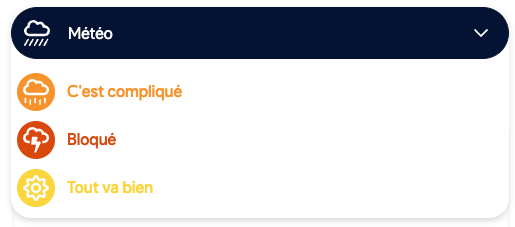
Three typical project health statuses
The project health status is a simple visual model that uses the weather metaphor to communicate on the health of a project. It is even the very first indicator of a project's health!
Closely tied to the continuous-improvement process, tracking and analyzing indicators gives teams feedback and essential information.
But careful... not just any old way!
At a minimum, this reporting indicator must be:
- Understood by everyone: ideally, its definition is the result of a collaborative effort by the team
- Focused: the information-sharing needs it addresses must be clearly defined
- Shared, so that everyone moves in the same direction, toward one single goal
For example, here are three typical indicators of a simple weather-style status and what they mean:
☀️ Sunny: the project is progressing as planned...
All the project milestones are on track. No action needed. Well done :)
🌧️ Rain: things are getting complicated
One or more major milestones are late, but the final delivery is not affected.
The project committee should be notified, using a sync point already scheduled with the sponsor.
⚡ Storm: the project is blocked
One or more major milestones are late and the final delivery is affected.
The issue should be escalated immediately to the project sponsor and the project committee.
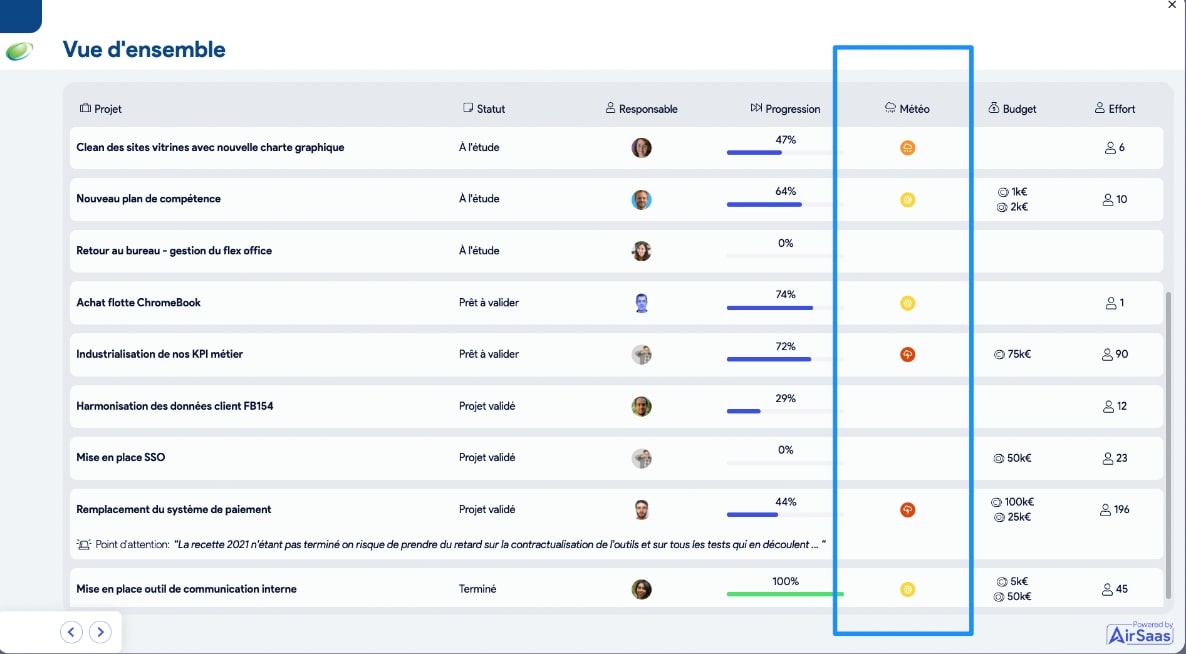
View of the project flash report generated from the AirSaas platform
The three "benefits" of the project health status:
👉 Summarize a project's progress
Adding indicators to your summary tables lets you simplify how the data is read and quickly convey the overall situation... and its context.
👉 Highlight the trend
By looking back at the previous weather report and making the changes visible, you let stakeholders grasp the "dynamics" experienced within the teams.
👉 "Spark the conversation"
Literally, "provocare". We too often assume it comes naturally. Quite the opposite. This visual information lets you approach project reporting in a lighter way.
The project health status, an unsuspected performance lever
The project health status gives you a true map of ongoing activities and of the potential weak signals, symptoms or syndromes of dysfunction in your system!
Weak signals: a few clouds and showers?
Some rainfall... is normal. No project ever goes exactly as planned... it's a shame, but that's just the way it is ;-)!
Symptoms: very frequent rain?
Ouch... the team hasn't seen the sun in a while... Watch out, on one hand for the team's morale, and on the other for the real causes of this repeated bad spell. A root-cause analysis of the issues encountered can (and should) usefully be carried out.
Syndromes: lightning has struck several times?
It's almost too late... the poor health has become chronic. The structural causes of that poor health are now deeply entrenched...
By focusing on weak signals and/or frequent symptoms — that is, the complicated or even blocking topics — you will be able to pinpoint exactly where to concentrate resources to optimize your project management. What gets measured gets managed!
In the end, this indicator is a visual reporting tool quite close to the visual management tools that come from the production methods of lean management. And it's the one everyone looks at most!
Four common problems with the project health status!
Yes! An indicator as simple as the project health status can be "corrupted". Remember that even the simplest of tools, used the wrong way around, becomes counterproductive — even dangerous.
1. Not enough nuance... there are only three indicators!
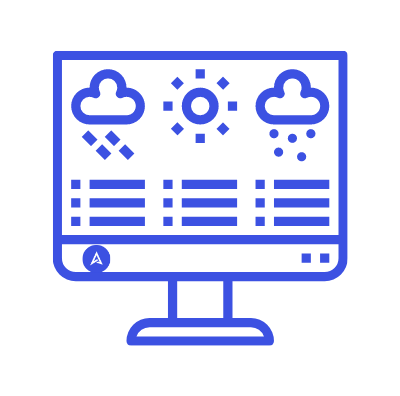
With a 4th status, it's easier to get past the "every project sits in the middle" effect...
When there are only three project status levels... we naturally tend to pick the middle one...
And that no longer delivers the clarity and readability you expect...
Having four status levels will give you nuance and finesse. As the saying goes... better "hard and sure" than "soft and fuzzy"! :-)
For example, 4 typical indicators:
- Blocked,
- complicated,
- getting complicated
- and normal!
2. No methodology... everyone does it their own way!
A shared project culture within a single platform saves time!
Focused on advanced use cases... we often forget this basic point of project management method: agreeing with all stakeholders on what moves a project from one status to another. It's fundamental.
3. No context... you don't know why a status change happened!
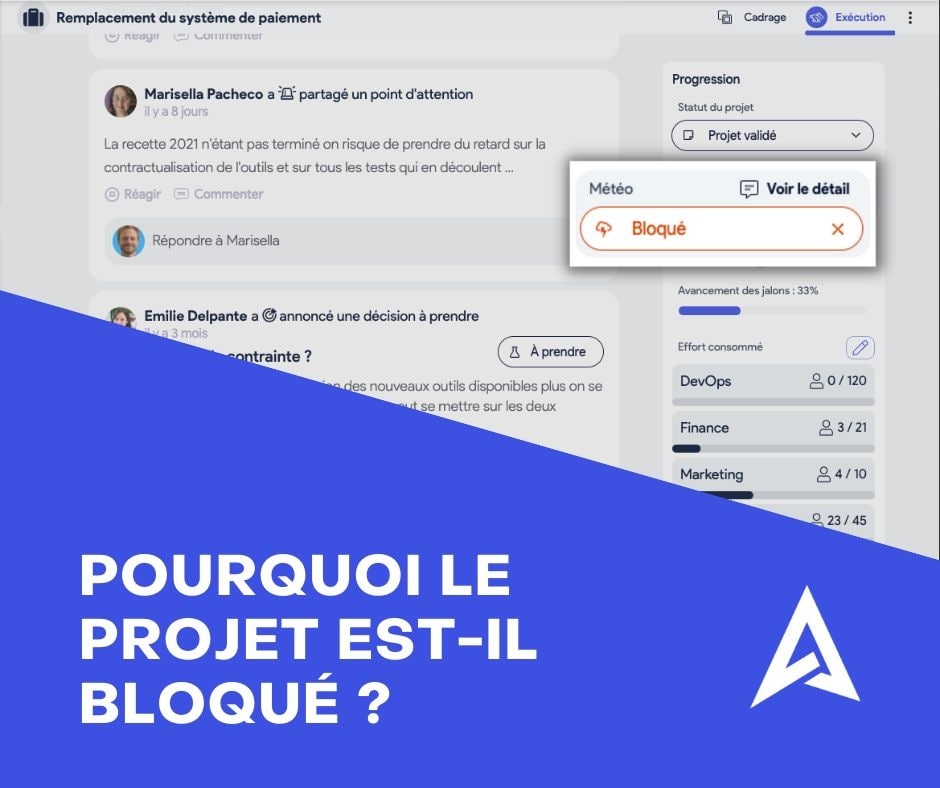
One click on "See details" and you find out why your project has been blocked for two weeks!
☀️ Knowing a project's status and risk level is good; knowing why it is in that state is even better. One click on "See details" and you find out why your project has been blocked for two weeks!
You need the status-change information to be understandable by everyone. To get there, your project health status can be "self-explanatory".
That is, always accompanied by a message and precise context, accessible in 1 click! Anyone landing on the project... will understand the why behind the what!
4. No integrity... we'd rather hide the problems!

The project status should not be used to hide problems
This tool's effectiveness rests on the project manager's integrity and on the accuracy of the status assigned. An inappropriate status can lead to avoiding a problem and paying for that failure at the end of the project. Its purpose is to demonstrate progress and to signal when the project committee needs to step in.
So, the project status should not be used to hide problems. It is rather a way to seek support and advice from the sponsor and stakeholders. Use a shared status definition to communicate.
Four visual alternatives to the weather metaphor for your project health:
1. The project barometer
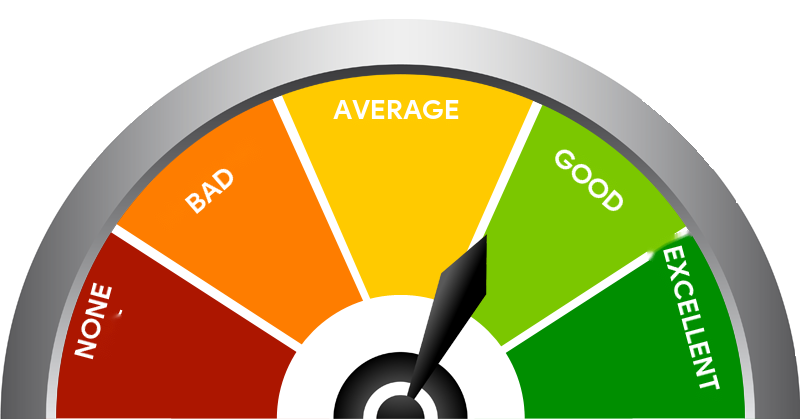
Simple, basic :) here with 5 levels... maybe one too many...
here with 5 levels... maybe one too many...?
2. The "ABCDEFG" diagnostic
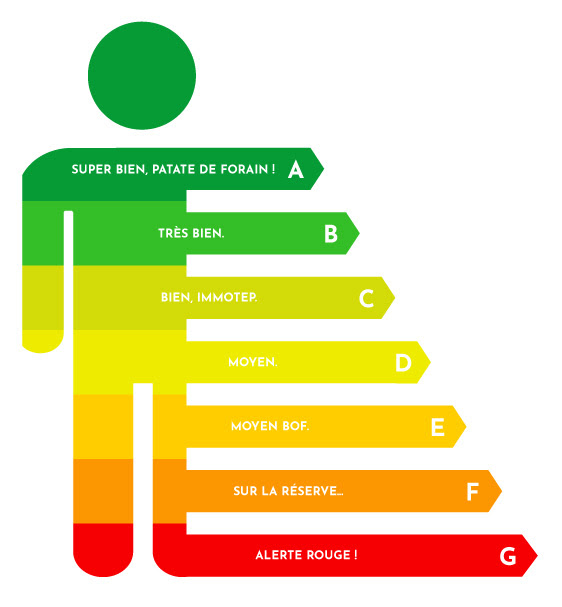
This model has that energy-rating feel everyone instantly recognizes...
As in this example, you can easily "customize" it by editing the labels of the titles for classes A, B...
3. The "traffic light" or "RAG" system
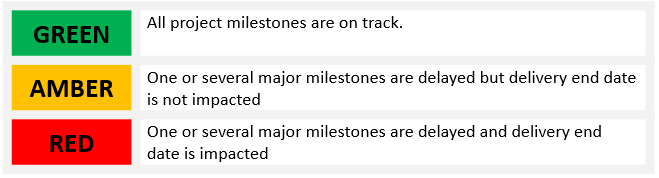
Inspired by Lean management methods... the classic three-color system!
The traffic-light version: green, amber, red.
It's known as the "RAG" status — for Red, Amber and Green.
4. Smiley emojis
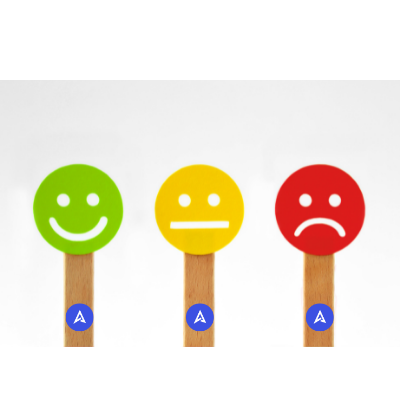
Or how to add an "emotional" touch to the colors.
Combined with color... they work well. Again, add a 4th smiley to bring in the nuance you're looking for.
In short, the project health status is a governance and communication tool. Just like progress, milestone and deliverable indicators, it is a key indicator of how the work is executing. But unlike the others, it is the "first" one to tell you about the project's health! To go further, the recommended read is "How to build effective project reporting".
What if you took back control of your project portfolio?
Book a demo and discover the tool in 30 minutes.