May 28, 202212 min readJérôme Dard
Project budgeting: how to budget a project without getting it wrong

Contents
A CIO recently confided in us: "the project would never have been approved if we hadn't lied about the budget!" Whether you agree or not, it's worth exploring the "unspoken truths" around money in project management!
Let's face it: the "project manager / PMO / CIO" team is caught in a paradoxical injunction. The impossible challenge of reconciling, on one side, market and business pressure for ever more innovation, speed and agility. And on the other, precise budget estimate requests from an executive leadership that needs to validate the company's financial equations!
Of course, to make things harder, all of this happens against a backdrop of an IT talent war and an increasingly VUCA environment ("Volatile, Uncertain, Complex, Ambiguous").
So how do you come out on top of a situation where 53% of projects exceed their budget forecasts by 189%!? (Source: Chaos Report).
In this article, we set out to step away (a little) from the general subjectivity around budgets in project management, by putting forward simple, pragmatic practices! Discover the lessons learned from Adeo's CIO, plus a quick refresher on the basics, so you can budget your next project without getting it (too) wrong.
Meet the budget challenge with estimation "by analogy"
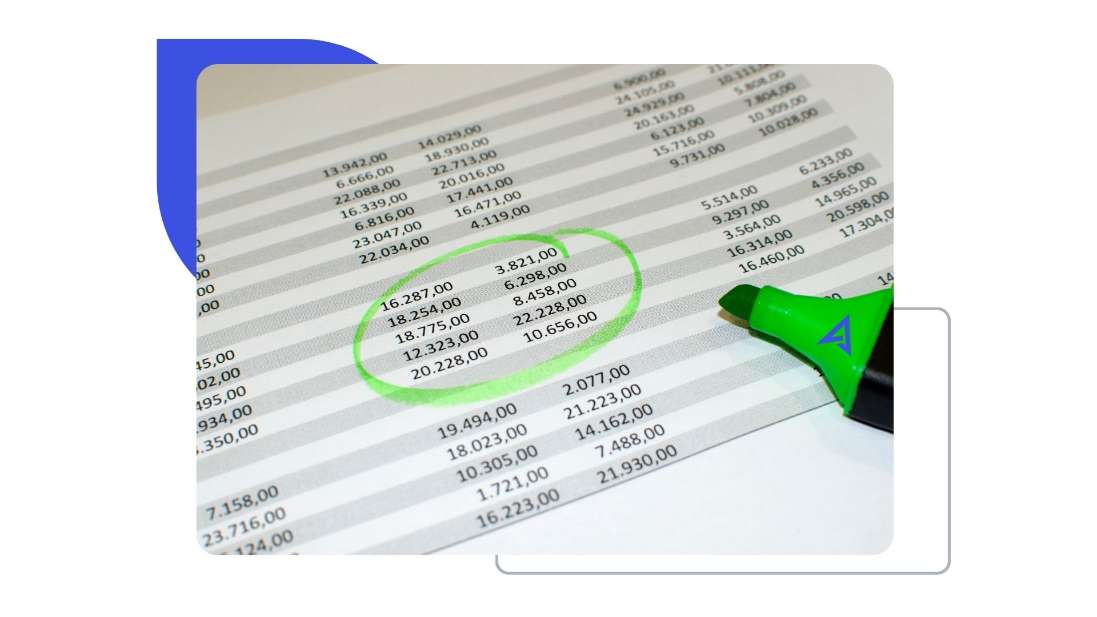
Smartly copy the budget of a near-identical project to move beyond guesswork
When a project manager has never run a given type of project, producing an estimate is hard! One trick is to rely on data from near-identical projects so that your estimate sticks as closely as possible to future costs and revenues.
Asking someone who has already run this type of project remains the most pragmatic way to do it. Go find the experience where it lives… websites, traditional and/or digital professional networks. Think of specialized networks such as LinkedIn groups like the Alliancy - DSI & Transformation des organisations group, and/or (shameless plug) the AirSaas "Pro de la Transfo" club. If you have more time and money to invest, joining one of the established networks will let you interact within circles such as ANDSI, CIGREF, the Club Decision DSI, the agora of CIOs, or the ADN Ouest CIO circle. There's plenty to choose from.
If you still can't find your answer after a few attempts in the French-speaking sphere... try the English-speaking CIO/PMO and CDIO peer-support networks. For example the CIO Forum LinkedIn group, or the IDG (TECH)talk online community powered by CIO magazine.
The goal is to avoid reinventing the wheel and to stay focused on innovation! On this point, as on many others, the free-software and open-source culture has paved the way. Nothing to be ashamed of!
"Good artists copy; great artists steal"
Break the project budget down into credible chunks!
As you're well aware, the biggest budget estimates are most of the time the finest "fakexcel" news!
Paradoxically, experience teaches us that the bigger and longer the project, the less useful it is to budget it. Indeed, the error rate only gets higher.
It's safer to estimate the budget phase by phase, or based on a project that has already been done, redone and redone several times (industrialized).
And yes, building an estimate "down to the last nut and bolt" takes time!
If the project is too big — in duration, headcount, or with high technical risks — then let's admit it: it's nearly impossible to budget the whole project properly. You'll have to slice the project up and budget phase after phase.
Otherwise, it's a macro budget — and that can be perfectly sufficient!
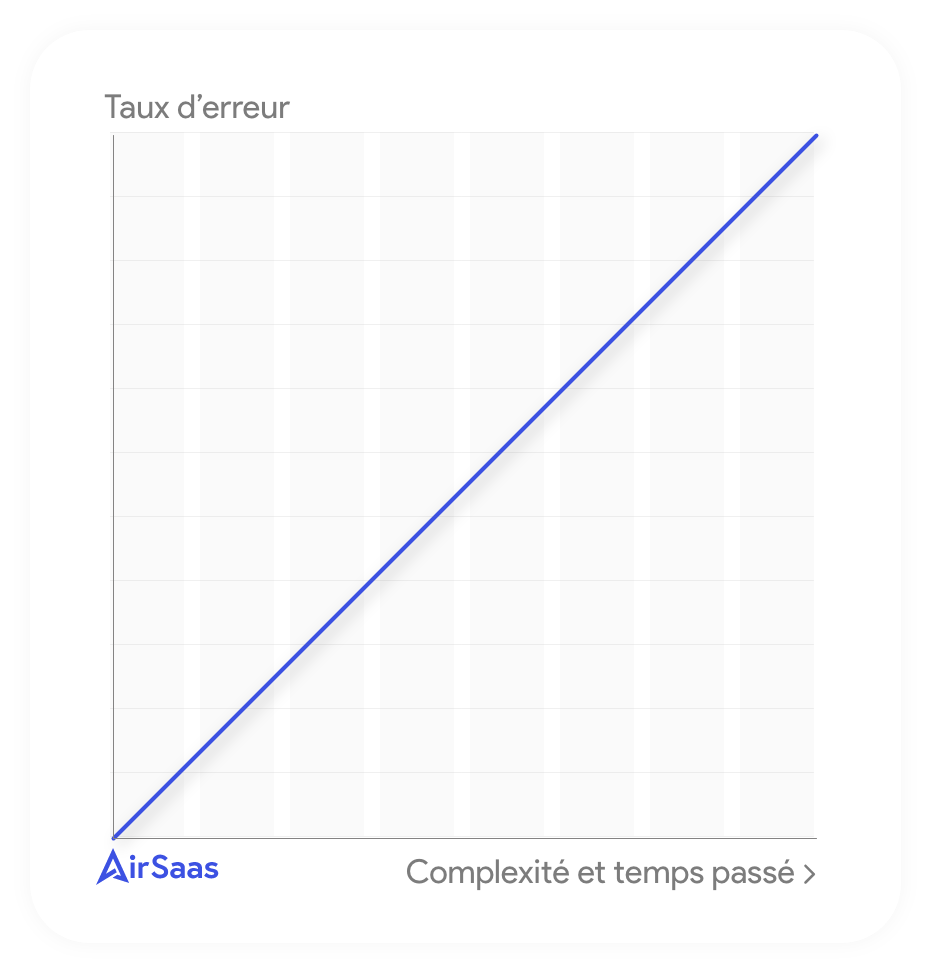
A performance line inversely proportional to the time spent on the project!
The limits of "estimates"
"We must stop making project estimates!… They're all rubbish" according to French specialist and agile coach Frédéric.
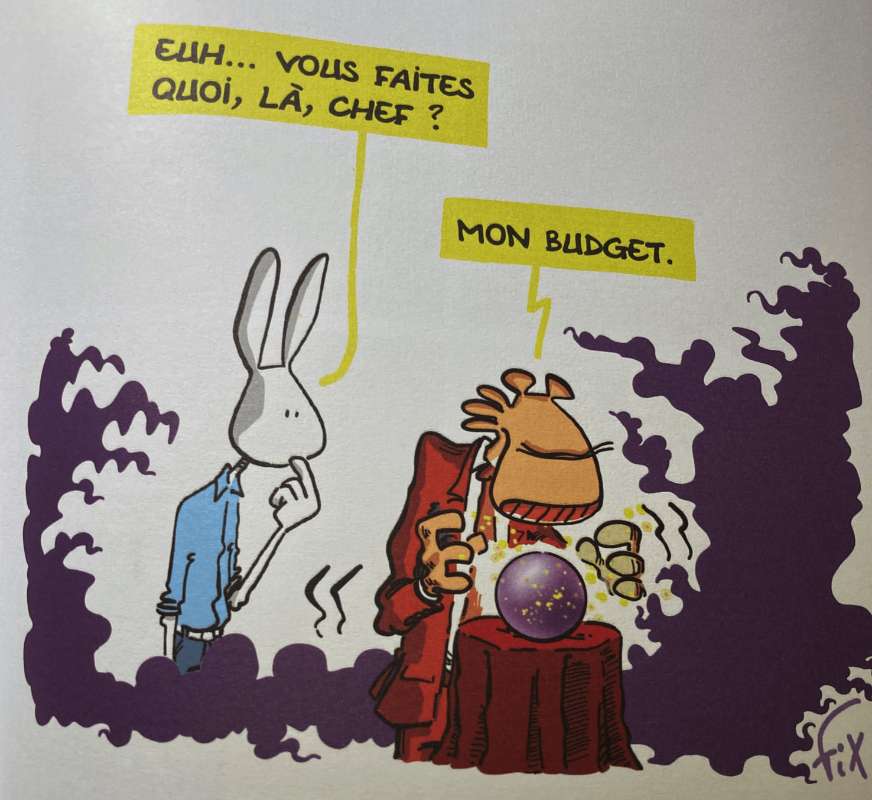
The impossible exercise of the project budget - Source: fix-dessinateur
The "No Estimates" philosophy is interesting and is getting more and more attention, particularly at agile community conferences. A true "load-bearing wall" of the software development industry, an estimate is indeed the cornerstone of many project management activities: building the budget, roadmap prioritization, decision-making, contracting…
That then means finding alternatives to all these project activities… In other words, reinventing project management: how you prioritize, how you communicate, how you make decisions… Quite a program!
Using reference frameworks, such as estimation charts, to build budget estimates is a method that, based on work units assumed to be comparable, helps estimate a project budget.
Focused on "pure" productive tasks, it overlooks time-related tasks (meetings, team check-ins) and tasks tied to work peripheral to production (sales, study phases, testing...).
The point here is not to tear down this approach, but to give experience and common sense their rightful place against certain excesses of rationality.
Lessons learned from the CIO of Adeo (Leroy Merlin, etc.)
On the budget side, the idea is to work with a fixed envelope. And I cap Adeo's overall investment in digital relative to the company's growth. We consider that these are not projects, so they have no end. They are products. When you shift the company toward a product-management orientation, the financial organization has to follow.
Rather than continuing to estimate overly long budgets around the notion of a project, Mathieu explains that he keeps his ability to project within a global economic equation… While organizing budgets around the central notion of product and agile cycles. So each budget is OPEX that accumulates.
Technological innovation as company culture. Clearly, "product-oriented" companies are pulling methodological innovation upward!
Budgeting a project: the 6 easily avoidable mistakes
1. Underestimating the project's timelines and indirect costs
Underestimating your timelines means making your resources work longer than planned — and therefore "blowing up" your budget!
Numerous studies have shown that it's common for a project manager to be overly optimistic when estimating how long a task will take. So ask your team members how much time they think they need to complete their assignments, and add a safety margin as a precaution (often between 20 and 30% depending on the person).
2. Your partners co-own the estimate: involve them!
If you want to forecast your costs and revenues effectively, it's essential to involve those most directly concerned: your partners. It will be much easier to anticipate the right amounts by calculating them with the people who will work on the project day to day.
Each of them will be able to give you a precise idea of the scale of the costs and revenues tied to the tasks they're responsible for, "cost by cost".
Through this dialogue, you're likely to get a provisional budget far closer to reality by asking your team members about their areas of expertise, than by handing the entire budget over to a consultant.
3. Ignoring your resources!
Taking stock of your resources is an essential prerequisite for building a provisional budget. You need to know every resource at your disposal. We're talking about material and human resources, but also the time (number of days) you have to see the project through.
One of the main causes of budget failure is poor planning of resource availability. Vacations, sickness, layoffs, resource replacements, or working on several projects at once always have an impact on the budget.
4. A provisional budget isn't static: make it evolve!
Project management costs are not set in stone! They will evolve with the scope throughout the project's life cycle.
While building it upfront forces you to try to predict reality, there will come a time when your assumptions are confirmed or proven wrong. When, during your project, you gain more information about the costs and revenues you'll be facing, use it to rework your provisional project budget!
It's therefore advisable to review your actual costs and revenues every month, and compare them with your forecasts.
Important: when you revise your provisional budget, don't forget to keep the previous version — it will keep you from losing sight of the course, and it will also be very interesting to revisit once you're well into the project!
5. Watch out for the "double run" of your systems!
When you budget for something that replaces an existing system, there can be a period where both systems are being paid for — and that can often financially derail the project.
A procurement lead once told us about discovering a project budget where users had asked for — and obtained — keeping the old app for archiving purposes... for two years! And that's the triple penalty: you keep the infrastructure costs, you keep the license costs, and the maintenance costs too!
With a better-anticipated budget forecast, you can build a local application that covers the archive-consultation need.
Also be careful when you budget a replacement of something that was CAPEX with OPEX — that's even worse, because you impact the company's balance sheet!
Also keep in mind that the project's cost isn't just a sum of internal expenses — there are externalities.
- Management and human-resources costs, including salaries;
- the company's running costs (electricity, etc.);
- taxes and duties;
- communication expenses and others
Careful — these indirect costs will be shared across several projects, notably through an allocation key!
6. The ultimate mistake: outsourcing this task to the management controller :-)
Support functions and the business must help each other! Reading a project budget's cost structure is a complex exercise. Whatever the size of your company, don't hand this file to someone who doesn't know the business. Get help... Don't outsource it
If you don't want to end up with accounting's analytical codes in your project budget, always rework things in your own tool.
It's a significant investment. But fundamental if you want to budget a project effectively.
The benefits of a successful project budget
The budget makes the project credible
Like a picture, a good budget is worth 1,000 words, because it will demonstrate just how thoroughly a project team has thought of everything.
So be careful not to forget the basics: a budget is a summary of anticipated costs and revenues. It therefore presents an estimate of all the resources required to reach objectives over a set period of time.
To manage a project budget effectively, it's common to set key performance indicators (KPIs). KPIs help you determine how much has been spent on a project, how far the actual project budget differs from what was planned, and so on.
Finally, as a classic rule, pay attention to the difference between purchase costs and recurring costs (CAPEX/OPEX). You separate IT investment spend from operating spend.
The project budget amounts to a tacit contract
The project budget represents a commitment between a project manager and their hierarchy and/or investors on the results to be achieved and the means to be deployed. A commitment to the company!
Building a provisional budget is essential when launching a project: while it can help convince superiors or investors that your project is worth funding, it will in any case give every party involved in the project visibility over its entire delivery. Framing, execution, change management, communication, operations, etc.
The budget is a medium: it lets you keep stakeholders informed
If the project's current budget can't be maintained, stakeholders need to know the root cause of any potential overrun so they can make informed decisions about whether to continue. Scope changes are probably needed. The important point here is that uncertainty in the broad sense — like a pandemic — is inevitable, leaving other budget-related decisions that must be made in a timely manner. Stakeholders such as the client may need to decide whether the timing or circumstances are right to continue, postpone or stop a project altogether.
Better budgeting lets you anticipate and adjust your project
The primary purpose of a provisional budget is to try to increase your visibility into the future of your project and its resources — in other words, to anticipate!
Indeed, building your project's provisional budget is one of the best ways to assess its feasibility. You'll be able to calculate the margin you hope to reach (or at least budget balance) and make adjustments to your strategy if you realize your business plan doesn't hold up.
Tip: you can even build several provisional budgets representing the different scenarios you're considering, factoring in the contingencies you can imagine (supply issues, new competitors reshaping the market, etc.)
A poorly managed project budget can destabilize the whole company — or not
Beyond the budget overrun itself, the potential impact of non-delivery costs on the business can be financially significant. The emblematic example is the city of Denver, where the failure of the new airport's baggage-handling software reportedly cost $1.1 million per day.
Take another very large project, such as the never-ending EPR saga. A name that has become synonymous with repeated delays and a financial sinkhole. Let's say it plainly: yes, it's a failed project budget — to date it stands at 4x the estimated budget and 11 years behind schedule!
To be fair, it was the first project of its kind — it's mission impossible to budget a construction site like that. Now that they've done it once, the next iteration will be much more on track for the next project — more precise for building the six other reactors planned, at a total estimated cost of between 52 and 64 billion euros!
Summary
- Small project or big project? We refuse to build global project budgets — they're useless!
- Need experience or advice? Call a CIO/PMO/project manager friend or turn to a website, but work by analogy.
- Is the project a replacement or something new? In the first case, watch the duration of the double-run phase.
- The project is long... update the budget throughout the project's entire implementation.
Provisional budget done? You can now add it to your project one-pager.
What if you took back control of your project portfolio?
Book a demo and discover the tool in 30 minutes.