May 16, 202210 min readJérôme Dard
How to get project scoping right with your business teams?


Contents
Scope your scoping! A successful project kickoff rests, among other things, on a genuine meeting between business knowledge, management sponsorship and technology expertise. Yet even though many companies have tackled this lack of collaboration right from the project charter, in project management we still see corporate silos holding firm from this pre-project phase far too often!
How did we end up here in project management? What is the key ingredient of good project scoping with business teams that you cannot afford to miss? How do the companies that innovate in project management do it?
In this article you'll discover some great, inspiring examples of IT/business co-construction (don't miss the flash design sessions run by Ouigo's CIO!) A highly pragmatic, super-effective way to handle business feedback and save a huge amount of time in project execution. With that, no more "wobbly" project scoping.
By the end of this article you'll also walk away with the key steps of collaborative scoping that works, plus a first list of questions to ask to energize your workshops. Finally, we'll take a quick look back at the key role of the BRM and a selection of examples of agile, participative scoping.
In short, stay tuned! We're telling you everything you need to know about the art of scoping your project… with your business teams!
A critical look at the classic "business orders, IT delivers" approach
To understand where we are today, it's worth taking a critical look at the legacy of the traditional split between the business side that orders and the IT side that builds. Yes, for far too long we watched a game of "pass the plate" between business units. Everyone on their own turf, with their own objectives.
To stretch the culinary metaphor, you could even say that the relationship between the kitchen (IT) and the dining room (the business teams) was clearly organized in silos. No mixing, please! Each with their own projects and their own zone — and in the middle, more often than not, a waiter (the project manager) not entirely comfortable orchestrating it all. And at the end of the chain, a customer eating a cold dish! Some waiting for a project scoping that took forever, others for better-written requirements. Not exactly a resounding success!
Scoping? First and foremost, co-construction!
Successfully scoping a digital transformation project requires a team co-construction approach, a shared responsibility. In project management, the goal is precisely to avoid silos from the very first steps — understanding the need, drafting the project charter — by creating your first team. A sort of MVP (Minimum Viable People), if you will.
That team brings together the future builder of the solution — tech! — the manager (aka Mr. Sponsor), and a representative of the need, the one who knows the day-to-day of the business: the business team.
- The project manager, general coordinator of this "micro-company", is in charge of scoping the project collaboratively.
- Alongside them to lead the scoping, the business representative — the one who knows the day-to-day and the project's key objectives, the customer expectations.
- Finally, this co-construction rests on the key role of the sponsor, who joins and leads an advisory body that decides on implementing the processes and control rules proposed by the business experts.
Depending on the company's size and organizational complexity, this micro-structure will be more or less sophisticated. Sponsorship may be handled by one or several managers, and so on.
It's this way of working cross-functionally from day one that allows people to break down silos and deliver new services quickly — to put collective intelligence first from step one.
Scoping: why you need a different relationship with time
Whatever the project, you still need a bit of time to think about what you actually want! Whether in terms of features or change impact...
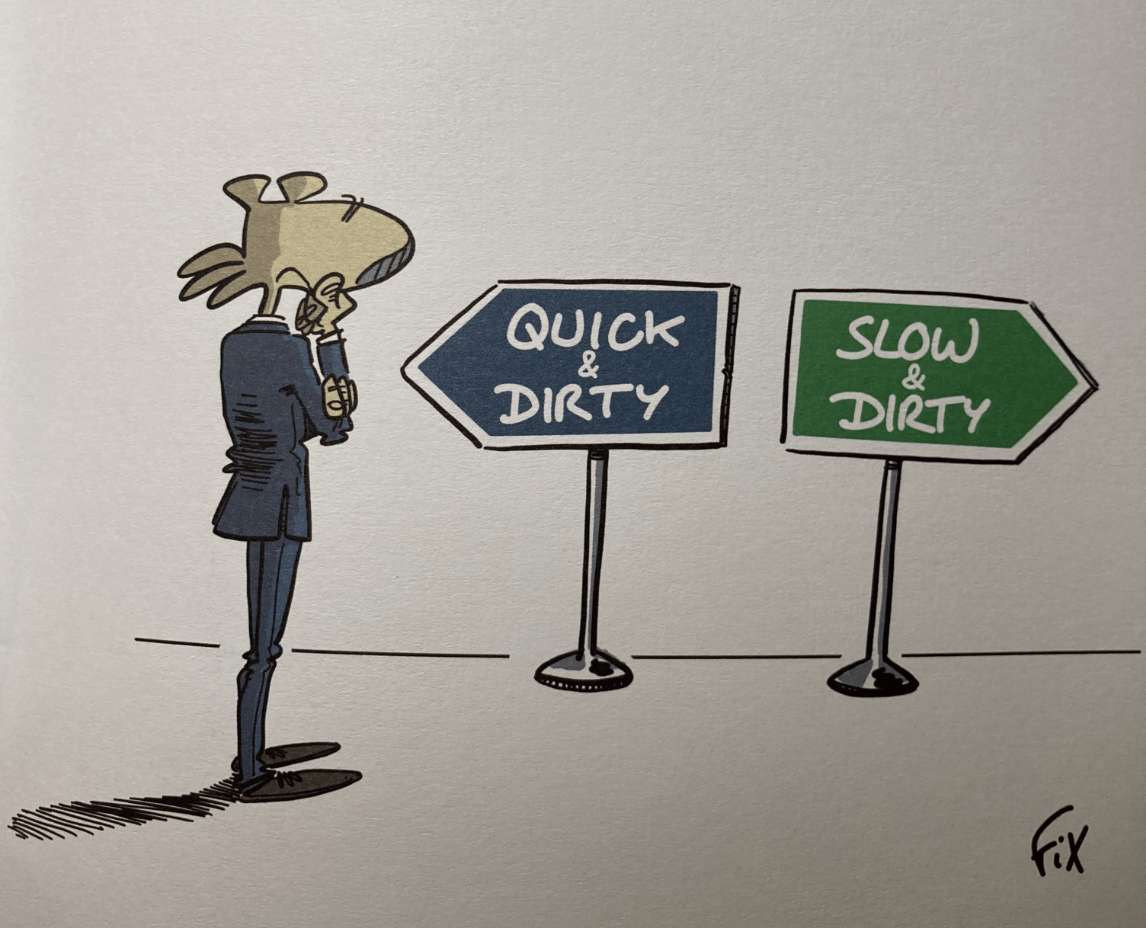
Source: Fix, cartoonist — album Chief Bullshit Officer, Diateino publishing, April 2022
"The longest part of a project isn't implementing an information system. It's rather the upstream thinking, on the company and business side, about how they actually want to work…!"
Given the general pressure of shrinking deadlines and the shortage of IT skills, making the case for a long scoping phase will be a challenge!
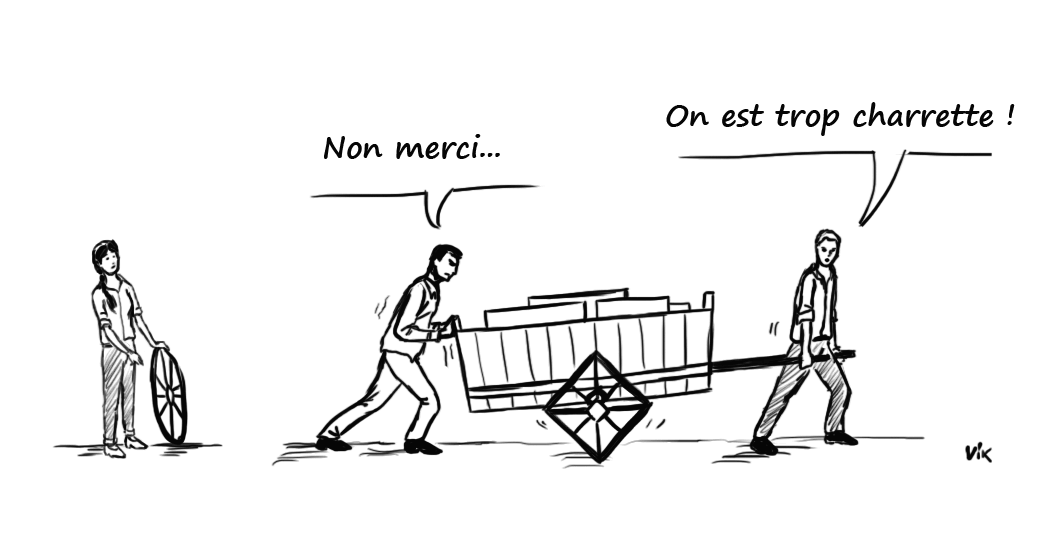
The time-management metaphor in a project — Source: vik-graphisme
And let's be honest: if the team that owns the problem doesn't even have the time to work on it properly from the start, better not to do it at all! The next steps on the schedule aren't likely to fare any better in terms of success!
"In our monthly business/IT meetings, we negotiate! If the department concerned can't delegate or staff teams, it means there's no value behind it! And if after a number of attempts... they can't free up time... sometimes we realize the project isn't the real priority... so we launch another project instead!"
Project scoping: what are we actually talking about?
Let's hit pause on the very definition of the scoping stage in project management.
Definition
It is indeed a study and analysis stage that shapes the decision to launch the project — or not — based on its value and feasibility. Its conclusions are usually summarized in a project charter.
This project charter is the concise document that lets everyone identify at a glance the main points of your project's scoping.
Among the basic techniques out there, we can mention:
- The SMART method (Specific, Measurable, Achievable, Realistic and Time-bound)
- The "5W2H" method: what, who, where, when, why, how — and how much?
Everyone has their own definition and their own method for producing a project charter.
The project charter answers three big questions
- Project description: expected gains, deliverables, etc.
- Project context: scope, people impacted, origin of the request, regulatory changes, the company's transformation plan, change management, etc.
- Project numbers? Budget, durations, etc.
Project scoping sheets are dynamic and collaborative. IT, business and sponsor teams can iterate together until the project is approved, building a genuinely complete requirements document that will guide the project's progress.
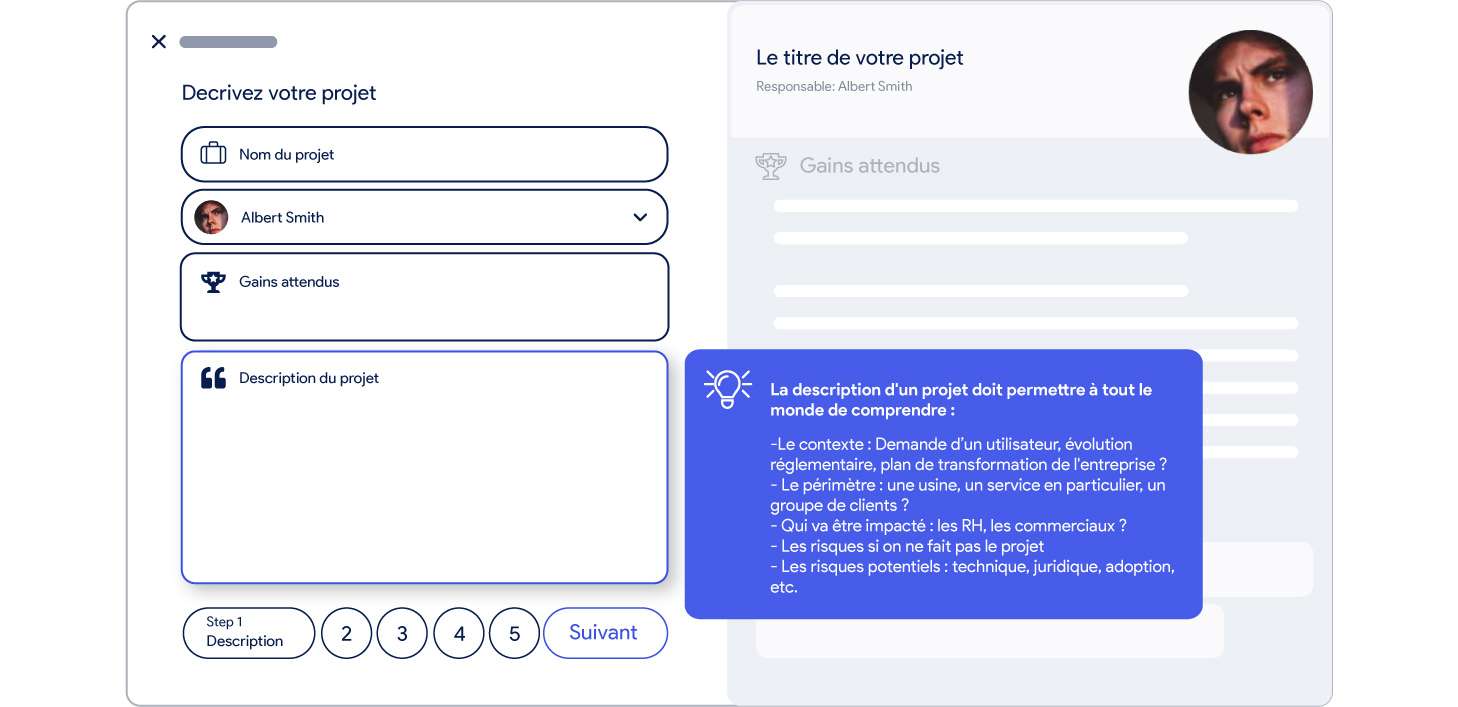
In AirSaas, we guide your team through filling in the information essential to a good project charter.
Project manager secrets: "questiology," or the art of asking the right questions!
Complete scoping means questioning the target of the need (the destination) AND questioning the approach (the path), based on everyone's time and objectives.
Questioning the real target of the need: the true problem
The main pitfall is missing the real issue! It's useful to question — and question again — the very wording of the problem. To go dig up what isn't written down.
Scoping is real work: shaping confused thoughts through dialogue. To get there, it helps to cross-reference business data with your customer service data! And with your customers themselves, of course.
Here's an example of open questions to ask to dig deeper into project scoping:
- Why hasn't this problem been solved before?
- How has it been worked around?
- If it's still there in three months, what's the impact?
- What's the shortest path with the greatest impact?
Remember: the goal is dialogue, so that the project delivers an innovative solution that meets precise, identified needs.
"If I had an hour to solve a problem, I'd spend fifty-five minutes defining the problem and only five minutes finding the solution."
Questioning the solutions: one need? 1,000 ways to meet it!
Successful project scoping means being able to propose several ways of addressing the identified problem. Take a concrete case: an internal customer request — "I'd like a faster elevator." In the first scoping session, everyone agrees on the solution and creates the project: plan the purchase of a new elevator! In the second scoping session, someone suggests adding a fun animation and a new screen to keep people waiting smartly! Problem handled. QED. :)
If you need something, call me — I'll tell you how to do without it
Scoping a project: tap into existing experience, too!
Remember to gather all the insights already shared around this problem
- Organize how insights are collected
- Every week, 2 hours of flash design to work with business teams on the insights and problems raised.
Organizing how "insights" are collected
- Log all incoming feedback continuously, whether it comes from the BRM or from ticketing.
Let's not forget that to scope projects well you need clear, clean, structured data! The garbage in / garbage out concept proves its point once again.
Feedback from the field: "flash design"
During the interviews for our CIO Révolution podcast, Isabelle André Perussi, Ouigo's CIO, told us about "flash design" — and we loved the idea.
Rather than starting to think about scoping a business need only when there's time to handle it, she explains that she organizes 2-hour flash design sessions as soon as the business submits its "ticket": 2 hours of brainstorming bringing business and IT together to rough out the need, explore the "miracle" SaaS solutions that might address it, and ultimately leave time for the need for a genuine internal IT project to mature. All of this happens well before the scoping phase. Word is, the investment pays for itself quickly — and a lot of project frustration gets defused just as fast.
BRM, agility: complementary approaches for scoping with business teams
BRM: Business Relationship Management
A practice inspired by the ITIL IT service management frameworks: "The BRM stimulates, identifies and shapes business demand for products and services, and ensures that the value of those products and services is realized, optimized and recognized." A role that strengthens the IT-business relationship. People dedicated, depending on company size, to understanding the company's needs on an ongoing basis!
On this role, check out the first-hand account below from Biogaran's CDIO, Frédéric Riou:
With this business partner role, the goal is to be proactive with proposals, to bring answers to the problems raised, to stay one move ahead: you know the business so well that the aim is to bring the solution before a problem is even identified.
Agile scoping: approaches that "engage"
With agile culture, you might use, for example, games "that do the job." Playful workshops to reach a 360° definition of the product or project: vision, objectives, story map, roadmap, POC, etc.
Here are three among many:
- The pre-mortem: build a plan before you start!
- The product box: physically materialize the different visions in the form of boxes.
- The 15-minute customer catch-up over coffee: you'll know whether to dig deeper or move on!
To dig deeper into this approach, the book Gamestorming, published by Diateino, is highly recommended.
Key takeaways
- Avoid silos from the moment you start understanding the need!
- Most friction comes from a poor understanding of IT's constraints and from business expectations not being taken into account. In your project approach, working cooperatively from the outset around a shared platform improves everyone's understanding of what can be done and by when.
- Scope your scoping! It's the phase you can't afford to miss. It's a matter of time, resources and investment!

In AirSaas, we guide users through filling in the essential information and objectives for scoping a project.
What if you took back control of your project portfolio?
Book a demo and discover the tool in 30 minutes.