May 4, 20228 min readJérôme Dard
How to implement a project approach in your company?

Contents
Project management is a profession in transformation too! Digital acceleration, the multiplication of cross-functional projects and a "VUCA" environment (volatile, uncertain, complex and ambiguous) make mastering this art ever more demanding.
In this article, we'll explore in detail why and how to put in place a pragmatic, (somewhat) standardized project approach. A chance to debunk a few preconceptions about methodology and help you build an effective project culture 🔥!
A quick refresher on the fundamentals
A project is a set of actions we want to undertake to reach a goal... The word comes from the Latin "projectum de projicere", literally "to throw something forward"!
Beyond the definition and the tools, what's really at stake are the key questions of how power is exercised and how the company's transformation gets delivered.
The typical stages of a project approach
Whatever your project management method, a project approach follows, in principle, a set of stages and uses tools!
- Framing of the overall objectives, stages and needs, together with the business teams;
- Choice of delivery methodologies, requirements, tools, team and project governance;
- Macro planning / milestones / communication plan;
- Execution and keeping the "cost-quality-time" triangle in check;
- Testing and acceptance;
- Delivery;
- Project retrospective and improvement;
Behind this "academic", ideal picture of the stages... what's the reality?
What we generally observe:
- Almost every company has a heterogeneous project culture, and project managers also have very uneven skill levels;
- The IT department has long been ahead on these topics, while business teams are not very "mature" in project management;
- We seem to have collectively gotten used to IT projects being late, more expensive and/or "off target";
- Any CRM tool gives a good overview of sales performance with a variety of reports... the operational performance of business transformation projects, on the other hand, is very hard to visualize and share...
- Finally, we frequently see the absence of continuous improvement or a project retrospective
In short: projects — everyone knows them... but, generally, no one puts the same definition and execution behind the word.
Three reasons to put a (real) project approach in place in your company!
💪 So that things move forward — really!
The emergence of more and more cross-functional projects, bringing together different business units, has made multidisciplinary, "silo-free" teams indispensable. This coordination is, in principle, easier when you bring people together within a defined window of time and resources. The progress of your projects — and, even more, the efficiency of your transformation — depends on it.
🚥 To get out of false prioritization!
The corollary of digital acceleration is an increase in the flow of initiatives. Great!... unless you fail to define a clear scope of initiatives and execution. The whole point is to focus and prioritize efforts! Otherwise you risk sliding not into agility... but into agitation and false prioritization.
Deliver with method...! Setting deadlines and objectives for each stage is what makes you effective! Choosing... is moving forward!
💸 To track where your money and your time are going...!
If everything is handled as a continuous flow, "run"-style, ... how do you evaluate the results, the budget and the value created?
Project stages and milestones let you regularly present a precise view of what you're doing — and what you're not doing — and steer by value!
How do you go about steering a project approach effectively?
👀 Change your point of view
Years of practice with task-based project management tools and frameworks have conditioned us to see delivery as a list of tasks, schedules and resources... and then a portfolio.
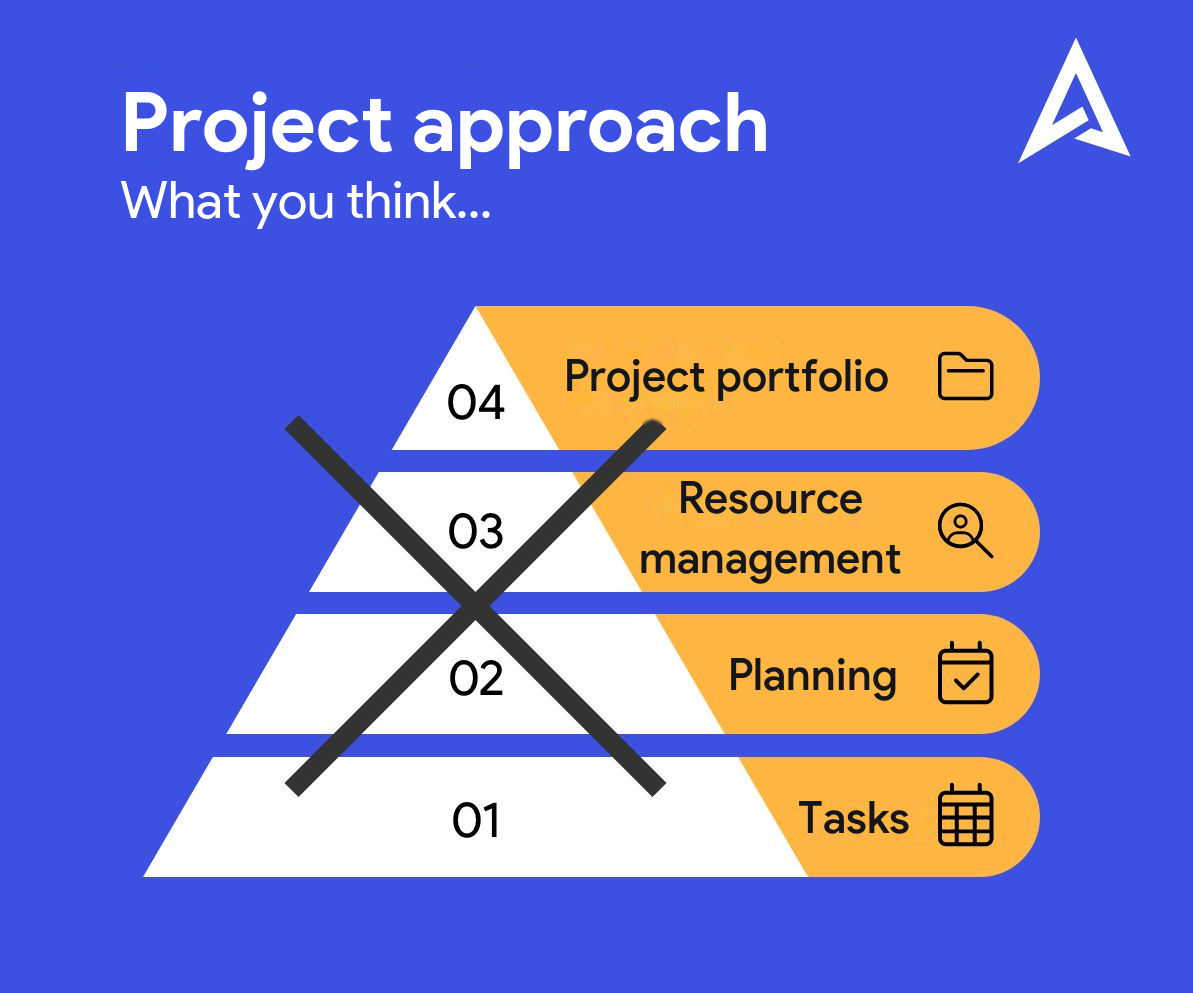
8 chances out of 10 of "enduring" an ineffective transformation
↔️ Standardize several approaches
Beware of the "sledgehammer to crack a nut" syndrome. Not all projects share the same definition... the same constraints and needs in terms of delivery methods. We can distinguish three main types, each with its associated approach.
- IT projects, which are already well managed in Azure DevOps/Jira, etc.
- major/risky projects where business teams must be heavily involved
- and smaller projects where business involvement is necessary but there's less risk.
From this simple segmentation... you can approach a redefinition of the do's and don'ts of project management by category, with a companion tool like AirSaas.
🏡 First, create and sell a transformation plan...
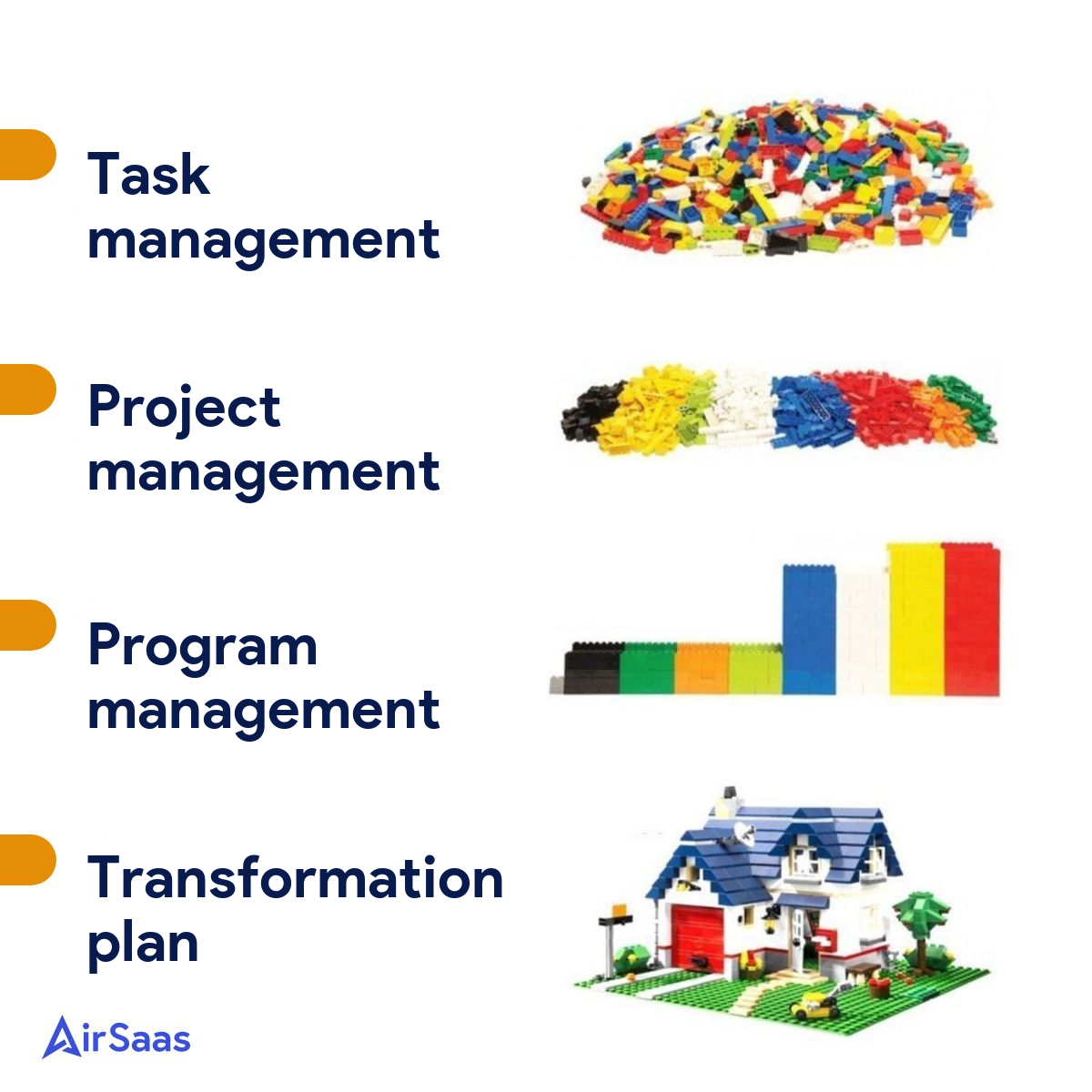
A clear vision that will "make sense" to everyone!
Schematically, the main phases of an (effective) project approach are:
- I sell a transformation plan that creates meaning... for everyone!
- I focus my initial objective on "short-range" projects!
- I "cast" the first project team with individuals and departments that know... and appreciate each other.
- In my project steering and reporting, I share milestones, not tasks!
- I truly recognize this team: the contributors, key users, business owners...
In detail:
I sell a transformation plan that creates meaning!
Make life easier by entering through the "top of the portfolio"! What matters most is having a global vision of what you want to do, so you can prioritize even before saying how you'll execute! Because yes, it bears repeating: there's no point putting tasks into projects you're not going to do!
I calibrate my initial objective on 2-3 "short-range" projects to rack up successes!
For example on a rhythm of 3, 6 or 9 months maximum... your first "project babies" should be neither preemies — quick-win style — nor kids who never leave home, like a never-ending ERP program!
I "cast" the first project teams with individuals and departments that know and appreciate each other...
We far too often think task management is what makes projects succeed. What actually creates project success... is the team! Then everyone has their own good practices... the IT department can seek out a business department it already works well with... to bank model successes. That's what we call the oil-spot strategy!
In my steering and reporting, I share the project status and milestones, not tasks!
I keep the key items up to date: decisions to make, attention points, milestones — to communicate the project status to the entire top management;
I bring the other departments into AirSaas to ensure unified, global communication and an always up-to-date view of transformation projects and initiatives.
I send flash reports to a wide audience — to stakeholders once a week. (Yes, yes — once a week, not once a month...!)
I truly recognize the contributors, key users, business owners...
The fundamentals remain the fundamentals: a sponsor who plays their role, business teams properly involved in the framing... a steering committee... the right tools... a transformation leadership that truly recognizes its contributors, with attention to the "atmosphere-meaning-salary" triangle!
In short, to redefine your project management... here's one of the equations of AirSaas' project-efficiency algorithm:
Team + steering committee + flash report + prioritization = project efficiency²!
⛰️ Transformation project management: the key elements!
Beyond the tools, then, the approach is about methods and key stages.
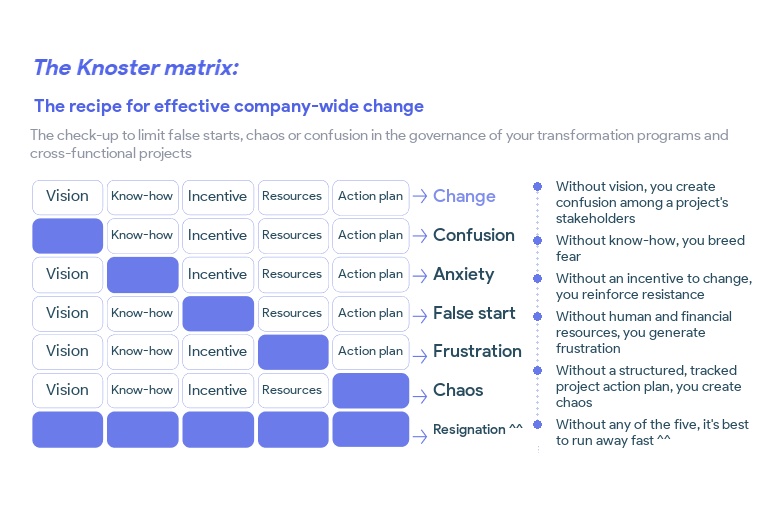
The Knoster matrix for a change-project approach.
- Without vision, you create confusion.
- Without know-how, you generate fear.
- Without a benefit to the change, you strengthen resistance.
- Without resources, you generate frustration.
- Without a structured, tracked action plan, you generate chaos
🤦♂️ Project approach: the 7 mistakes!
- Confusing tools with the project approach: the approach is the one that includes the human factor!
- Believing that the prettiest Gantt chart or Asana board protects you from failure! It's the team, stupid!
- Confusing project approach and program: the added value must be visualized globally.
- Not (at all) taking resistance to change into account in a project: "People don't hate change. They just hate the way you try to change them." M. Kanazawa
- Confusing agility with agitation: what matters is effectiveness!
- Giving priority to... too many priorities! A bit like an intersection with blinking orange lights everywhere!
- Choosing the wrong tools: "when all you have is a hammer, everything looks like a nail"!
The key takeaways
- Let's say it clearly: 80% of projects won't need a Gantt chart or task-level prioritization!
- By visualizing the portfolio — that is, an ordered set of projects steered by value between the business teams and the IT department — it becomes easier to manage part of the frustrations and to involve top management by addressing the fundamental topics: strategy, dialogue and cooperation across silos, budget allocation...
- Creating the conditions for an effective project approach requires acculturation work and upskilling on practices and a philosophy that isn't just agile... but "pragmatic"! Don't think only project management — think change management and leadership too.
Once the general fundamentals of the approach are in place, the next challenge is to switch to project mode in detail. This article should help: How to switch my company to project mode?
What if you took back control of your project portfolio?
Book a demo and discover the tool in 30 minutes.