August 4, 20229 min readJérôme Dard
What does modern project steering look like?
Contents
The pandemic, the IT talent war and the explosion of cross-functional projects have created a quicksand context for organizations seeking more effective project steering with agile, traditional or hybrid methods.
That famous VUCA world (Volatile, Uncertain, Complex and Ambiguous) is well and truly here! Add a pinch of artificial intelligence, a wave of Great Resignation, and a wildly heterogeneous project culture : you get a complex work context — or, to stay positive, a fascinating one!
In these conditions, before even thinking about how best to adapt, the art of steering a project well requires one key skill: discernment. That is this article's intent: to help you find your bearings. To contribute to a better reading of what's at play, without slipping into either blind optimism or easy distrust.
Yes: project steering, too, is an activity in transition — one that requires updating our approaches and skills, and sharing experiences.
Which beliefs should we revisit to stop enduring projects and failing to deliver them? What should we add to keep pleasure and efficiency in the approach? Which interesting trends should we watch to follow and anticipate how project steering is evolving? And finally, what are the 7 key steps to grow your company's project culture?
The article to read to release the handbrake on your project delivery and the speed limiter on your company's transformation!
Task splitting and the myth of the lone-hero project manager: two beliefs to revisit
Moving beyond task splitting in MOA-AMOA-MOE silos
In project management, the legacy of years of the MOA/MOE split (business owner on one side, delivery on the other) and of task-based project management tool frameworks has conditioned our vision of delivery as a list of tasks, a schedule and resources.
For a long time we believed that splitting up tasks across a schedule would "do the trick". We also bet on THE super Project Manager for success. The reassuring Top Gun to steer a project, but operating in silo mode between business and delivery...
And in the end, the project didn't even match the real need. Tool adoption and ROI were most often negligible. Quite a paradox given the energy and talent deployed.
In real life, you succeed at project management thanks to individual and collective commitment, versus an approach centered on tracking and controlling tasks. 80% of projects don't need Gantt-style planning today. A committed team will do!

Thank you Ludovic. This gift of a quote belongs on the cover page of your project committee/SteerCo decks
Preparing the umpteenth Gantt chart won't protect you from delivering a project late, over budget, and with no user adoption.
When you've lived for several decades with MOA-AMOA-MOE, you also had to knock down the historical barriers of the silos that existed. We set up training on development efficiency for the members of the IT department and for the business teams. To explain everyone's roles, expectations and commitments.
The end of the myth of the lone-hero project manager
That responsibility is far too heavy for a single person to do everything, lead increasingly complex work and solve difficult problems almost daily.
I strongly believe in dual steering, because having a lead who is neither business nor IT makes it possible to stay neutral and keep a critical eye. Everything must be explicit, roles must be concretely defined in advance, and trust must reign.
Today, the project manager's role has moved away from someone who can tick actions and tasks off as done on a Gantt chart, toward a strategic leadership position that makes change happen in an organization.
To sum up, here are the three convictions we share :
- One project = one team. You succeed at a project thanks to individual and collective commitment to objectives, not by controlling tasks and phase progress.
- Project leadership = business/Tech/sponsor co-steering.
- Ideally, a key project happens within a timeframe that stays human: a 9-month deadline for example - like a gestation!
Hybrid steering and PPM software: key ingredients for successful cross-functional project steering today
Hybrid methods to make project steering easier
The Agile Manifesto is already 20 years old! One of the project management trends we see more and more is the acceptance that hybrid management approaches are the way forward for better execution.
True "full agile" struggles to spread beyond IT/digital teams. In this context, semi-agile is an interesting hybridization for companies looking for a methodological refresh of their delivery methods.
I don't talk about agile, I talk about efficiency. Because I don't want to be bound by straitjackets, including the 2001 manifesto: the goal is not to say "we do agile for agile's sake, V-model for V-model's sake, API management for API management's sake, cloud for cloud's sake"… We do something that everyone understands and that brings added value!
You'll still aim for continuous development iterations with significant customer involvement in the deliverables at every phase — but managed within a governance and decision structure, with the project's steering committee.
The rise of hybrid project management is good news because :
- Most large organizations aren't equipped to run all of their operations within one coherent agile framework
- Projects are more complex than ever. They involve far more people and expertise: more than what a Scrum team in the strict sense could hold !
Project portfolio management (PPM) software: the new generation is here
Gone is steering with a dedicated tool, isolated from the company's ecosystem! As our environment becomes more complex, uncertain — and let's say it, sometimes political — we increasingly need new-generation tools to help deliver cross-functional projects within that kind of environment and constraints.
Using a modern platform will let you standardize project framing, project tracking, reporting and governance.
(Editor's note: I suggest you read the sentence above a second time! :-)
Yes : the more the company grows — and its project volume with it — the more the ability to keep communication clear, consistent and easy to access for everyone becomes key. The growing number of initiatives and ongoing projects coming from the business makes portfolio management useful, even indispensable, for more and more organizations of all sizes.
Developers use Jira, marketing loves Trello, the innovation team is on Wrike, quality swears by Zendesk, HR uses Monday, the IT department is on Teams.... Help : the silos are back ! The real challenge is to offer a macro, shared tool AND one that syncs with the other platforms used every day.
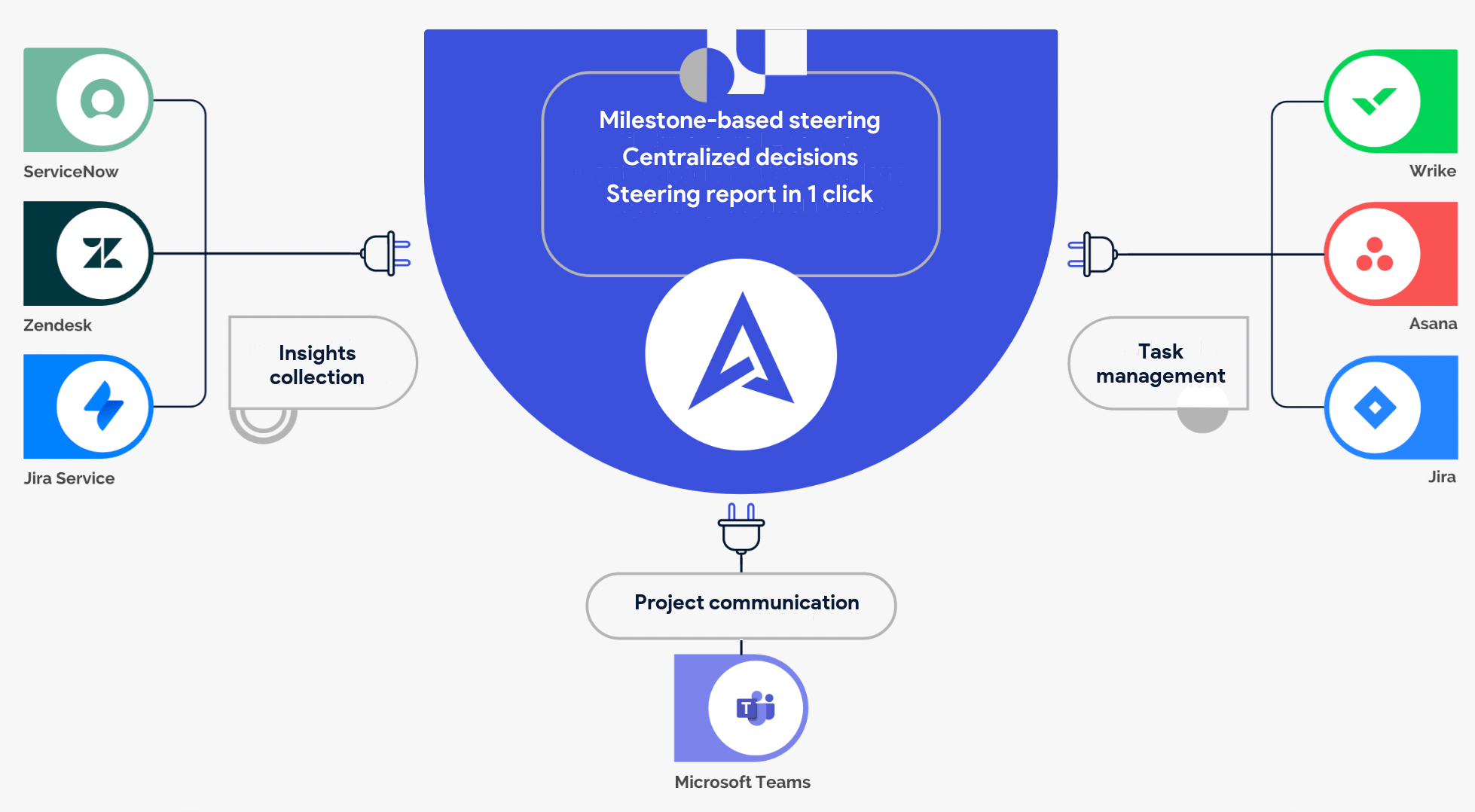
AirSaas is a macro, shared tool that syncs with the other platforms
For a real impact on delivering the company's transformation, you'll want to include and collaborate with the various business teams and stakeholders in one shared space-time. The goal being a clear view of the scope to ease decision-making, prioritizing by value, collaboratively and continuously. Quite a program without the right platform!
Good news for whoever steers. Automating and standardizing reporting is now within reach and has become genuine assistance for project steering. Simple help to automate and simplify repetitive, low-value tasks (for example collecting data, sending a flash report, identifying risks and re-keying data...).
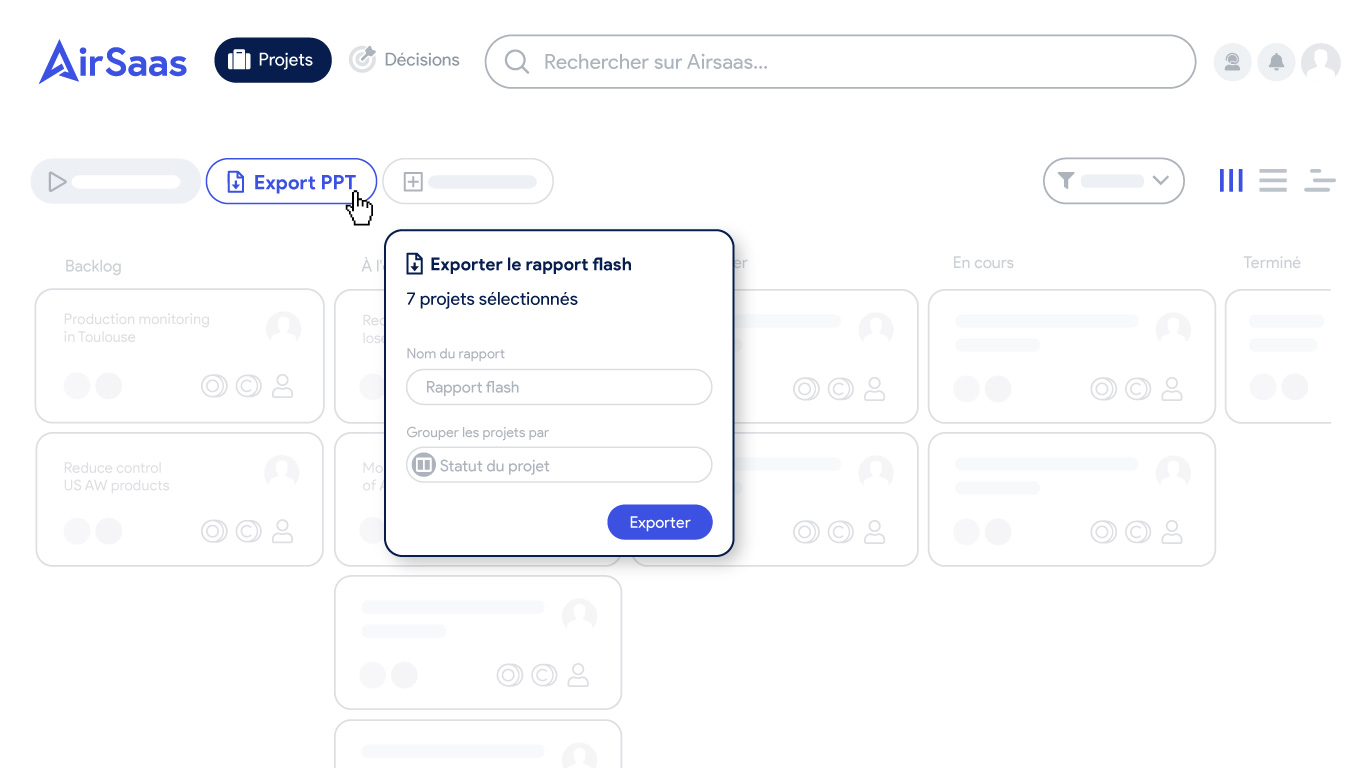
The power of consistent, automated project reporting
Standardizing the format , means saying: we're going to make our lives easier to steer a project, to understand each other whatever the stake we're facing. Which, in passing, also reduces everyone's cognitive fatigue.
The Knoster matrix: the recipe for effective global change
Let's keep in mind the complex, human — and therefore multifactorial — nature of steering a transformation project. That's what gives it its flavor! The Knoster matrix (see the table below) offers a very relevant reading grid, among the models , to run a check of the essential elements and indicators of modern steering.
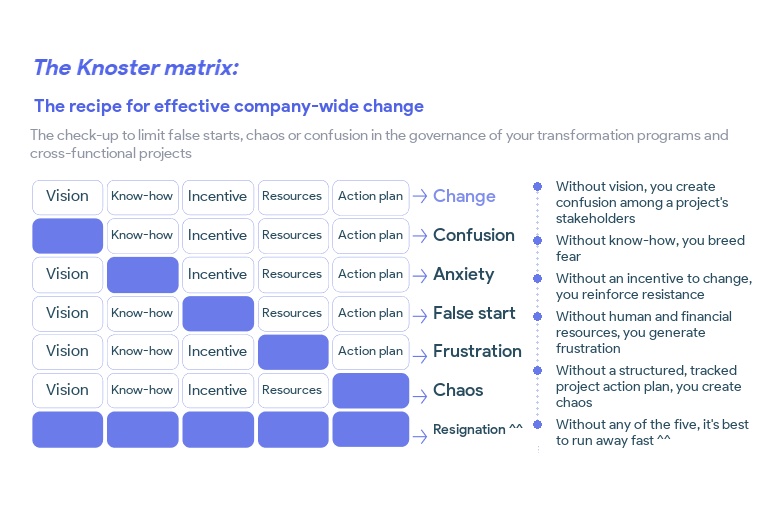
The Knoster matrix to limit false starts, chaos or confusion in project steering
- Without vision, you create confusion among a project's stakeholders
- Without know-how, you breed fear
- Without a benefit to the change, you strengthen resistance
- Without human and financial resources, you generate frustration
- Without a structured, tracked project action plan , you generate chaos
7 steps to grow the project culture in your company (without losing 3 years of your life!)
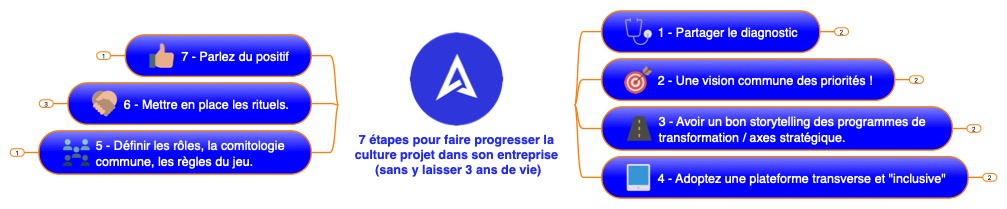
A memory aid on project culture
1 - Share the diagnosis
You need to get to a shared assessment with the teams (project, business, leadership): there are too many topics, everyone is underwater, people keep asking "where do you stand?". We're in permanent RUN mode. It's dragging...
🙍🏻♂️ If the assessment isn't shared, it will be hard to say "we're going to change how we work". The challenge here is to create the conditions and pick a key moment, in particular to let people speak freely about the diagnosis.
2 - Build a shared vision of priorities
Define with the leadership team / steering committee what is vital and what is not.
🙍🏻♂️ Otherwise you'll once again end up with a list of 70 projects, all super important, and a team of three people to carry them.
3 - Have good storytelling for the transformation programs / strategic pillars
For example: "the sales excellence program (CRM project, behavioral analytics project, predictive analytics project...) must take us into the European top 3".
🙍🏻♂️ Otherwise, after a few months, the projects will no longer make sense, and the teams' lack of motivation can quickly be felt.
4 - Adopt a platform to standardize project management
Start by putting in place a platform like AirSaas to standardize specifications, project framing, project tracking, reporting and governance.
🙍🏻♂️ If not all teams are mature in project management, then putting them on Jira is guaranteed failure — just like trying to get them to build a Gantt chart, or to produce understandable, well-thought-out framing documents in PowerPoint.
5 - Define the roles, the shared committee structure, the rules of the game
What is a sponsor? A project manager? A business lead? Everyone's rights and duties?
🙍🏻♂️ Without that, no one will be accountable for anything.
6 - Put the rituals in place.
🙍🏻♂️ Every Tuesday, a five-minute project manager + business lead meeting per project: decisions to make, attention points.
Every Friday, send the flash report to all stakeholders
Every month, a steering committee on next month's stakes and alignment on available business-team time.
7 - Talk about the positive
🙍🏻♂️ OK, problems need solving, but above all you need to keep the teams on board, continuously. So talk about the wins, communicate them . Make people want in. Knowing and building on the strengths of the team's talents — that's the secret!
You now have an up-to-date view of what's at play in project steering today. Suggested next step: zoom in on a key ingredient - the project milestone: a technique to sequence your projects intelligently.
What if you took back control of your project portfolio?
Book a demo and discover the tool in 30 minutes.