April 20, 202213 min readJérôme Dard
How to run an effective project post-mortem
Contents
In project management we talk about the project post-mortem, closure, retrospective, debriefing, continuous improvement... call it whatever you like. The whole point is to stop! Stop producing, and think. Think before acting again. A ritual with a major stake attached: improving as a team! Yet beyond the good intentions, 99% of the CIOs we talk to tell us that, in the end, they never find the time to run their project post-mortem.
Just like the kick-off, the project post-mortem is a "must". In plain terms: past a certain company size, it's a mandatory step in project portfolio management. If you want to sound sophisticated, you can call it a high-value "meta" activity in the culture of your "learning" organization. If you want to call a spade a spade, it's simply an investment that pays off!
So what exactly is a project post-mortem? What should it include? Why run one? How do you run it effectively? What are the new trends? And finally: which ready-made templates can you use?
Let's do the post-mortem of the post-mortem: here we go!
What is a project post-mortem?
In the dictionary, the definition behind the term is the following: a balance sheet (from the Italian bilancio, balance) means "a statement of a company's assets and liabilities" and, by extension, the sum of the positive and negative aspects of something — the overall result.
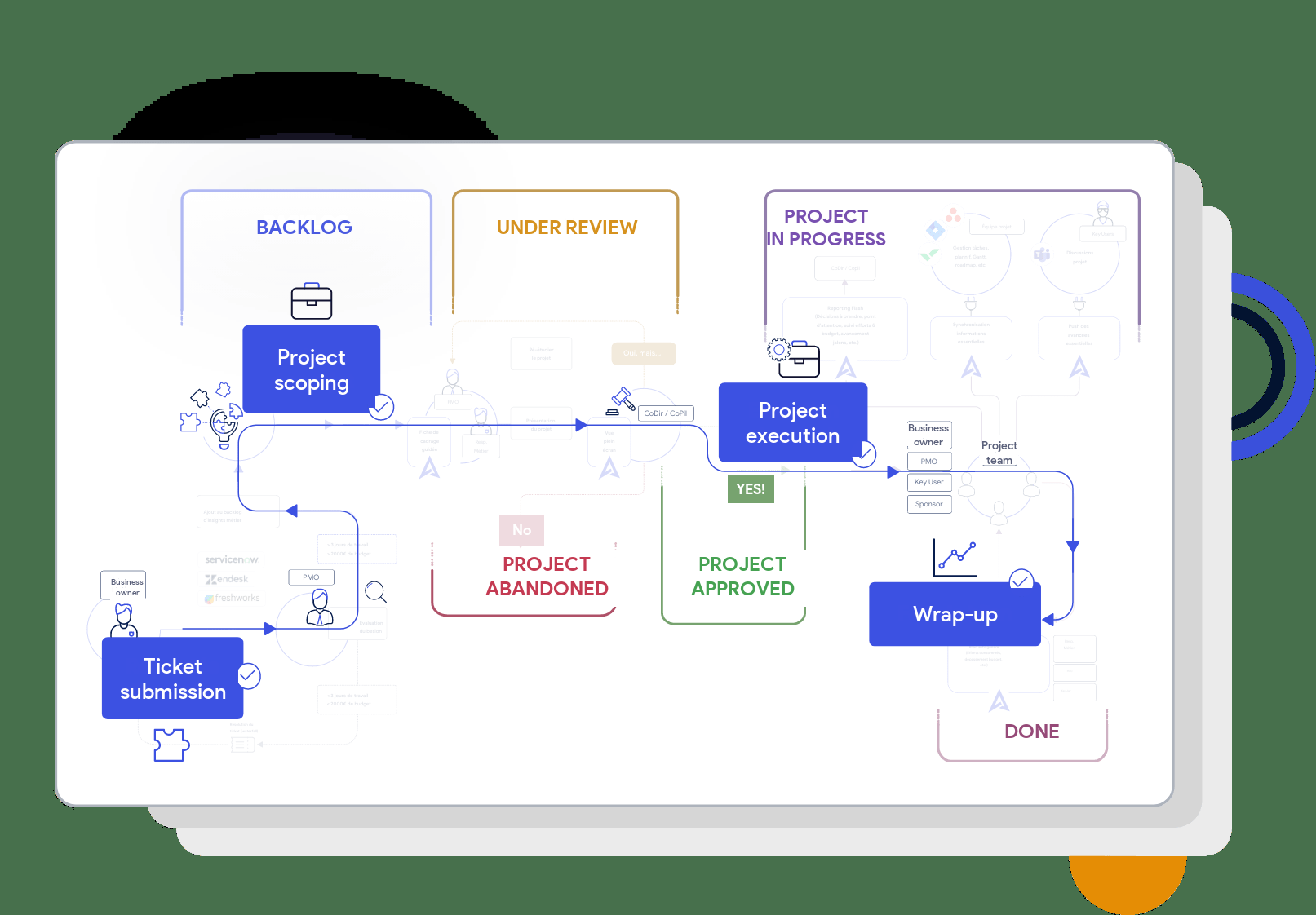
You are here! The post-mortem matters as much as a project's framing and execution
In the "PMBok®, "the project manager's Old Testament", the post-mortem process is called "closing". It carries the same weight as the initiating, planning, executing, and monitoring and controlling phases. Except that it marks "the end of the act" — and therefore the end of the contractual bond between the stakeholders.
This phase includes: "Receiving the client's sign-off, archiving documents, closing contracts, evaluating lessons learned and rewarding performance are all part of the closing process."
A project post-mortem is therefore about taking stock, in order to land on improvement proposals for every aspect of the project worth carrying into the next initiatives. The goal, of course, is to identify what produced good results and what produced less good ones.
If you lead digital projects, you know this already: studies keep reminding us that 3 out of 4 projects fail to meet their objectives (1)!
Why run a project post-mortem?
The end of a project is the right time to:
- Anchor lasting lessons
- Get people talking openly
- Assess yourself, individually and as a team
- Celebrate and thank the stakeholders
- Analyze
- Improve
- Update the documentation.
- Hand over the keys to project steering to the team taking over operations
- Get some rest!
- Build "team spirit"
The end of a project is not the right time to:
- Settle scores — you're not in a courtroom!
- Create a sub-project within the project
- Stay silent
The 5 (bad) reasons why people don't run project post-mortems
Reason 1: I don't have time
No: "I don't want to make the time" — that's not the same thing.
Reason 2: The team is in simmering conflict
Yes — and that's exactly why, as far as possible, you need to get people talking openly. That's when team spirit gets built.
Reason 3: Nobody wants to hear about the project anymore, it's a flop
If you want to keep going in that direction and stack up flop after flop... don't change a thing!
Reason 4: I don't have the budget
Wait, what? You're running a strategic transformation project and you don't have a provisional budget?
Reason 5: It's pointless
If you've been debriefing continuously, then indeed, doing it in the heat of the moment may add little. But if you want to take stock of the value over the medium term, a whole different view of the project reveals itself.
What should a project post-mortem include?
A "classic" project post-mortem typically covers the following:
- Did the project meet its objectives? Costs, deadlines, scope, quality...
- The way the project unfolded
- Team coordination
- Client satisfaction
- The lessons learned
Traditionally, CIOs focus on that first dimension. 🚫 Mistake!
How can you improve this process, given how the IT department's role has evolved into that of a fully fledged strategic business partner?
How to innovate on the project post-mortem? A review of the new trends
With digital acceleration, the globalization of agile culture and the CIO's changing place within organizations, new practices have emerged. Post-mortem methods and rituals have transformed too! Here's a review of a few examples drawn from field observations and CIO interviews.
Two post-mortems are better than one
Generally speaking, a project's added value and expected gains aren't visible right at closure and go-live! It can be worthwhile — not least from an IT-department marketing standpoint — to create this moment of reporting and consolidating the targeted gains around the famous "business value". What overall value was generated, and what were the project's actual gains at 6 months / 1 year?
Another example, simply at the vocabulary level: the term "project post-mortem" has given way to "retrospectives". Just as short iterations are now more in vogue in software delivery culture, more intermediate retrospectives are being run.
With its recent status as a fully fledged business partner, the IT department — positioned as a transformation leader — now tackles strategic initiatives. Project post-mortems are no longer run in silos, but genuinely as interdependencies. The point is to offer teams a global view of the cathedral they helped build.
Beyond the project's content, the aim is therefore to put the project back into its overall context! Did it contribute to the progress of one or more of the organization's major strategic initiatives?
Beyond the traditional open questions — the pluses and minuses across various dimensions — we increasingly see project post-mortems opening the dialogue with more targeted questions. For example: "If you had to do this project again, what would you have liked to know from day one?".
Something that helps structure the "lessons learned" — what was experienced and digested, and can then be shared: behaviors, beyond tools!
Finally, remote obliges: working from home has encouraged remote project post-mortems. Can you run a good project post-mortem remotely? The emotional, personal and collective stakes are such that it would be a shame to give up the dynamics and energy of a shared moment of "real life" team spirit. It's like suggesting you grab a drink... over video call!
That said, if you have no choice, tools dedicated to this kind of process can make your post-mortem easier — Klaxoon, Miro and the like. Vendors have caught on, offering a few retro templates. Still, as you'll see at the end of this article, a simple 5-page PowerPoint template is enough to facilitate this process.
How do you organize a project post-mortem?
One prerequisite, two phases and three dimensions
One "essential" prerequisite: run your final project post-mortem "cold". The hot debrief is indispensable, but it's not enough to anchor lasting lessons and cultural change.
Two key phases to respect in any project post-mortem:
First of all, get people talking openly! To get there, you need — among other things — to set a safe frame, for instance by clearly stating the intentions and scope of the process: who will the post-mortem be shared with? Once the frame is set, an "ice breaker" can be useful. With the conditions in place, you run the post-mortem itself — using one of the agile or Lean grids... whichever. (You'll discover 5 templates for that at the end of this article.)
Then you can move on to phase 2: the solutions, the action plan. That's the phase that most often gets neglected. In our experience, teams spend too much time on phase 1.
Three dimensions of the project post-mortem: the individual, the team, and the corporate level.
The individual assessment is done by each individual on the team. Sounds redundant? Actually, not that much! We're far too inclined to assess others. "You did this... you should have..." — the infamous accusatory "you"! Ideally, everyone "self-debriefs". If you take the time to run a quality project post-mortem, that's the ideal scenario.
The success of the collective dimension can be assessed by everyone. With a special place for the PMO / project manager, whose responsibility it is to facilitate the group. To do so, they can prepare a series of open questions, for example: "If you had to do this project again, what would you have liked to know from day one?"
Finally, you'll still need to assess the company's momentum. The project was carried out in a strategic context, amid corporate stakes that need to be analyzed and restated.
Tip: for dimensions 2 and 3, offer stakeholders a "TRIP" (from the French for Prior Individual Reflection Time). One minute of solo thinking before any group sharing. It won't vaccinate you against groupthink, but it can allow a much wider variety of answers.
Who should you invite to the post-mortem?
At a minimum, this process should take place with your full team present — the one that actively "contributed". Good practice is to invite everyone who contributed at least 30–50% of their time.
- The Product Owner (the client-side project owner, or a functional project manager, depending on how the team is organized)
- All team members
- A facilitator — an "organizational coach"
The 7 habits of effective project post-mortems
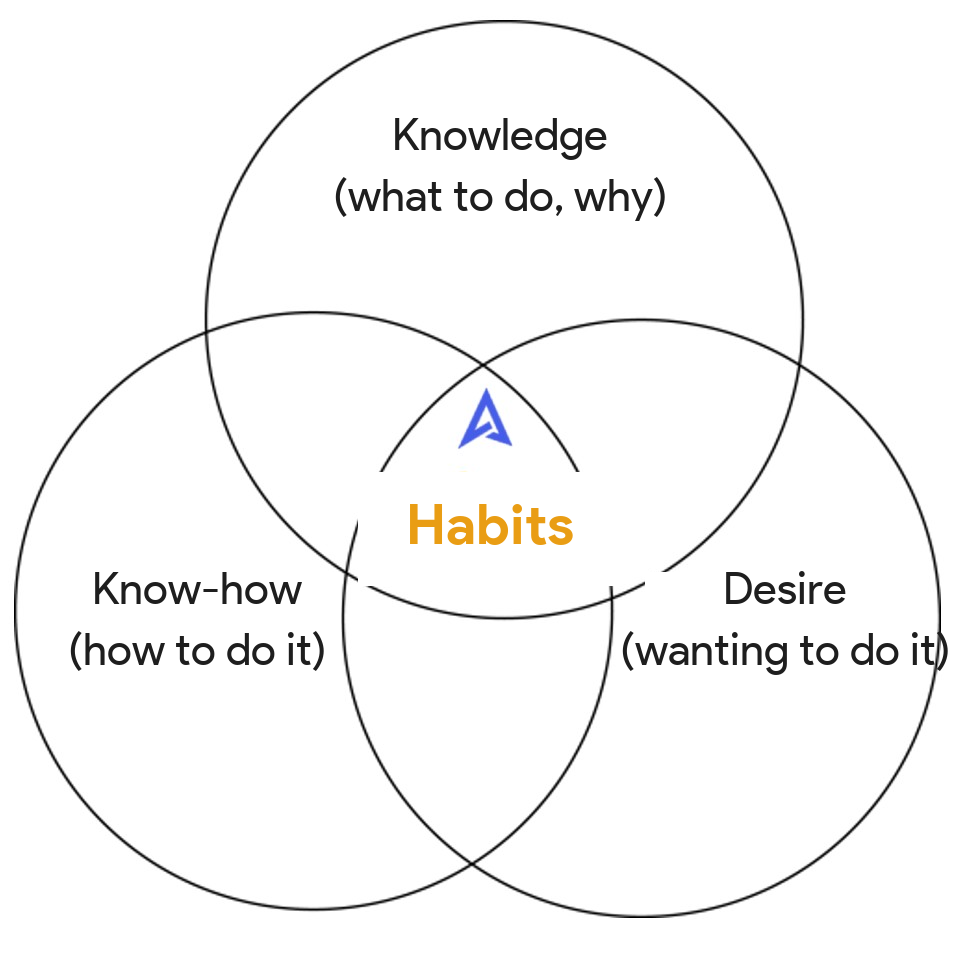
The power of habit...!
- From kick-off, I schedule post-mortem moments at several stages of the project, with intermediate assessments and a final post-mortem.
- I entrust the facilitation of the post-mortem process to a coaching specialist / facilitator. Someone who, ideally, played no active role in the project. The goal is to set a safe frame. Easier said than done! A quality post-mortem requires candor and honesty from participants — that may well be the essential point of vigilance in an effective retrospective.
- I take the time! You can't sum up 1 year of project work in 1 hour! Depending on your context and the organization's size, set aside an "appropriate" amount of time — ideally equivalent to the pre-framing phase.
- I run two post-mortems: one on the first dimension, the "cost-quality-time" triptych, and another — once the business transformation gains have settled — on the business value delivered. That's the one that rarely gets done! We're no longer in the hot debrief of periodic retros, but in a genuine moment of cold analysis.
- I use visual tools: visual management, sticky notes, Klaxoon... the tool doesn't matter as long as the approach stays "light". Anything but Excel! User/employee experience, always and forever. Yes: at this stage there's no need to over-detail — you're after a global, summarized view.
- I pay attention to the working atmosphere and to keeping things "relaxed". You're also there to "release the pressure" while sharing a "learning", friendly moment!
- I plan concrete rewards. From sweets to goodies, a restaurant, all the way to a bonus — the palette is wide, so you don't just "pay in words"!
How do construction firms — or the military — run project post-mortems?
There's more to life than tech! Outside the digital industry, how do people analyze the gaps between framing, execution and delivery?
Without going into every detail, we've picked two examples of project post-mortem practices outside IT.
Project post-mortems in construction?

Continuous project post-mortems rather than one at the end, when it's too late
"We never take the time to do a look-back! What matters is doing weekly reviews. In practice we tell each other all the time, constantly, and we formalize it once a month."
"It would be endless to run a post-mortem on an operation like a building — a 5-year project, plus the warranty that keeps running after delivery..."
Lionel C., real-estate program director at a national property developer.
While this testimony is of course not representative of an entire sector, it's still interesting to realize that the construction industry — said to be more "mature" than IT — works this way, with an implicit, continuous project post-mortem culture.
The project post-mortem in the military

No room for error. Every mission ends with an individual and collective debriefing.
Feedback from Gilles Jurine — 15 years of active service in the French Air Force. Gilles served as a fighter pilot, instructor and head of training at the École de l'Air in Salon-de-Provence. "The best debriefing after a mission is when each person individually self-debriefs on the mission. Versus a top-down debriefing." The 5 invariants of every mission are: Preparation - Briefing - Mission execution - Debriefing - Mission report. The debriefing is done "hot", and the report "cold".
5 ready-to-use project post-mortem formats
1. The "all-terrain" grid, useful for any team size.
- What worked ☑
- What could be improved ↗
- The thank-yous 🙏
- The good ideas 💡
- And above all, the post-retrospective action plan ✅
2. The "Mad-Sad-Glad" model
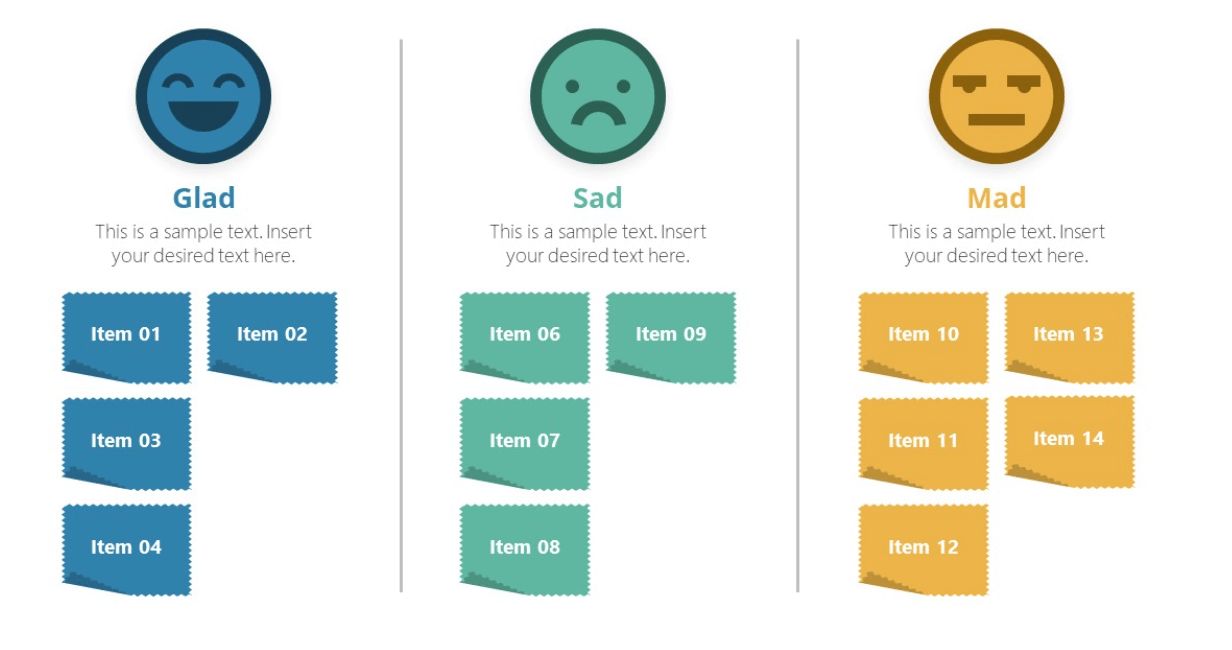
Mad-Sad-Glad: a project post-mortem along a more "emotional" axis
The Mad Sad Glad model is an agile retrospective technique. It focuses on the emotional well-being of the project development team. In doing so, it helps boost team morale and create a positive environment.
Emoji icons are used to visualize feelings about agile practices. While most retrospective meetings follow a traditional whiteboard method, this presentation will help you move the meeting onto digital media. The PowerPoint template can also be used as a Google Slides theme for virtual meetings.
3. The 4L model: Liked, Learned, Lacked, & Longed For
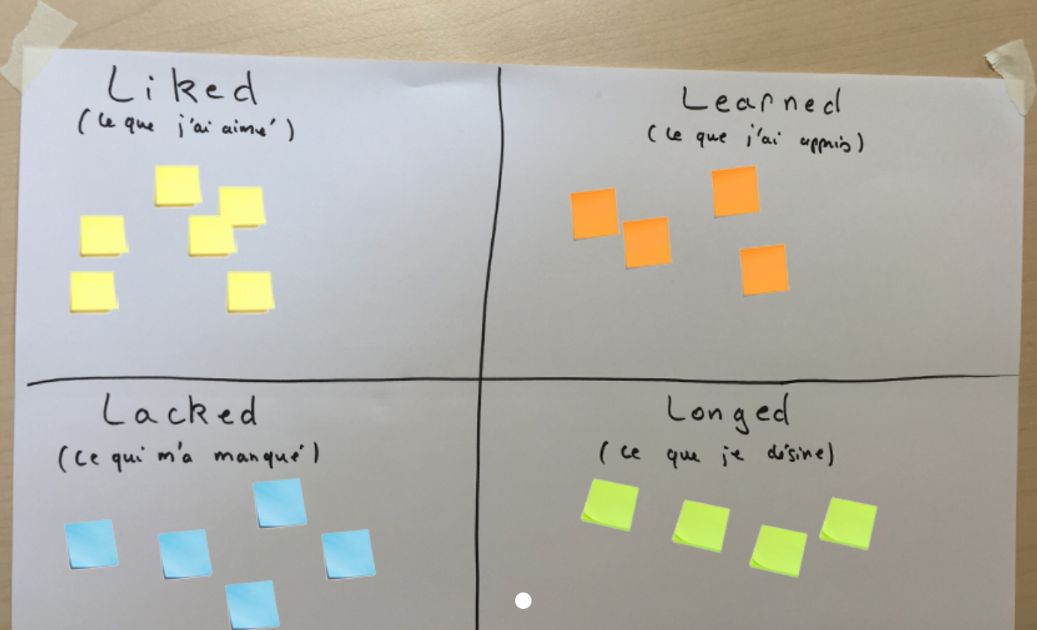
The 4L: a very complete model for a "learning" organization
With this template, the point is to formalize, clarify and map what the teams liked, learned, lacked and longed for — better known as the 4L retrospective! This popular retrospective format is loved by agilists and scrum masters for its simplicity and its ability to help teams set short- and long-term goals for future improvements.
4. The "DAKI": Drop, Add, Keep, Improve
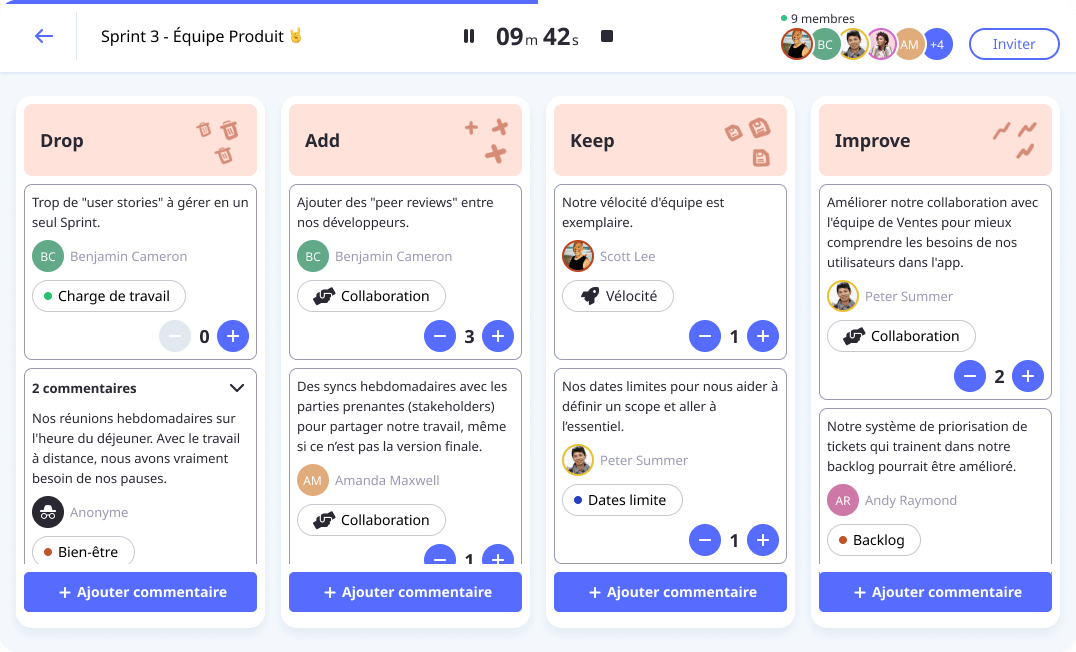
The D.A.K.I retrospective model
Our favorite! A model you can capitalize on.
5. The Starfish
The Starfish is a concept-mapping technique used in the agile and scrum project retrospective process. It gives a general overview to estimate the overall success of a project. This retrospective diagram presentation illustrates the starfish shape in 5 steps. The starfish shape, a metaphor for the retrospective technique, will engage an audience and communicate each idea effectively. The Starfish retrospective is an action-oriented tool, designed to prompt participants to create positive, actionable ideas. Instead of taking notes on what went well or not, this method lets you get into specific details. It encourages a team to discuss ideas that generate value.
As you can see, the practice of the project post-mortem has transformed too — influenced by the emergence of lean, agile and digital cultures and the development of collective-intelligence processes.
The project post-mortem is now run in several rounds, generally involves more stakeholders, and often mixes several business entities.
If you want to dig deeper into this key notion, continue reading with the following article: "The project review: a checkpoint to learn from your mistakes."
Sources and references:
(1) Source: the North American study "Leading Change: Why Transformation Efforts Fail", published in 1995 in the Harvard Business Review — only 30% of organizational changes succeed.
(2) The Project Management Body of Knowledge (PMBOK) is the Project Management Institute's guide defining the knowledge areas covering project management and cataloguing professional best practices in the field.
What if you took back control of your project portfolio?
Book a demo and discover the tool in 30 minutes.