February 1, 202622 min readJérôme Dard
Project portfolio management: definition, methods and tools

Contents
What is project portfolio management?
Project portfolio management (PPM) is a strategic discipline that consists of selecting, prioritizing and steering all of an organization's projects to maximize value creation.
Unlike project management, which aims to "do projects well" (the operational domain), project portfolio management seeks to "do the right projects" (the decision-making domain).
The Project Management Institute (PMI) defines it as the centralized management of the processes, methods and technologies of a set of projects, making it possible to optimize trade-offs and their planning, while assessing the level of risk and the financial viability of the projects.
Concretely, a project portfolio brings together all of a company's projects, programs and operations. Like a stock portfolio, it is about deciding where to invest your budget, resources and time to get the best return on investment.
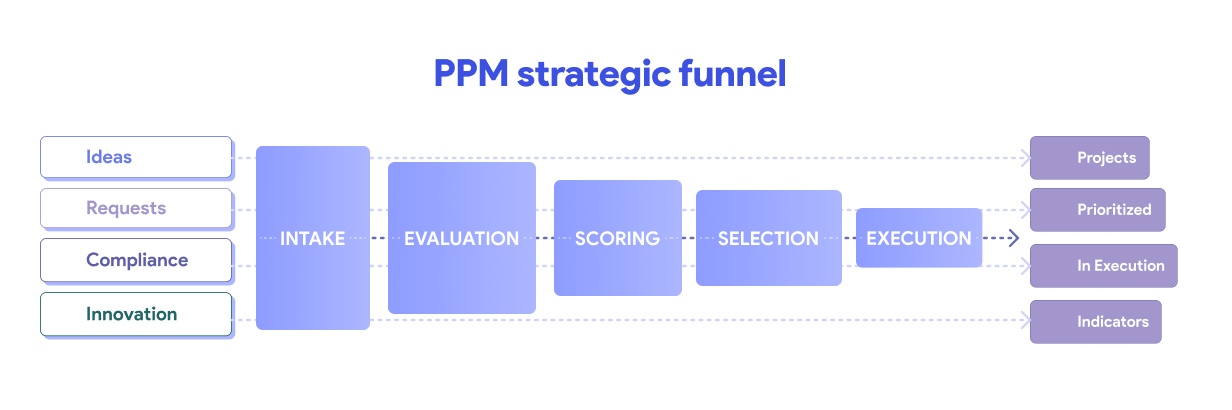
PPM works like a strategic funnel: at the top, a massive flow of ideas coming from strategy, customers or regulation; at the bottom, a rigorous selection of coordinated, executable initiatives. Without this filter, the organization exhausts itself trying to run everything at once and condemns its projects to mediocre results.
What project portfolio management makes possible
- Ensure the strategic alignment between projects and the company's vision
- Prioritize the initiatives with the highest added value
- Optimize the allocation of resources (human, financial, material) across projects
- Anticipate the risks of an imbalance between capacity and demand
- Provide consolidated visibility to decision-making bodies (steering committee, executive leadership)
- Stop or postpone the projects that no longer create value
Team capacity: the constraint at the heart of the portfolio
Project portfolio management rests on a truth that many organizations refuse to face: team capacity is finite. And it is this constraint — not scoring matrices, not progress percentages — that must structure every decision.
In concrete terms, capacity is measured per team and per quarter. That is the scale of the Quarter Plan: each team (infrastructure, development, data, security, etc.) has a real number of person-days over the coming quarter, once absences, maintenance, run and contingencies have been deducted. This quarterly capacity is the true budget of your portfolio — far more structuring than the financial budget.
| Resource management | Capacity planning | |
|---|---|---|
| Horizon | Short term (week/sprint) | Quarterly (Quarter Plan) |
| Granularity | Person by person | Team by team |
| Key question | "Who's working on what this week?" | "Can this team absorb this project this quarter?" |
| Use | Optimize day-to-day assignments | Decide which projects enter the portfolio — and which ones wait |
Capacity planning is the strategic safeguard of your portfolio: without it, you validate projects your teams will never be able to absorb.
Project portfolio vs program vs project: what are the differences?
Confusion between these three concepts is common. Here is what sets them apart.
The project
A project is a temporary initiative aimed at producing a single deliverable. It has a beginning, an end, a budget and SMART objectives (Specific, Measurable, Achievable, Realistic, Time-bound). Project management focuses on the successful delivery of this initiative.
Example: Deploying a new CRM tool for the sales team.
The program
A program is a set of interdependent projects that share common objectives. The projects within a program are linked: together they contribute to a strategic outcome.
Example: The "Digital transformation of the customer relationship" program, which brings together the CRM project, the website redesign project and the chatbot rollout project.
The project portfolio
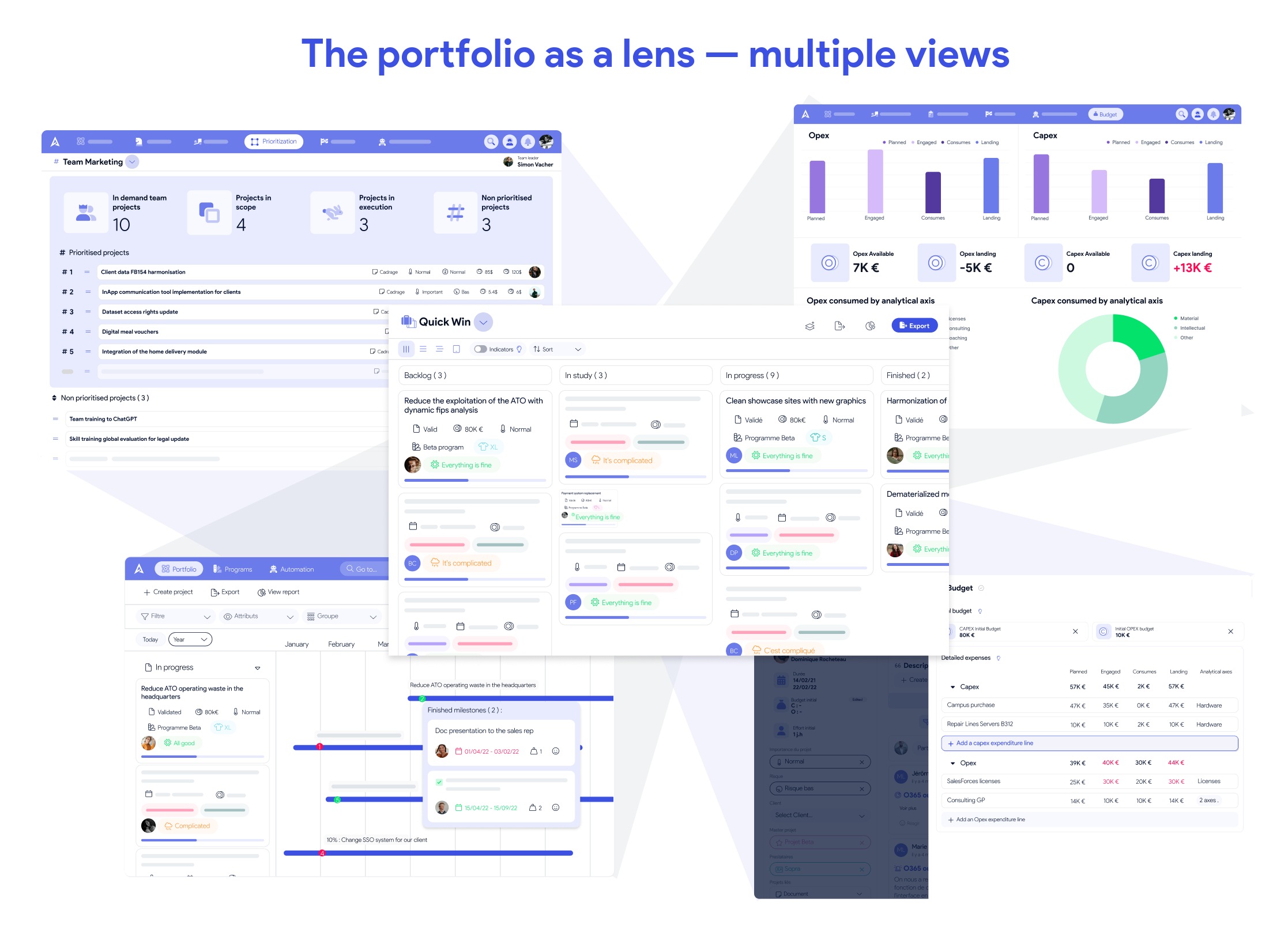
A project portfolio is not a hierarchical level above the program. It is a lens — a way of looking at a group of projects from a given angle, in order to make decisions suited to that scope.
In practice, the same organization handles several portfolios at once: the portfolio of the IT infrastructure team, that of the business application team, the portfolio of vital projects, that of regulatory compliance projects, or the global portfolio as seen by executive leadership. Each view answers a different question: "Is my team overloaded?", "Are our vital projects moving forward?", "Are we aligned with the strategy?".
This is what makes project portfolio management so powerful: it does not impose a single framework, but offers the ability to filter, group and compare projects according to the needs of each stakeholder — team, business unit, IT department or leadership committee.
Example: The IT department steers a global portfolio, but each team (infra, dev, data) has its own portfolio view with its capacity constraints. The leadership committee, for its part, looks at the portfolio by strategic axis.
Comparison table
| Criterion | Project | Program | Portfolio |
|---|---|---|---|
| Nature | A temporary initiative with a deliverable | A set of projects linked by a common objective | A view of a group of projects, filtered by team, theme or strategic axis |
| Objective | Deliver a concrete result on time | Achieve a common strategic benefit | Decide what to do, what to stop, what to postpone — based on real capacity |
| Decision level | Operational | Tactical | Strategic |
| Core constraint | The cost/time/scope triangle | Coordination between interdependent projects | Team capacity — there will always be more projects than you can absorb |
| Owner | Project manager | Program director | PMO / CIO / Executive management |
| Key question | "Will the deliverable be ready?" | "Are the projects delivering the expected benefit?" | "Are the right teams working on the right topics, at the right time?" |
Why put project portfolio management in place?
In most companies, the number of projects far exceeds the capacity to deliver them. It is a universal law of transformation: demand will always outstrip the supply of available resources.
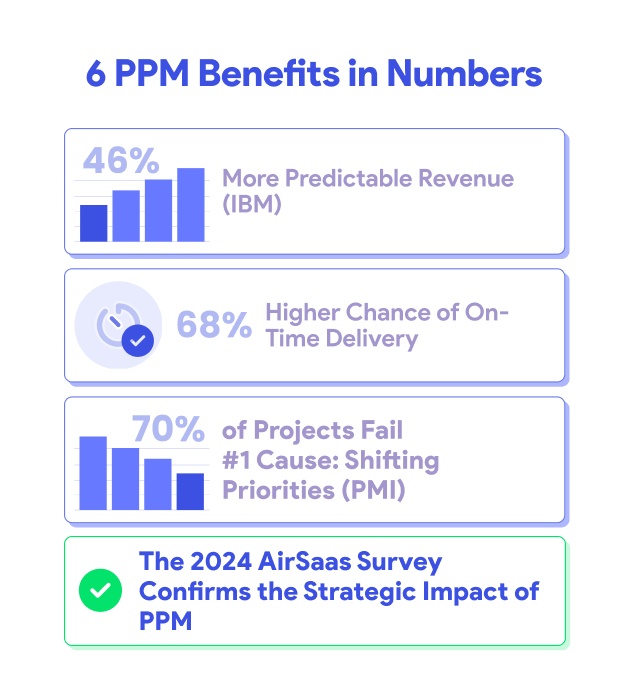
The figures confirm it: according to the IBM Institute for Business Value, organizations that lead in project portfolio management show revenue performance that is 46% more predictable than their less mature competitors. Excellence in PPM is not an organizational luxury — it is a measurable competitive advantage.
Without project portfolio management, organizations suffer a well-known phenomenon: urgency chases urgency. Teams operate in "best effort" mode, trade-offs are made on the fly (or by executive whim), and no one has visibility into what is truly a priority.
The 6 concrete benefits of a project portfolio management approach
1. Strategic alignment
PPM guarantees that every project contributes to the company's strategy. No more "orphan" projects that consume resources without creating measurable value. Every euro invested is traced back to a strategic objective. A truth too often ignored: technical success ≠ business success. The flawless execution of a project without strategic alignment is still a waste of resources.
2. Objective, transparent prioritization
By making the rules of the game and all the topics under portfolio review visible, the approach builds a relationship of trust and transparency between the IT department, the business lines and executive leadership. Prioritization decisions rest on hard evidence, not on political power plays or the loudest voice in the leadership committee.
3. Capacity optimization — the real added value
This is where project portfolio management truly comes into its own. Capacity is not measured at the scale of the whole organization — it is measured team by team, quarter by quarter. The Quarter Plan approach consists of confronting, each quarter, project commitments with the real bandwidth of each team. Organizations that master this planning increase their chances of delivering their projects on time by 68%. The secret: spot the bottlenecks on critical skills (IT architects, business experts, specialized engineers) and accept postponing what does not fit into the quarter. The result: less overload, fewer cascading delays, credible commitments.
4. Proactive risk management
With a consolidated view of the portfolio, risks are identified at the scale of the organization, not just project by project. A risk on a structuring project can affect the whole portfolio: PPM makes it possible to anticipate it.
5. Better communication with stakeholders
Consolidated portfolio reporting (dashboard, flash report, portfolio review) gives leaders the data they need to make informed decisions, without having to dive into the detail of each project.
6. Decision-making agility
Frozen 3-to-5-year IT roadmaps are a thing of the past. With modern PPM, prioritization happens continuously, at a pace suited to the company's changing context. Field data flows back in real time, enabling quick readjustments.
🏢 Misconception: "Project portfolio management is only for large companies." False. SMEs and mid-sized companies can sometimes draw even more benefit from it, because they have more agility and the ability to implement the approach faster. The challenge is to adapt the level of formalism to the size of the organization.
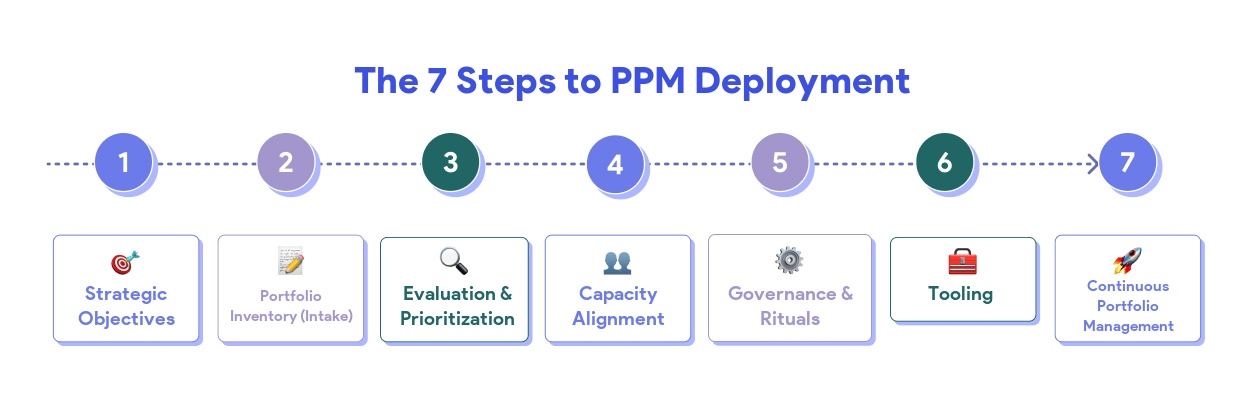
The 7 steps to deploy effective project portfolio management
Step 1 — Define the strategic objectives
It all starts with the compass. Without clarity on the strategy, your portfolio will be nothing but an inventory of unrelated projects.
Three concrete actions for this step:
- Formalize the 2-3 year vision with executive leadership
- Identify the priority strategic axes (growth, efficiency, compliance, innovation, etc.)
- Translate these axes into measurable selection criteria for the projects
Step 2 — Inventory and categorize every project (Intake)
Build an exhaustive inventory of all current and upcoming initiatives: validated projects, projects on hold, ideas in the making. Centralize every request — whether strategic, regulatory, from the business or from customers — in a single intake (capture) process. It is the best way to eliminate redundancies and identify pooling opportunities.
Each project should be documented with a standardized sheet including, as a minimum: objective, sponsor, estimated budget, resources required, deadline and strategic contribution.
Then categorize your projects by type (transformation, run, regulatory, innovation, etc.) and by program where applicable.
Step 3 — Assess and prioritize the projects
This is the heart of the approach. Apply your selection criteria to score and rank each project. The prioritization methods are detailed in the next section, but the key is to have a multi-criteria approach that combines business value, feasibility, risks and strategic alignment.
Step 4 — Align capacity with demand (Quarter Plan)
This is the most decisive step — and the one most often rushed. For each team, assess its real capacity over the coming quarter: available person-days, once absences, run, maintenance and a contingency margin have been deducted. Then confront that capacity with project commitments.
This is often the moment of truth: what seemed like a priority can turn out to be unrealistic if the team concerned is already saturated. The exercise must be concrete: not "do we have the means overall?" but "can the Data team absorb this project in Q2, or does it need to shift to Q3?"
The goal is not to plan everything down to the day. It is to make sure the commitments are credible. Better 5 projects delivered this quarter than 15 projects "in progress" none of which delivers a tangible result. Beware the trap of the progress percentage: a project at "60%" does not mean it is close to delivering anything usable — it is often just a ratio of effort consumed.
Step 5 — Define the governance and the rituals
Put in place the decision-making bodies and the recurring rituals that will keep your portfolio alive:
- Monthly portfolio review: trade-offs, Go/No-Go decisions, reallocation of resources
- Steering committee: validation of strategic directions and major investments
- Weekly reporting (flash report): consolidated progress status sent to stakeholders
- Weekly project check-in: 5 minutes per project between the project manager and the business owner
The PMI distinguishes three types of PMO (Project Management Office), depending on the level of control exercised:
| PMO type | Role | Level of control |
|---|---|---|
| Supportive | Provides templates, tools and best practices | Low — teams remain autonomous |
| Controlling | Requires compliance with methodologies through audits | Moderate — a structuring framework |
| Directive | Manages projects directly and assigns project managers | High — centralized steering |
The choice of PMO type depends on the maturity of your organization and your management culture. The current trend is toward the "facilitator" PMO (between Support and Control), which structures without bureaucratizing. More broadly, success in 2026 demands a metamorphosis of the PMO: it must evolve from an administrative support role into that of a strategic partner. Strategic steering is not about monitoring schedules, but about ensuring that every euro and every hour invested serves the company's growth.
Without regular rituals, your portfolio will quickly become obsolete. It is the frequency and discipline of these rituals that create value.
Step 6 — Equip the approach with a tool
Tracking a project portfolio in Excel is no longer viable beyond 10 projects. A dedicated PPM tool (Project Portfolio Management) makes it possible to centralize information, automate reporting and provide real-time visibility to all stakeholders.
The key criteria for choosing your PPM tool are detailed in the dedicated section below.
Step 7 — Steer continuously and improve
Project portfolio management is not a one-off exercise, it is a continuous process. At each portfolio review, ask yourself three questions:
- Are the current projects still aligned with the strategy?
- Should projects be added, postponed or stopped?
- Is capacity still sufficient to keep the commitments?
Prioritization methods for a project portfolio
Prioritization is the most complex and the most political exercise in project portfolio management. Here are the most widely used methods.
Multi-criteria scoring
Each project is assessed against a grid of weighted criteria. The criteria generally fall into three families:
- Financial criteria: Net Present Value (NPV), Return on Investment (ROI), payback period
- Strategic criteria: alignment with annual objectives, customer impact, competitive differentiation
- Operational criteria: technical feasibility, probability of success, regulatory urgency, resource availability
Each criterion receives a score (for example from 1 to 5) and a relative weight. The total weighted score makes it possible to rank projects objectively and to set a cut-line: projects above it go ahead, those below are postponed or dropped. Applying the cut-line is the ultimate act of management: once resources are consumed by the highest-scoring projects, everything below the line must be postponed or cancelled, without exception. It is the only way to guarantee that high-impact initiatives get the oxygen they need to succeed — and to protect the portfolio from "pet projects" with no real value.
Advantage: Transparency, reproducibility, ease of explanation to stakeholders. Limit: The quality of the scoring depends on the quality of the input data. As Robert Cooper, an expert in portfolio management, points out: "The sophistication of financial methods often exceeds the quality of the data. Purely accounting methods sometimes produce the poorest results if they are not complemented by strategic judgment."
The value/effort matrix (and risk/return)
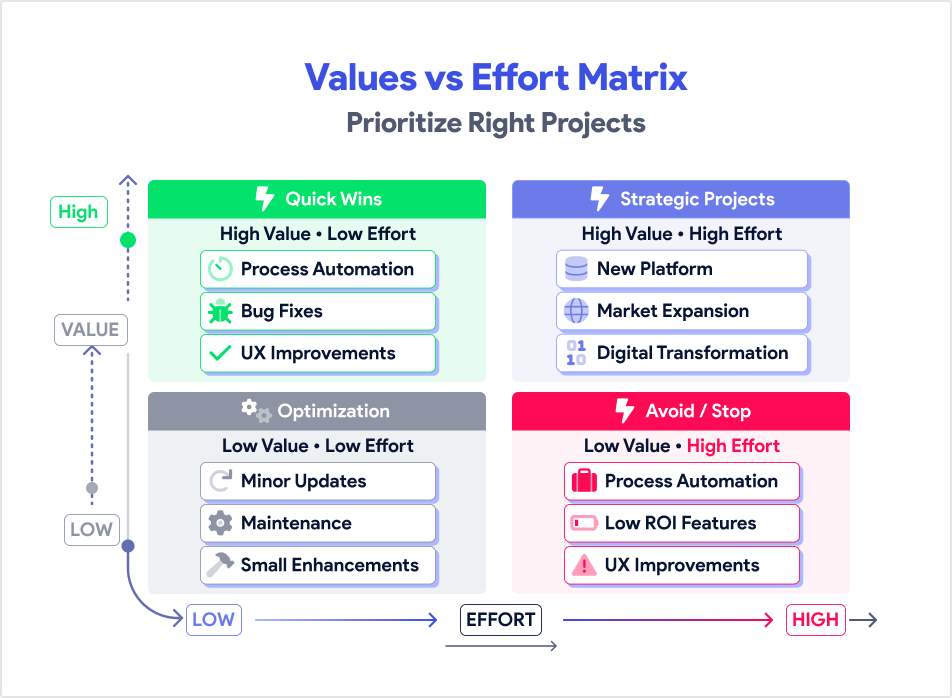
This simple, visual approach positions each project on two axes: the expected value (business impact) and the effort required (cost, complexity, duration). Projects with high value and low effort (the "quick wins") are the priority.
A commonly used variant is the risk-return matrix, which makes it possible to balance the portfolio across four quadrants: the "Quick Wins" (low risk, high return), strategic projects (high risk, high return), optimization projects (low risk, low return) and projects to avoid (high risk, low return).
Advantage: Visual, quick to set up, excellent for prioritization workshops. Limit: reductive for complex, long-term-impact projects.
The MoSCoW method
Classify projects into four categories: Must have (vital), Should have (important), Could have (desirable), Won't have (not now). This method, which comes from the agile world, is particularly suited to situations where you need to decide quickly.
The WSJF model (Weighted Shortest Job First)
Coming from the SAFe framework, WSJF prioritizes by dividing the value (Cost of Delay) by the size of the effort. The cost of delay combines three components: business/user value, time criticality (window of opportunity) and risk reduction or learning opportunity. Projects with a high cost of delay and a small size go first. It is the most widely used method in organizations that have adopted agility at scale.
The RICE method
RICE is a rapid scoring model that assesses each project along 4 dimensions: Reach (scope/number of people impacted), Impact (degree of impact per person), Confidence (level of confidence in the estimates) and Effort (workload required). The RICE score = (Reach × Impact × Confidence) / Effort. The projects with the highest score are prioritized.
Prioritization through Lean Portfolio Management
Lean Portfolio Management (LPM) goes further by embedding prioritization into a continuous flow, aligned with strategic objectives (OKRs or strategic Epics). Capacity is allocated by "value stream" rather than by project, which allows greater agility in trade-offs.
| Characteristic | Traditional PPM | Lean Portfolio Management |
|---|---|---|
| Funding | Based on specific projects | Based on value streams |
| Planning | Rigid annual cycle | Rolling, iterative, adjusted every quarter |
| Governance | Centralized control (top-down) | Decentralized decisions with guardrails |
| Focus | Administering individual projects | Overall economic performance of the portfolio |
The shift to LPM marks the end of rigid annual planning, often obsolete by the first quarter. We no longer fund isolated projects ("Fire and Forget" approach), but continuous value chains. This agility is secured by three guardrails:
- Investment by horizon: balance between maintaining the existing estate, immediate gains (quick wins) and breakthrough innovation.
- Capacity allocation: strict trade-off between developing new features and reducing technical debt.
- Outcome-based indicators: use of KPIs tied to real results (Outcomes) rather than to the mere progress of tasks (Outputs).
"What-If" simulation analysis
Scenario analysis is a powerful lever for pulling yourself out of permanent crisis management and swapping intuition for predictive impact analysis. A rigorous simulation rests on three steps:
- Identifying the variables: isolate the critical levers — budgets, availability of key skills, cost of delay (Cost of Delay), inter-project dependencies.
- Modeling scenarios: build optimistic, pessimistic and "most likely" trajectories to test the portfolio's resilience.
- Assessing the impact: precisely measure the potential drift on deadlines, costs and overall workload.
For example: simulate adding an urgent project to measure the shift on the delivery dates of ongoing initiatives, or assess the impact of a 15% budget cut on the composition of the portfolio. Modern PPM tools embed these simulation capabilities to inform trade-off decisions in the steering committee — putting an end to the reign of "the loudest voice" in the leadership committee.
⚡ AirSaas best practice: Portfolios prioritized on a frozen 2-3 year horizon are a thing of the past. Today, continuous prioritization is standard practice. An AirSaas survey (2022) shows that the majority of CIOs reprioritize their portfolio at least every quarter, and often every month.
The essential KPIs for portfolio steering
Steering a project portfolio without indicators is like driving without a dashboard. Here are the must-have KPIs, organized into 4 categories.
Strategic alignment KPIs
- % of projects aligned with the strategic axes: each project must be tied to an objective. A healthy portfolio shows 80 to 100% alignment.
- Budget distribution by strategic axis: see whether investments are consistent with declared priorities.
- Benefits realized: real value observed after closure, compared to the benefits expected at selection.
Capacity and resource KPIs
- Resource utilization rate: productive time vs total available time. Above 80%, the risk of overload is high.
- Demand vs capacity ratio: how many projects are on hold for lack of bandwidth?
- Productivity per resource: tasks or milestones completed per period, to spot performance gaps.
- Team churn: staff turnover during the project — a leading indicator of management or overload problems.
Operational performance KPIs
- % of projects "green" / "at risk" / "on alert": the classic project-health triptych, essential for an effective portfolio review.
- Milestone compliance rate: are the key milestones met on time?
- Budget variance: gap between planned and actual costs — an early warning signal.
- Number of change requests: an indicator of scope stability. A high number signals insufficient initial framing.
- Project health index: a composite score combining cost, time and risk into a single indicator.
- Compliance: adherence to the processes, methodologies and regulations in force.
Value and results KPIs
- ROI of delivered projects: is the portfolio really creating the expected financial value?
- Delivery time (Time to Market): how long between the decision to launch a project and the first delivery of value?
- Cancellation rate: the organization's ability to stop unprofitable projects — a sign of maturity, not of failure.
- Stakeholder satisfaction: satisfaction surveys with sponsors, business teams and project teams.
- Risk management: ratio of mitigated risks to identified risks — measures the effectiveness of anticipation.
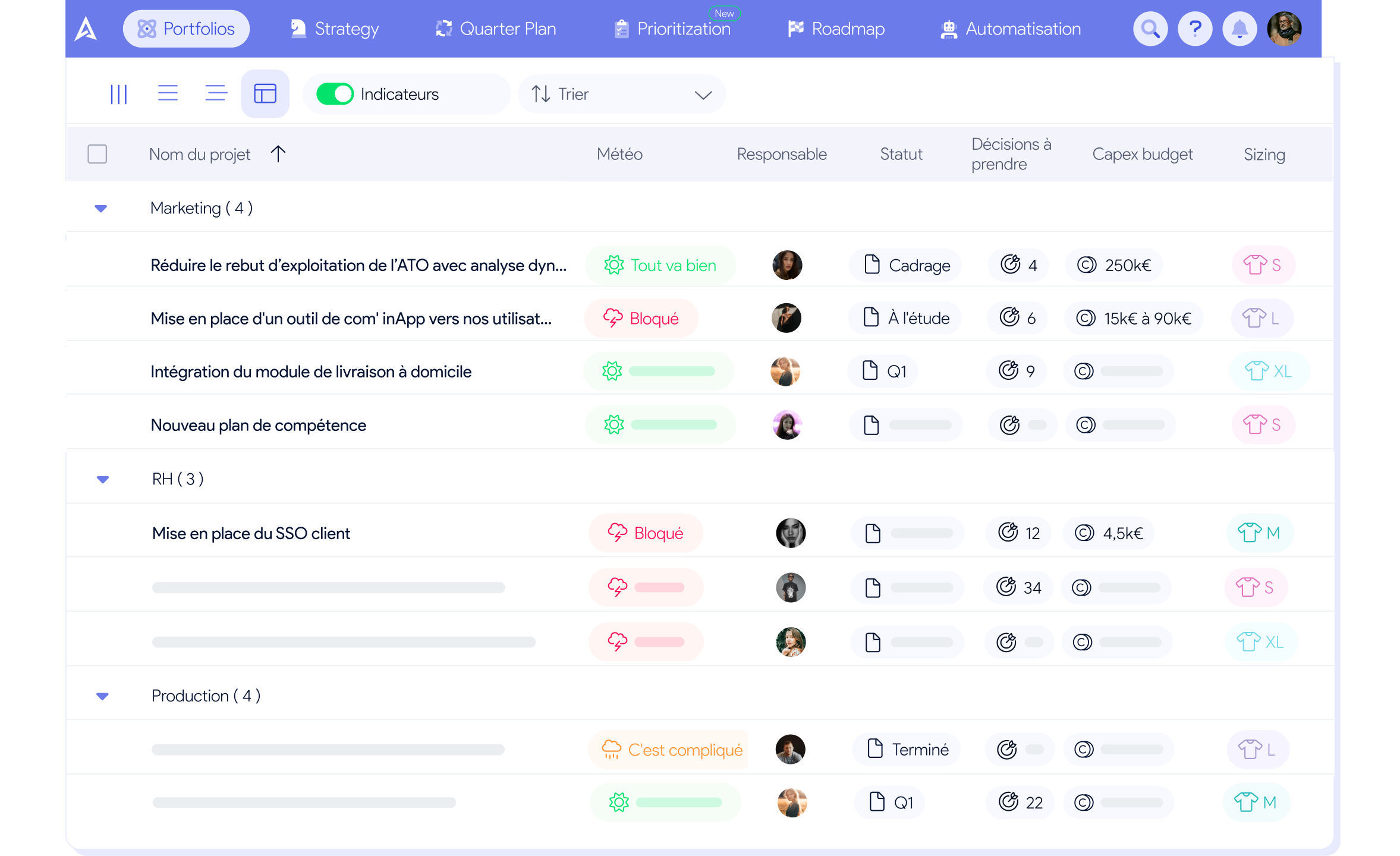
How do you choose your PPM tool?
The market for project portfolio management tools has changed considerably. Gone are the ERP/PPM behemoths of the 2010s. Modern solutions bet on simplicity, collaboration and automation.
The essential criteria for a good PPM tool
Ease of adoption: the tool must be usable by project managers, the business AND leadership, without complex training. If no one uses it, it is useless.
Consolidated portfolio view: visual dashboards with filters (by program, by strategic axis, by project health, by owner). The macro view is the whole point of the tool.
Automated reporting: automatic generation of flash reports (PPT, PDF, URL) for the steering committee, without spending 4 days compiling data by hand.
Ritual management: the tool must structure your portfolio reviews, your project check-ins and your steering committees with suitable workflows.
Integration with the existing ecosystem: native connection with task management tools (Jira, Asana, Monday, Azure DevOps) to feed up operational data without double entry.
Real-time collaboration: all stakeholders (IT department, business, leadership) contribute on the same platform. No more "I didn't know."
What a PPM tool does not solve
A tool, however good, cannot make up for fuzzy governance, undefined strategic objectives or indecisive management. The tool is a catalyst: it amplifies good practices, but does not create them.
The mistakes to avoid in project portfolio management
After hundreds of conversations with CIOs, PMOs and transformation directors, here are the most frequent mistakes we observe.
Mistake #1 — Confusing portfolio management and project management
The portfolio is not there to micro-manage the tasks of each project. It is there to make strategic decisions: which projects to launch, stop, accelerate or postpone. Mixing the levels creates confusion and weighs down governance.
Mistake #2 — Not daring to stop a project
A portfolio that never "kills" a project is a sick portfolio. If a project no longer creates value, has seen its context change or ties up critical resources, you have to know how to stop it. It is a sign of maturity, not of failure.
Mistake #3 — Underestimating capacity management
Validating 20 projects when you have the capacity to run 8 properly is the recipe for collective failure. And capacity is not managed "overall" — it is managed team by team, quarter by quarter. An organization may have budget available and resources "on paper", but if the Data team is saturated in Q2, no Data project will deliver. The chronic inability to say "no" is the most widespread symptom of organizations that are immature in PPM. Project portfolio management forces you to confront demand with the reality of each team's capacity — and to own the trade-offs that follow.
Mistake #4 — Relying on the percentage of progress
The % of progress is one of the most misleading indicators in portfolio steering. A project shown at 70% may be months away from delivering the smallest usable deliverable. This figure most often measures effort consumed (how many days have been spent) and not the closeness of a tangible result. Organizations mature in PPM replace the % of progress with concrete indicators: milestones reached, deliverables accepted, features shipped to production. The question to ask in a portfolio review is never "what % are we at?" but "what will be delivered and usable by the end of the quarter?"
Mistake #5 — Heterogeneous, time-consuming reporting
If each project manager produces their reporting in a different format, at a random frequency, the steering committee will never be able to have a clear view of the portfolio. Standardize the format, automate the collection, set a regular rhythm.
Mistake #6 — Launching the approach without sponsorship
Project portfolio management touches on budgets, priorities and sometimes power plays. Without a sponsor at executive-leadership or IT-department level, the approach runs out of steam at the first difficult trade-offs.
Mistake #7 — Wanting to do everything at once
Favor a gradual approach: start on a limited scope, with simple rituals and a small number of pilot projects. Show the first results, then expand. Adoption comes through proof, not through decree.
What if you took back control of your project portfolio?
Book a demo and discover the tool in 30 minutes.