April 21, 202210 min readBertran Ruiz
How to be a good cross-functional project manager?

Contents
What are the challenges and considerations of such a position? How can you make cross-functional project management and team coordination effective without hierarchical links? Explore the key elements that will help you shift the dynamics of your project management approach.

Leading team meetings: one of the important responsibilities of the cross-functional project manager
Challenges and considerations for managing cross-functional projects
The project manager is responsible for project management and operations. This requires creating a dedicated team with members from various departments who each have different skill sets and have no hierarchical connections, whether they are internal or external to the company.

Out-of-order project manager :(
No hierarchical link with the team
This matter is often seen as a challenge but actually it has the potential to enhance project management outcomes. Indeed, it can inspire a fresh team dynamic built on openness and shared responsibility.
The challenge here will be to:
- Stay factual and transparent.
- Rally the team around the project's goals and the importance of achieving them.
To accomplish this, you'll need proactive team members and a committed, unifying sponsor.
Belonging to different teams
The first challenge of not being part of the same team is the lack of proximity. Team members often don't share the same office, may be located on different sites and don't always have the same schedules or organizational structure. So, how can this be managed?
Dedicated work sessions
It is essential to find shared time dedicated to the team so you can move forward together on the various topics. Beyond the necessary weekly update, team members should be able to schedule group or sub-group work sessions as needed to address operational needs.
Onboarding the team members' supervisors
To dedicate time for team members without creating conflicts between the tasks (and workload) of their main roles and those of the cross-functional operations, it is very important for the sponsor to raise awareness and reach an agreement with the team members' supervisors, so that the necessary resources are made available. The project manager and the supervisors will coordinate to ensure that the actions of one activity don't penalize those of the other.
Visibility, transparency and dedicated tools
To overcome this lack of proximity, it's important for all members of the task force to be able to find all the information they need, and quickly. The project manager or PMO will therefore make sure everyone's work is accessible and communicated, and that the data is centralized, organized and shared. Ideally, they will set up a shared tool for tracking that fosters exchanges between members and is accessible to everyone. This tool should also let them assign tasks and provide a global view of progress.
Moreover, to address each person's different way of working, it will be important to establish a simple organization, framed upfront by the project manager while making sure it adapts to and suits everyone, with ergonomic, intuitive tools.
Stakeholders not working full-time on the project
It's quite challenging to steer operations in which the stakeholders are not fully dedicated to the project. Besides the limited daily and weekly time of team members that can impact the roadmap, the people on the other side don't have this project as their only daily concern. Their respective main assignments may sometimes be deemed a priority and generate delays, loss of information or of clarity on progress.
The whole challenge here is to make everyone's work easier by:
- Minimizing their mental load
- Making sure everyone defines and commits to what they can achieve within the allotted time
- Maintaining precise, clear communication
A clear and effective project framework
It is therefore particularly essential that the project framework and stages are perfectly clear. Everyone must be able to know at any moment where the project stands, and what is still to come.
The cross-functional manager is therefore responsible for setting up a simple structure for the project, capturing the global vision, the dated milestones and the different phases of execution (while making sure to break tasks down with clear deliverables for the team members).
Ownership and engagement
With the absence of hierarchical links, it's important to see relationships between colleagues as something closer to a partnership. It is therefore important for everyone to take ownership of the milestones assigned to them, to validate those milestones with the cross-functional project manager, and to commit to delivering a specific output by a set delivery date.
The project manager's role is to ensure the roadmap can be met within a reasonable timeframe, while challenging the stakeholders on any potential under-scoping or over-scoping of workload and execution deadlines.
Don't hesitate to reach out to your supervisors and to the sponsor to validate a set of specifications and a workload plan — the key being to always stay transparent and clear in your assessment of the project's status.
The ups and downs of timing
The unforeseen events that could disrupt a project's progress, or even endanger it, are many. This is especially true in cross-functional project management, as the unexpected factors are significant and often beyond the project manager's control. A team member facing an issue in their main assignment, the unavailability of a project component, a major and unexpected change within the company — any of these can jeopardize the entire project management.
Anticipation is winning!
The project manager must anticipate, as much as possible, the blocking factors that they or the members of the project team could encounter. They must be a resource to help the stakeholders in case of problems, for the smooth running of the project.
The ability to manage the unexpected and risk is certainly one of the most important qualities for project managers. They often work on projects that drive innovation and change and, as such, must pay particular attention to analyzing the context in which the project will evolve, whether technical, human or financial. The ability to identify the problems that could arise on the key elements and put the right corrective actions in place to "de-risk" them is decisive. For example, taking time in the framing phase to:
- Anticipate bottlenecks and blocking factors on the critical elements of the project
- Prepare corrective actions
- Build a margin into the roadmap for the execution and decision-making phases
The 7 tools of the cross-functional project manager
The problem-based approach
Unlike the solution-oriented approach, which involves keeping watch on new solutions/methods/technologies to introduce into the company (which often amounts to trying to fit round pegs into square holes), the problem-based approach is more pragmatic because it keeps a constant ROI-focused reflection on the project.
You'll spend much more time in the first phase of the project understanding what makes up the problem, and finding ways to measure its impact in terms of cost or lost revenue for the company.
Above all, this approach highlights the levers for action that will become the key features of the solution, and helps keep a common thread all the way to the project's deployment by:
- Making it possible to monitor whether the actions taken on the project will address the sub-parts of the problem
- Maintaining a financial perspective, and therefore better budget management
- Addressing the most critical aspects of the problem quickly
- Sizing the right testing scope and the right KPIs
- Consolidating a ROI
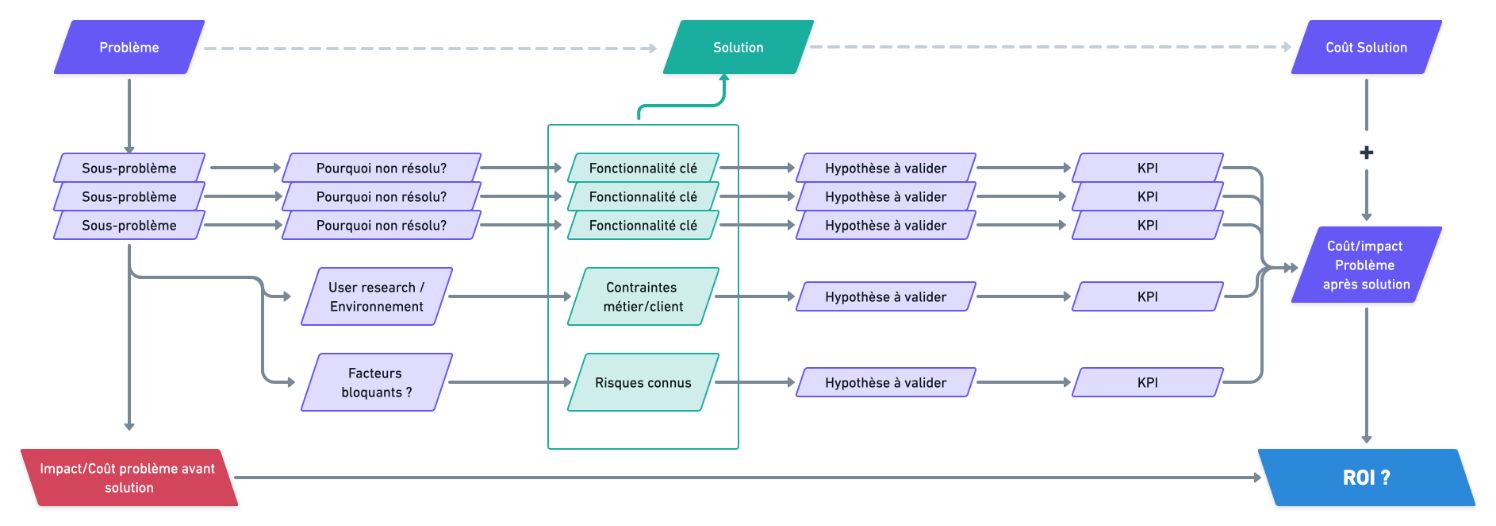
Diagram of the problem-based approach
Data
As the value of data no longer needs to be proven, we'll emphasize the importance it holds in a cross-functional project with a problem-based approach.
Here it is the data that drives the actions and decisions of the entire team, as well as management's Go / No-Go decisions — which makes exchanges factual and transparent.
A good project manager seeks to understand how to collect, analyze and provide the relevant data for the project.
Well-defined, it serves as a self-monitoring tool to anticipate future corrective actions.
The project framework document
This is certainly the most important phase for the project manager and it accounts for the major part of a project's success. This phase should be accompanied by a document summarizing all the important elements of the operations to be launched.
Here is an example of what this document might look like:
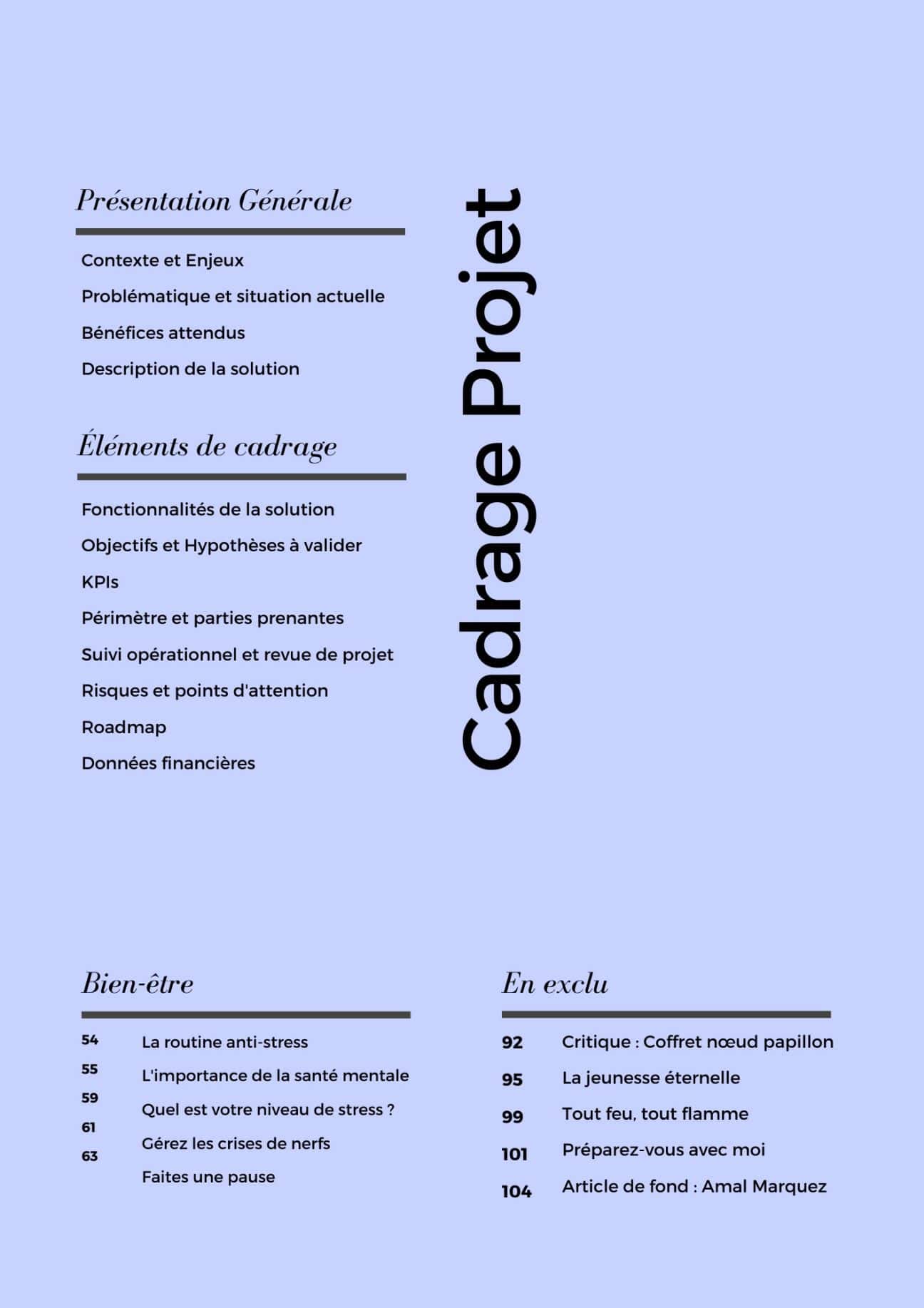
Example of a project framing document
It's a document that must come from collaborative work with all the operational stakeholders. It gives everyone a clear, global view and locks in each person's commitments. It will help facilitate decision-making in the steering committee and ensure continuity of information between "planned and actual" throughout the project.
It will serve as a roadmap for the cross-functional project manager, help them anticipate the blocking factors, and see whether the project is going off the rails.
Monitoring and communication
In cross-functional projects, communication is key — you have to make sure everyone has access to the same information, you sometimes have to play the role of mediator, and ensure that all lines of communication are open between the project manager and the stakeholders.
There is also sometimes an "evangelization" to carry out in order to be sure you can bring on board everyone who has, or will have, contact with the project.
A feedback culture and openness to the outside
"Alone we go faster, together we go further." A saying that neatly sums up the importance of a feedback culture and the importance of surrounding yourself with, and opening up to, people outside the project.
Whether toward other colleagues, innovation ecosystems, or companies with a similar market or way of operating, keep in mind that if you're facing a problem, others may be too — and may already have tried to solve it. Whether they succeeded or failed, it will be an important source of learning and information.
The key moment
The project manager plays a role in facilitating the steering committee. They must ensure that all the important items on the agenda are addressed. To do this, they will have prepared, ahead of time, the speakers, key points and decisions to cover during this committee. For this, they can rely on a few of the following points.
Having a good sponsor

Team spirit is built over time.
They're the one who manages to re-energize the team
Beyond the fact that they are often part of, or represent, management for a group with no direct hierarchical link between them, they play a decisive role in mobilizing the workforce of the team formed for the objective; they convey the vision and the stakes of the initiative, as well as the benefits that flow from it. They let team members step outside their usual framework by entrusting them with a new mission. They also let team members share and showcase their ideas by giving them the means to put them into action.
They set the direction
The sponsor will enable and facilitate the setup of these new projects, give the guiding and strategic direction so the project fits into the company's vision and stakes. As such, they will be one of the key arbiters of the initiative, as well as for decision-making and defending the project to the leadership team.
They defend the project with the cross-functional project manager in the steering committee
The sponsor's posture is decisive. Their role is to monitor and challenge stakeholder progress, to settle Go / No-Go decisions (possibly in consultation with other committee and/or leadership-team members) and to approve the proposed next steps. It is important to give them all the key information so they can facilitate the operational workflow, or even redirect/realign it if we stray from the initial vision and goal.
They are the first one convinced by the initiative and the project; as such, they defend the project and its direction, alongside the project manager, to the stakeholders and/or other management members.
The essential skills of a good cross-functional project director
In short, a good cross-functional project manager must have the following skills:
- Team spirit
- Good communicator
- Organization and rigor
- Pragmatism
- Active listening and anticipation
- A taste for risk management
- Curiosity, in a mindset of continuous learning
- A fan of the feedback culture and of seeking out lessons learned
To go deeper into this approach, we recommend reading this key article: How do I move my company into project mode?
What if you took back control of your project portfolio?
Book a demo and discover the tool in 30 minutes.