July 28, 202621 min readBertran Ruiz
Project steering committee: the complete guide


Contents
The project steering committee (Copil in French) is an essential body in any business transformation. It acts as the link between the executive committee and the teams that deliver the projects. It describes a group of people whose role is to make decisions and ensure a goal is reached within a company.
In this article, we'll take a closer look at how it operates and the role it plays in overall project management.
What is a project steering committee?
A steering committee is a group of people — including the project manager — responsible for overseeing the smooth running of a project within a company. To improve project tracking, both in terms of oversight and of the choices to be made, it is generally formed as a team that cuts across the project, with one member from each category of role.
The steering committee takes the concrete form of meetings held regularly throughout the project. These sessions serve as a governance checkpoint to review progress, assess performance indicators and make decisions based on data-driven insights.
This committee can draw on the analysis of metrics from the project's activities in order to make concrete decisions.
Why do we need a steering committee?
The steering committee exists to keep the machinery of a project running smoothly. It is a decision-making body that lets the client and the vendor or partner (internal or external) move forward on the same path, aligned on the goals and the tasks to be carried out.
A steering committee is mainly set up for complex projects, where many contributors are involved and/or bound by strong interdependencies. It also reduces the risk of failure by tracking project progress closely and by spreading the decision-making load across all the players.
The main purpose of the steering committee is to make decisions about the project or projects under way. The steering committee is NOT an information-sharing body! In every company, the committee meeting should have as its goal to decide, to make choices on the “hot” or important topics that impact how the project (or projects) unfolds and is implemented.
What are the responsibilities of a project steering committee?
From setting goals to reviewing progress and making decisions, the steering committee has a central role throughout the project. Its purpose is to support and steer all strategic decisions related to the project.
Let's recap the steering committee's key responsibilities:
- Monitor project progress against the major milestones of the timeline and deadlines.
- Arbitrate on blocking topics that impact how the project unfolds.
- Allocate the resources needed for the project to progress: it escalates to the strategic committee (if one exists) the issues that are beyond its remit, along with major decisions.
- In smaller organizations, the steering committee may also handle the arbitration on strategic direction.
- Review the status of the expected deliverables.
- Track consumption of the budget defined initially and flag any risk of overspending.
- Monitor the risks, their likelihood of occurring, and anticipate solutions.
Who should sit on a steering committee?
The members of the steering committee are executives, managers and the business teams involved in the project. The project sponsor is an integral part of this group.
Steering committee or executive committee?
Depending on the size of the company, the make-up of the steering committee varies. Regardless of the structure, one principle must remain non-negotiable: the steering committee must have real decision-making authority. If its decisions can be overturned by another person or governing body, the committee loses its purpose.
In large companies, the difficulty lies in scale. With so many ongoing initiatives, the executive team cannot attend every steering committee. As a result, decision-making may become diluted, leading to political friction and unclear accountability.
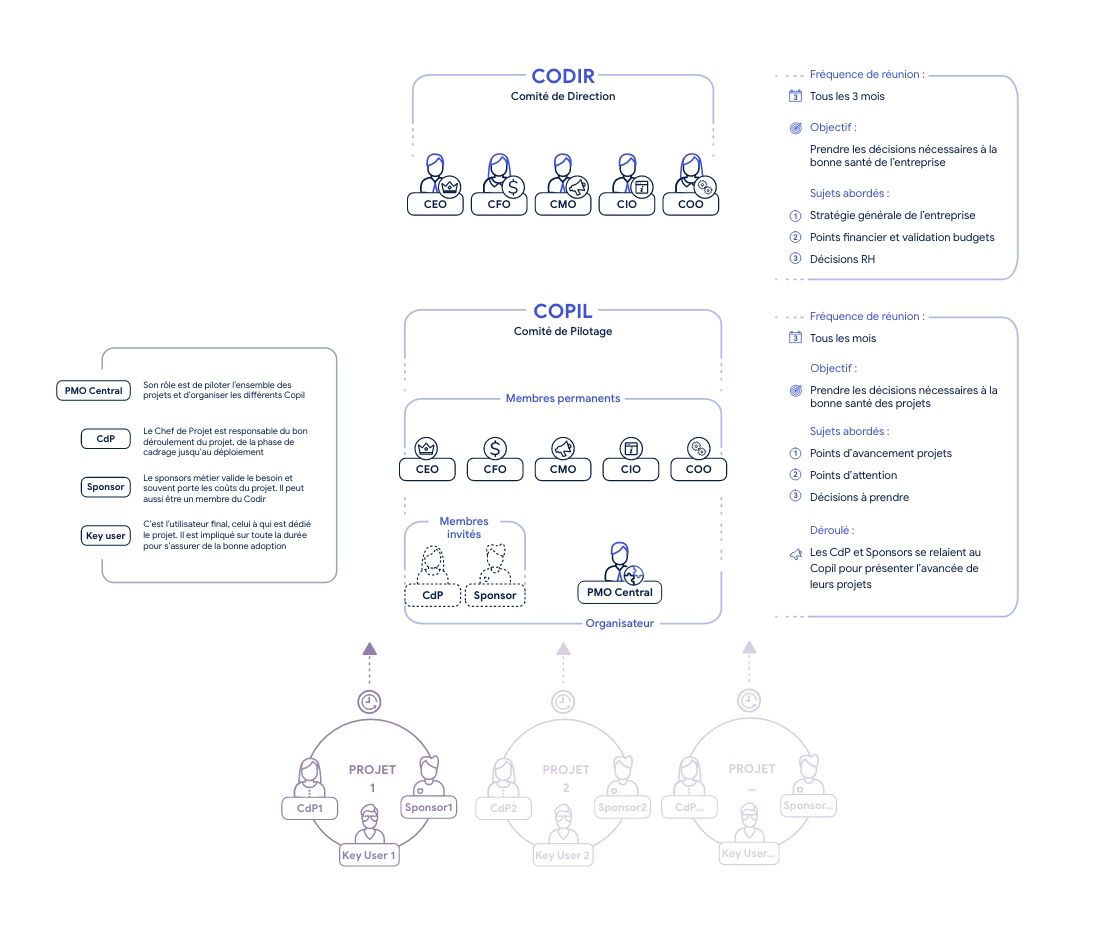
Steering committee, project committee, leadership team, technical committee: who does what?
These four bodies coexist in most organizations — and confusing one for another is the number one source of pointless committees. Here's who decides what:
| Steering committee | Project committee | Executive committee | Technical committee | |
|---|---|---|---|---|
| Role | Make decisions and settle trade-offs on the project | Coordinate execution, tee up decisions | Steer company strategy | Settle technical choices |
| Participants | Sponsor, project manager, business decision-makers | Project manager(s), operational teams | Executive management, directors | Architects, experts, project manager |
| Frequency | Monthly (1.5-2 hours max) | Weekly | Weekly to monthly | As needed |
| Horizon | The project: milestones, budget, risks | The week: tasks and blockers | The company: strategy, finance, HR | The solution: architecture, tooling |
Who's really in charge?
In project management, there is often a great deal of confusion between project execution and decision-making authority. This confusion can lead to delays, misalignment or even failure.
So be careful: as a project manager running cross-functional projects, you cannot arbitrate alone or make decisions about which resources to prioritize or about deadlines that go beyond the scope of the mission. For decisions to be made, you must regularly present reporting and highlight key information to the steering committee.
The project manager paradox
Most of the time, projects fail because there is a misalignment between teams and stakeholders. Too often, project managers spend their time chasing overdue tasks instead of focusing on what truly drives progress: continuous alignment. Their main responsibility isn't micromanagement — it's leadership. Strong leadership, not control, is what keeps projects on course.
A team whose role is to decide
The steering committee team is like a navigation-assistance system that would ultimately make the decisions on the direction to take. The members of the steering committee are an essential relay of power within the company.
The team is formed at the start of the project by the sponsor, in close collaboration with the project manager. It is imperative that the business experts likely to take part in decision-making are on the team. In practice, steering committee members are drawn from the following types of players:
- Sponsor
- Project director (who may also be the sponsor)
- Project manager
- Business representative, as needed
- Group of "key users"
Common mistakes to avoid
1 / Confusing the steering committee with the project committee
A project committee (Copro or Coproj) is a meeting organized by the project managers, who are aware of every facet of the project and its stakes. It is a checkpoint meant to surface arbitration points to submit to the steering committee if needed.
The project committee is therefore a meeting, most often weekly, that brings together a client-side project manager and a vendor-side project manager when the project calls on outside help. The operational people involved can thus coordinate the project and make sure it is moving in the right direction. It is the opportunity to raise any issues or delays, but also and above all to find a solution for organizing what comes next.
The project committee is sometimes confused with the first steering committee: a first steering committee, also called the “kick-off meeting”, generally takes place before the project starts. After that, it comes in at the project's key stages (end of the scoping phase, before go-live…) to approve the decisions made. If there's one thing to remember: Project committee = micro, task allocation. Steering committee = macro, arbitration and decisions.
2/ Not knowing exactly what happens in a leadership team
The leadership team brings together people who have decision-making authority across the business.
The members of the executive committee meet to review the projects under way across the company's departments and to put forward a strategic vision. They sit alongside the CEO, offering support, opinions and recommendations: the executive committee is a way of making, collectively, the decisions meant to serve the company best.
The leadership team talks about the project during the project steering committees but also gets together as a collective decision-making body, giving recommendations and approving strategic choices in the best interest of the company. While it may be involved in project steering committees, its scope goes far beyond: finance, corporate strategy, M&A, human resources and more.
How to prepare a project steering committee meeting
The project manager sets the points to be covered — it's up to them to fold in the work of the stakeholders concerned or of working groups formed to solve a specific problem. Nothing should be discovered for the first time during the steering committee. The agenda must be well defined, include the essential points, and be sent to participants 48 hours before the meeting.
Everything happens upstream
Everything must be sent upstream, at least one week in advance, to the people attending the meetings. Documents useful for understanding the project can also be sent by the project manager.
The sponsor must be aware of everything, and above all of the critical topics that will be included in the presentation. Ideally, certain decisions will be made before the meeting between the project manager and the sponsor. The goal would be to have the approvals of the various managers on these topics.
A bit of politics
The project manager must work upstream, with the committee participants likely to oppose certain decisions, to try to defuse the situation and understand exactly what is going on. The project manager is therefore a negotiator, or at least must become one. The progress of the project depends on their political tact. They must ease tensions and put the project back on the rails more often than their fair share. The name of the game is to avoid, as much as possible, open conflicts between stakeholders. The business teams would then risk disengaging from the steering committees, and none of the other project bodies would be able to unblock the situation.
Running the meetings
The purpose of the meetings is to get a progress update on the project and to maintain an ongoing dialogue between the different technical and functional teams. The project manager or project director runs the steering committee. They present progress using dashboards and precise, concise reporting. The sensitive topics must absolutely be addressed. The sponsor gives their approval to the decisions that are made.
The meetings most often take place once a month. Sometimes a quarterly rhythm is chosen. Each session should be focused and on-time, lasting no more than 90 to 120 minutes.
Documents used
The two key documents are the agenda and the minutes. The agenda captures the review of the schedule, risks, actions in progress, and decisions made and pending — shared with participants ahead of the meeting. The minutes, sent within 24 hours by the project manager to every participant, log and document the decisions; they then join the project documentation.
A typical steering committee agenda fits into six items:
- Recap of the previous steering committee's decisions and their execution (5 min)
- Macro-level progress: milestones reached, milestones at risk — based on the macro planning (10 min)
- Budget: spent vs planned, alerts (10 min)
- New risks and attention points (10 min)
- Decisions to be made — the heart of the meeting (40 min)
- Next steps and communication (5 min)
So you don't have to start from a blank page, we've published a steering committee presentation template, with the full running order and practical tips.
What AI changes in steering committee preparation
Everything above still holds. But let's be honest about what has changed over the past two years: the most expensive part of steering committee prep — digging up what was said, what was decided, what has moved since last time, then turning it all into a presentable deck — no longer takes hours. It takes a few minutes, on one condition: the data has to exist somewhere.
That's the real shift. For twenty years, the project manager spent 80% of their prep time manufacturing the information and 20% thinking about what to do with it. That ratio has flipped. In practice, with minutes, decisions and attention points logged as you go, you query the portfolio directly: AirSaas exposes an MCP server you plug into Claude or ChatGPT, and you ask in plain language — “what has moved on this project since the last steering committee?”, “which decisions have been pending for more than three weeks?”, “which milestones are at risk this quarter?”. The actionable summary lands in under five minutes.
As for the deck, you no longer build it: you generate it. Clean, consistent, in the same format from one committee to the next. Which frees up most of your prep time for the only thing that really matters — deciding what you want the committee to rule on, and anticipating the objections. Form stops being work; substance becomes the subject again.
Steering committee and AI: the 3 questions to ask your portfolio
- The prep note sent ahead of the meeting. If you have the data, you can now produce and send, 48 hours ahead, a one-page note: what has progressed, what's blocking, and the decisions expected. That wasn't sustainable when it took two hours to write. It is today — and it radically changes the quality of the discussion in the room.
- The one-pager read in silence to open the meeting. For the first five minutes of the steering committee, everyone reads the summary on their own. No narrated presentation, no slides walked through out loud. Everyone gets to the same level of information at the same time, then you move straight to the decisions. It's the practice that saves the most time — and the one that most quickly reveals the topics nobody had spotted.
Steering committee success: the "top tips" to keep from messing it up
1 - Steering committee - leadership team - what matters is deciding!
In some organizations the leadership team encompasses the steering committee. It doesn't matter. If you are a project manager, make sure decisions are made for your projects.
2 - Marathon vs. Sprint
The steering committee is not a meeting. It is a series of meetings. The steering committee unfolds over time, with a frequency to be respected. Ideally it takes place at least once a month; otherwise you lose the thread and don't force the right decisions to be made. The project gets bogged down and it's failure. When you plan your first steering committee, send invitations to everyone concerned for the next six months.
3 - Require the presence of everyone concerned
Every decision-maker absolutely must be present at every steering committee. Our advice: manage members' attendance ahead of the meetings. An announced absence — or a no-show — often means the person disagrees with the project or doesn't feel valued enough. Either way, an absence can hurt the project's productivity, and even the atmosphere of the meeting.
4 - A single format
Once a format has been adopted by all stakeholders and has proven its effectiveness, don't change it. Consistency lets you focus on substance and forget form. It is better to spend time formatting your presentation ahead of the first steering committee — choosing the right indicators and color codes — and then to lock in that template, which will serve as the basis for every steering committee. This way you'll be more effective at handling the important and/or urgent topics.
5 - Time Keeper
For some, time is money; for others it's just a matter of respect and discipline. A steering committee that drags on for three hours will quickly lose engagement.
If you agree on 10 minutes per key item, then it's 10 minutes. The timekeeper has the right — and the duty — to cut a discussion short so the meeting moves forward. They are the guardian of a certain discipline that, over time, most members will come to appreciate.
6 - Manage frustrations
A steering committee is not a place to settle scores in public. If something's wrong, raise it with the person concerned well in advance. If they are clearly involved in a major blocker, let them know you intend to share that information during the meeting. The element of surprise is not the effect you're after during a steering committee.
7 - Continuous reporting
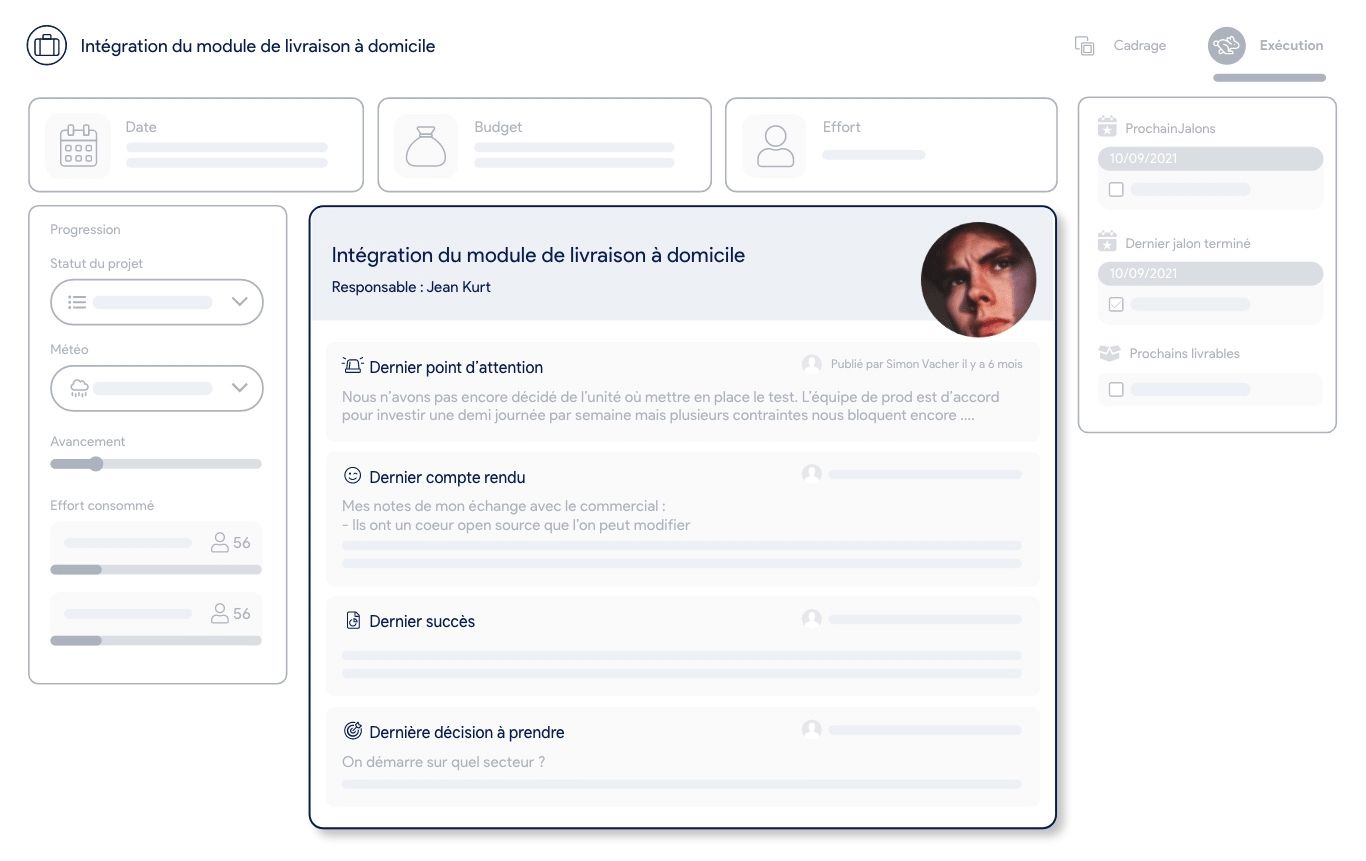
The best way not to catch the steering committee's participants off guard is to communicate continuously about the project's progress. Send updated information and reporting (many tools are available); this makes the people concerned react as they feel involved. That way, by creating small tremors through weekly reporting, you'll be able to anticipate a backlash or a revolt that's starting to brew!
8 - The surprise guest = the false good idea
That's precisely the worst thing you can do: bringing a “surprise guest” into the steering committee on a one-off basis. They don't know how the meeting runs and will probably ask questions that were settled weeks ago. A one-off guest is a disruptive element whose added value is relative at best. If they're an expert, why not ask them to write a recommendation note on a specific topic, sent to the people concerned ahead of the meeting?
As a reminder, the steering committee is not an arena in which everyone debates. It is a decision-making forum. Occasional guests do not have voting rights.
9 - (again) a bit of politics
If the presence of a business expert is necessary or desirable, then don't hesitate for a second and invite them to the meeting! It would be clumsy to ask a third party to speak on behalf of the business — you'd risk quickly losing credibility. Business experts should be valued whenever possible and involved in the decisions made. In doing so, you help create a healthy climate and, as project manager, you earn the respect you're due.
10 - If the decision is not made
If, within the allotted time, the decision isn't made — or worse, if a half-decision is taken — it's important to mention it clearly:
The goal of the steering committee on this project was to make a decision on this project. We were unable to reach a ruling. The project is therefore put on stand-by and will fall behind schedule as of today.
Since what isn't written down doesn't exist: putting this sentence in the meeting minutes will, at review time, hold everyone accountable to their responsibilities.
11 - Lunch break
While the "time-keeper" has the right to end certain discussions, some conversations are worth continuing informally, especially when they improve alignment. A practical tip is to schedule your steering committees from 10:00 to 12:00. Not only does hunger help ensure the meeting ends on time, but the informal conversations that can follow over lunch often unlock conflicts and reinforce collaboration. As always, drink responsibly.
Sponsor, milestones, key user, reporting: speaking the same language in the steering committee
Because yes, in companies everyone talks about projects… but very few people talk about the same thing.
Take milestones: the common mistake is reporting too many of them, which makes effective tracking unreadable. A fundamental reminder: in steering and reporting, I share the status of milestones, not tasks. You don't transform an organization by inviting teams to do “task-by-task” project management. The goal is to structure, communicate, then steer a transformation plan.
We've put together a cheat sheet on 5 common project management words that are still often misunderstood: sponsor, milestones, project manager, key user, reporting. By revisiting what's really at play behind these keywords, used in every steering committee, you get back to meaning — to process. What if the key, in the end, was simply understanding each other better? Read it here: Steering committee: definition(s) and misunderstanding(s).
It all comes down to preparation! What to do before the committee
A steering committee should not be your umpteenth weekly or monthly meeting. Nor a working group treated as a collaborative co-creation workshop. It's not there to answer operational or business questions: all of that has already been handled beforehand, in smaller groups. The project manager and the sponsor must have a very clear idea of what they expect from each session.
Thanks to this preparation work, the project manager knows the members' objections and, together with the sponsor, prepares the right action plan. Setting objectives, interactions with the sponsor, the place of personal interests, defusing disagreements ahead of time, the anonymous-form trick, stakeholder watch-outs: everything you need to strengthen your preparation is in this article — How to properly prepare a steering committee? The emphasis is on the human side: human relationships are so often at the root of project failures that they deserve major attention.
The steering committee is starting? Here's what to do to run it effectively!
The committee was prepared with as much anticipation as possible. It's the big day, the appointed hour… and you've already spotted a few surprises: one of the members is absent, a deck that isn't quite pulled together. You feel you're not fully on top of your game. Yes — under stress, our behavior changes!
What pitfalls should you avoid, how do you manage time and tensions well, what's the optimal presentation deck, how do you handle derailments, political stakes, and the right level of detail to communicate? All these questions are legitimate. Going through our checklist will spare you needless tension: How to run a steering committee?
The steering committee is stuck? How to improve the decision-making process?
As we saw above: this committee is a team whose role is to decide! In a company, decisions are the central element that blocks or unblocks a situation. BUT nobody — no company — steers by decisions:
- No clear way to make a decision other than in a meeting — no history.
- No transparency about the decisions,
- No way for a project manager to easily escalate a decision to be made.
The clearer, more transparent and more readily “usable” the decision-making process, the stronger the company's ability to act. Otherwise, everything drags! A decision should be as simple as an API. That's the stance AirSaas takes: every decision to be made is raised by the project manager, logged, archived with its history, and visible to the sponsor — between steering committees, not just during them. The steering committee stops being the decision bottleneck: it becomes the forum where decisions get settled.
Without effective decision-making, projects get launched, stopped or extended in an irrational way. We all have someone in mind who monopolizes the floor for 10 minutes, or who asks for one specific detail that keeps everyone from discussing the substance… Discover tips to handle these situations better: How to decide in a steering committee?
How to set up an effective steering committee?
As we saw above, the steering committee is there to keep the project's machinery running smoothly. But how do you keep that body itself well oiled? Watch-outs on member involvement, defusing tensions, political games, staying effective over time, the most useful tools: read our reference article — How to set up a steering committee?
How to handle aggressiveness in steering committees?
How do you spot and manage difficult personalities in your companies and steering committee meetings? It is one of the most critical challenges in any assembly — the one that determines working conditions. There are two types of aggressive behavior… A bit like first aid, our collective responsibility is above all to be able to spot the types of "aggression": the ones you have to sanction and the ones you have to remediate!
In the second category we find the classic profile of the aggressive, rude, disrespectful person operating on the edge of a red card: they raise their voice, shout, stand up, throw out a cutting remark to personally attack certain members — going after people rather than what they do. Careful: ignoring it = making it worse. Plan for a firm reframing and a reset of the agreed discussion rules. Discover the 7 tips we've selected to make office life easier: How to manage aggressiveness in steering committees?
Steering committee: 5 tips to make everything go smoothly
Congratulations — you've just read a complete guide! You now know the fundamentals of the steering committee, its tools, how it works, and how much good execution of this process matters within your company.
Beyond the fundamentals, we've prepared for you, on another page, 5 premium tips to go further. Pragmatic and actionable practices: discover, for example, the IT/Business/Sponsor relational contract. You'll also be won over by a "gem" of pure rhetoric with the vague & precise answers method, to use if you're caught off guard, etc. Here is our — inevitably subjective — selection of 5 practices we wish we'd discovered before our first committee :-) Project steering committee: 5 tips to make everything go smoothly.
Want to learn more?
Frequently asked questions
A steering committee — Copil in French, short for COmité de PILotage — is a project's decision-making body. It brings together the sponsor, the project manager and the decision-makers involved to settle blocking issues: milestones, budget, risks, priorities. It is not an information meeting: if no decision gets made there, the steering committee serves no purpose.
The steering committee decides at project level (milestones, budget, trade-offs); the executive committee — Codir in French — decides at company level (strategy, finance, HR…). In SMEs, the executive committee often doubles as the steering committee, joined by the project manager and the sponsor. In large organizations, the two bodies coexist and the steering committee reports to the executive committee.
The project committee (Coproj) is the operational meeting, often weekly, where project managers coordinate execution and surface the points that need arbitration. The steering committee is the monthly body where those calls get made. In short: project committee = micro, task allocation; steering committee = macro, decisions.
The project sponsor, the project director (who may be the sponsor), the project manager, business representatives as needed, and a group of “key users”. The golden rule: every decision-maker must be present — and surprise guests are off-limits.
Best practice is a monthly steering committee of 1.5 to 2 hours max. Below that frequency, you lose the thread and decisions bog down. From the very first session, send the invitations for the six months ahead: a steering committee is not a meeting, it's a series of meetings.
Everything is won ahead of the meeting: documents sent one week before, agenda circulated 48 hours before, critical topics defused with the sponsor before the session, and managers' sign-offs pre-negotiated. Nothing should be discovered for the first time during the steering committee. After the meeting, the minutes go out within 24 hours with the decisions logged.
It removes the most expensive part: piecing the history back together and building the deck. If your minutes, decisions and attention points are logged as you go, you query your portfolio directly in plain language — AirSaas, for instance, exposes an MCP server you can plug into Claude or ChatGPT — and you get an actionable summary in under five minutes. Two practices follow: a prep note sent 48 hours ahead, and a one-pager read in silence during the first five minutes of the committee. AI doesn't decide for you: it gives you back the time to prepare the substance.
A single, fixed format from one steering committee to the next: macro planning, key indicators, budget, risks, and above all the list of decisions to be made. We've published a ready-to-use steering committee presentation template on the blog, with the standard running order and practical tips.
What if you took back control of your project portfolio?
Book a demo and discover the tool in 30 minutes.