June 17, 202210 min readJérôme Dard
How to manage conflict and aggression in steering committee meetings?
Contents
We've all seen it: the aggressive email, the person who intimidates the other members of the steering committee meeting. The one who never lets anyone finish a thought and constantly interrupts. Someone who raises their voice, shouts, maybe even pounds the table or storms out of the SteerCo slamming the door! And let's be honest: the pandemic and lockdowns didn't exactly help.
Lucky are those who have run a steering committee meeting without ever being disrupted by one or more members. Aggressive types, self-proclaimed experts, the stubbornly silent... But how should you respond to disrespect? Are there ways to rein in a difficult personality? Who should step in? How do you act — and skillfully stop risky behavior before it's too late? What does it mean to work on the climate of your steering committees? And finally, how do you judge which behavior is out of bounds and deserves sanctions — and which isn't?
And between the lines: how do you manage your own aggression — keeping your self-control, your "anger management"? Here is the essential of what you need to know about aggressive behavior; we've prepared your survival kit for hostile environments. You'll walk away with a selection of 7 tips to use when it happens.
This article is part of our series Steering committee (SteerCo): the basics, which covers the essentials of the project steering committee — simple, pragmatic pointers.
Spotting the types of "aggression" in steering committee meetings: which ones call for sanctions?
Remember that aggression is a reaction to an emotion — anger and/or frustration. It can stem from fear, from a lack of confidence, from envy or jealousy, or simply from not knowing how to behave in that project committee...
First things first: you need to be able to tell what falls under the law and what doesn't. Whether you're facilitating the SteerCo process, the project manager or a participant, your responsibility is to recognize what is acceptable and what is non-negotiable. Ignorance of the law is no excuse — even in project management!
Two levels of aggressive behavior, two responses
- "Unlawful" aggression: I sanction it!
- The disrespectful aggressor, right on the edge of violence: I reframe the behavior and "we" renegotiate the rules.
First case: no questions to ask — you sanction.
This is aggression that crosses the line. Physical aggression, violent verbal abuse... The goal here isn't to accommodate or negotiate, but very much to keep people safe. In business as anywhere else, no stakeholder is above the law.

Anger, frustration: nothing justifies "open" aggression that targets people.
On this point, it's important to distinguish between mistakes — aggression driven by an excess of emotion, for instance — and misconduct: say, a "deliberate" behavior that puts another person's integrity, and the group's, in "danger". The right response is, first of all, to stop the steering committee if needed. To protect people. Then formalize the conflict, stick to the facts, and leave a written record of what just happened.
Here, your responsibility — as an individual or as a manager — is not to look the other way. The organization "must" sanction the behavior. Show that there is a consequence, that there is no impunity. In a word: show managerial courage.
The second level of aggressive behavior is the more classic profile: the aggressive, rude, disrespectful member operating right on the edge of a red card. For example: they raise their voice, shout, stand up, throw out a sweeping jab to personally attack certain members of the steering committee meeting — or the whole SteerCo! They go after people, not what people do. Same principle: this calls for a reframing conversation and a reset of the rules. In case of disrespect or verbal aggression, point specifically to the discussion rules agreed for steering committee meetings. Ask participants to stick to them and to avoid aggressive behavior throughout the project.
Aggression problem: react.
Within this same category, a harder one to spot is the occasional passive-aggressive. The one who doesn't even know they're being aggressive. This is the SteerCo member who never lets others finish a thought and constantly interrupts. Someone who reacts with subjective comments — through explicit attitudes and body language, even audible sighs ("Pff")... In short: disrespect, a contained aggression, but one that's clearly there. In the 7 tips below, we'll see how to respond to this kind of aggression.
Right away, if there's one thing to remember: you'll need to run an individual reframing conversation and a collective negotiation of the ground rules of your steering committee meeting.
7 tips for managing aggression in steering committees
Ignoring = making it worse — Take aggressive behavior seriously and don't downplay it
An aggressive person attacks and seeks confrontation. They expect only one thing from you: that you strike back aggressively. Do the opposite — keep your cool and let them talk until they regain their own calm and their ability to listen; otherwise you won't manage to be heard.
Keep the disrespectful participant from monopolizing the debate and foster the collective spirit that project mode is built on. Capture the opinions expressed — with keywords, for example. Show that you take the committee member's opinion seriously. Ask them, and the project team, to add other keywords to sum up that opinion.
Don't ignore them — question their opinion instead: "How did you reach that conclusion?" "Why are you using that tone?". Refocus their remarks on the subject of the presentation.
Keep your body language "relaxed" and mirror the aggression
Don't let your emotions carry you away. Choose your reactions. A basic practice: focus mindfully on your breathing for a moment. Gaze into the distance.
"Never look surprised" is more or less the golden rule. Think of the film Itinéraire d'un enfant gâté and the cult scene where Jean-Paul Belmondo coaches Richard Anconina in the art of public speaking. Easier said than done. Careful: the idea is to stay yourself, using relaxed, detached body language. Practice until you find your "poker face" — not that tense grin :-) ! It's your genuine smile, your humor, that will do the work.
People often don't realize how aggressive they're being. One trick that works: repeat your aggressor's exact sentence back with a different intonation.
Don't feel obliged to answer every verbal attack
Use silence as a de-escalation tool. If you do want to respond, pick your battles and counter-attack by surprise. One retort that lands beats five limp counter-attacks!
If someone cuts you off, don't hesitate to answer with a simple, calm sentence. Something like: "Yes, I'd love to hear your take on this — let me finish my point and then the floor is yours." Note the "Yes, and" instead of the "No, but...".
As much as possible, don't take it personally. Try even to desensitize yourself — aggressors usually go after everyone. Despite appearances, you're not necessarily the target!
Responding to disrespect: hit "pause"
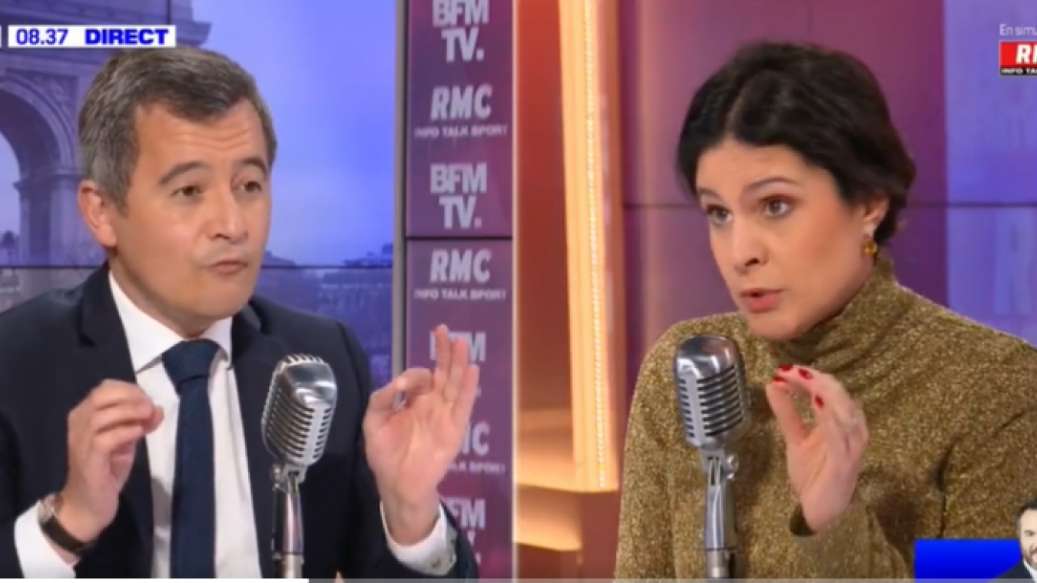
The emblematic example of a "clash" between France's Interior Minister and a journalist
You may have seen this exchange: confronted with the latest crime figures, French Interior Minister Gérald Darmanin called the journalist's analysis "a bit populist" and didn't hesitate to talk down to her. "Will you let me speak, madam? Your presentation is very quick and a bit populist. (...) No, don't take offense, calm down, madam, it's going to be fine," he threw out in a condescending tone.
"I beg your pardon?", reacts Apolline de Malherbe, outraged. "It's going to be fine," Gérald Darmanin repeats. The journalist pushes back: "Gérald Darmanin, wait — how are you speaking to me?" she protests. "I find your way of answering staggering. That's not an answer, it's almost an insult," she points out. "Don't take offense — I answer the way you attack me," the minister tries to retort.
The moment the interview leaves the usual bounds of verbal sparring and turns into a disrespectful attack, the journalist's reaction is a model of its kind. She crosses her arms in a T and simply says "Pause — we stop playing," in a calm, determined tone. By dodging a substantive question, her interlocutor created a second controversy.
A reminder: it's never a good idea to tell someone to "calm down". In project management, in governance, or in everyday life!
The art of feedback, NVC: master the fundamentals of communication
Prevention beats cure. Don't hesitate to give yourself a very useful refresher on the three methods of caring / nonviolent communication (OSCAR, DESC and OFNR) to turn your difficult messages into constructive, effective feedback! Including in an email.
A picture is worth a thousand words. For this refresher, nothing beats the (masterful) Sketchnote created by Maxence Walbrou — coach, facilitator and illustrator.
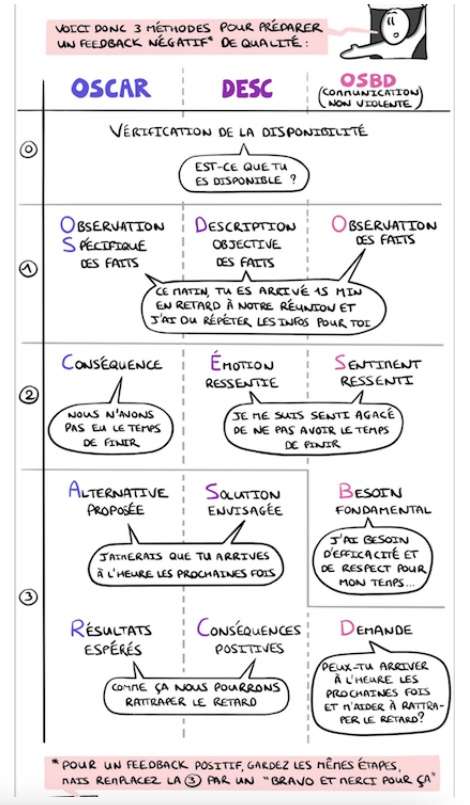
Illustration source: Maxence Walbrou — bloculus.com blog, article "Sauvez des vies faites des feedbacks"
Work on the climate before, during and after steering committee meetings
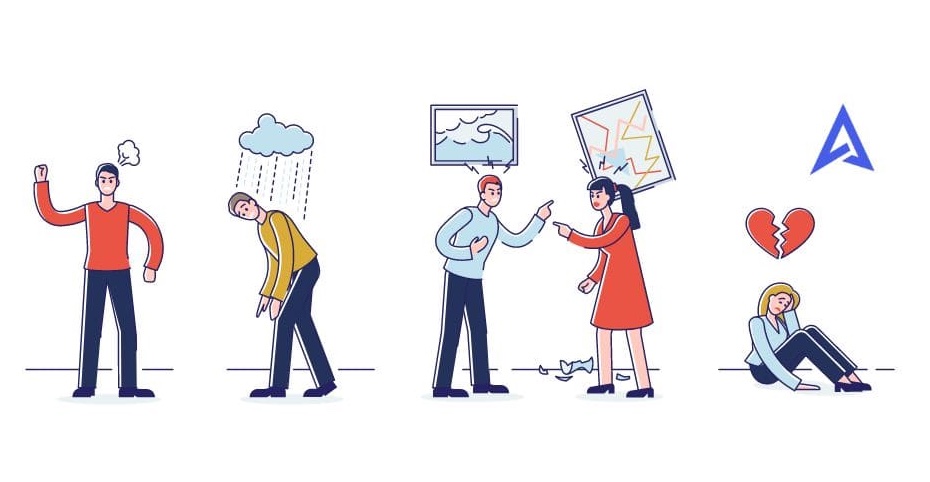
When you spot repeated weak signals of aggression, prevention work can still be done. It might mean, for example, agreeing on ground rules — a kind of collective "code of honor" ahead of the committees. Together you negotiate the rules on communication, active listening, smartphone use, saying "I" versus "we". And also limiting the accusatory "you" that kills the conversation. In short: you negotiate, and you talk about everyone's needs.
You can also decide to lighten the project portfolio! Clearly define what is vital and focus the steering committee meeting on it — you won't have time for anything else anyway.
One of the secrets is to honor inclusion moments. These "ice breaker" or personal check-in moments are there to create a climate conducive to constructive exchanges, to get people talking. Don't skip these lighter moments. Alternating intense phases and downtime is a good way to release unnecessary (over)pressure — and to prevent any hostility.
Finally, know when to interrupt a SteerCo before anger takes over! If emotions still won't come down, stop the steering committee meeting. Take a ten-minute break so everyone can cool off. Use the break to take the person aside one-on-one and calmly discuss their aggressive behavior.
Once things have cooled down, after the SteerCo, don't hesitate to go back to the member who behaved aggressively and set up an informal meeting to hear what was left unsaid.
Knowing when to ask for help when aggression has become unmanageable in the project
Faced with dysfunctional situations, report them and hand the matter over to experts
You are not alone! Send a very factual written report to your management and to Human Resources. Several collective options are possible if the situation has spiraled. Recently, for example, a mediation was run within an IT department going through strong growth and a never-ending merger/reorganization. Those combined contexts were generating serious difficulties and open hostility in exchanges.
Another possible option: running a workplace-climate survey can be genuinely useful. But don't forget that preventing psychosocial risks is a profession in its own right!
To go further, check out our 5 tips for a smooth project steering committee.
Final word: vigilance and prevention to avoid any excess of aggression
In project management as in everything, it's the excess that is toxic. A little aggressiveness is tolerable. No need to dramatize. And it's worth underlining: when things get passionate, it also means people are engaged! Voicing disagreements — even bluntly — can sometimes be very healthy. Let's simply stay vigilant about excessive behavior and uncompromising about any unlawful violence.
You've now read the 7 tips to decode — and more serenely defuse — future aggressive behavior in steering committee meetings. Found this decoding and defusing of borderline behavior interesting? Keep going on the prevention theme with the article How to prepare a steering committee well?
What if you took back control of your project portfolio?
Book a demo and discover the tool in 30 minutes.