June 1, 20229 min readJérôme Dard
Governance steering committee: tips for successful meetings


Contents
The composition of your project steering committee reveals a lot about the PMO or project manager you are!
As a Chinese proverb reminds us: "the fish rots from the head down". Indeed, organizational dysfunctions can often be traced back to its leaders and managers.
Successfully running your project steering committee means getting your trade-offs and decisions right. It means engaging a project's governance, those who hold power over resources, timelines, quality and performance.
The problem: the topics raised in a steering committee are complex. The time available is limited, and finally, the concentration of oversized egos is extreme!
Let's add that there are sometimes so many projects that the leadership team can't attend every steering committee. This can lead to a surplus of internal "political" games and indecision.
In this context, how do you avoid or defuse the pitfalls of group dynamics and make sure the process of running the project steering committee goes as smoothly as possible? We asked our friends in the CIO, PMO and project-manager community, drew on our own experience, re-read all the articles, asked Google... to select 5 best practices we wish we'd known before our first project steering committee...
No basic advice here - you already know you need an agenda for a steering committee. We'll look at what isn't written in the manuals, with a focus on pragmatism and the relational dynamics of a project. To discover the fundamentals, we've prepared this other article for you: Steering committee (SteerCo): the basics
Tip 1: Agree beforehand to avoid putting your IT / business counterpart on the spot in the steering committee
Set up a kind of "relational contract": never put your partner in the business / IT project-manager tandem on the spot in front of the committee. This isn't one party's steering committee, it's the project's steering committee! Make it a kind of golden rule"
This simple tip, used wisely, won't guarantee an ideal project - just normal relationships that stay partly calm during moments of tension.
It's worth stressing that, in a context of increasingly self-organized and agile project teams, the very idea of a single project manager seems more and more anachronistic, even obsolete. Yes, you are a project group, a hybrid "leadership". To be complete, let's add that to the duo formed by the IT and business project managers, you must add the sponsor. It's this trio that should run the steering committee.
The project manager must coordinate before and after the steering committee to align on the sometimes cross-functional messages and objectives.
To anchor this practice well, we can compare it to what plays out within a family. Take the example of a teenager having behavioral problems at school... If one of the parents, to side with the child, undermines the other co-responsible adults (parent and/or teacher), things start to break down. This crack between the three education partners can be exploited and give rise to endless interpretations and debates! The analogy with projects is worth what it's worth, but it does capture the importance of the relational contract, so that everyone plays their role within a collective framework, in shared responsibility.
Tip 2: No information should be discovered during the project steering committee
All the documents; agenda and appendices must be sent out, at least a week - and ideally 15 days - before the day of the steering committee!
Careful: mastering this basic tip isn't so easy. It's about putting yourself (a little) in the shoes of the project steering committee members. Because yes, let's remember it: sending a "slide-ument", the equivalent of a 100-page book to read, only a few days before the meeting is like putting your audience through a painful experience.
The guiding principle: little to no information should be discovered during the steering committee.
Likewise the sponsor must be kept informed of the critical points included on the agenda. Without making them re-read the entire communication plan, you'll have prepared and validated the key messages, decisions and recommended solutions.
Finally, ideally, some project steering committee decisions will be made before the meeting, between the IT/business project manager and the sponsor. The goal would be to secure the sign-off of the various managers on these topics. It all comes down to preparation.
Tip 3: Be precisely vague!
Here we're on a purely rhetorical tip. You're the IT/business project manager or PMO. One of the project steering committee members puts you on the spot during the meeting. If you don't know what should be done, but you don't want to admit it, use phrases such as : "We'll look into this issue and get back to you by next Tuesday, 3:00 pm".
In communication technique it's important, even essential, to "acknowledge receipt of the sender's message". This way you make sure you don't have to come back to it, and you avoid a latent background noise.
Note it on the flip chart or the platform's support. You don't say a word about what you're going to do, but the exact deadline creates an impression of certainty. Of course, you must send an update before the deadline. Even if it's only a "sorry, we had to reprioritize the topic" with a new deadline :-) you'll be seen as a very reliable person, able to meet deadlines and communicate clearly and in advance.
It's a tip close to the one that consists of welcoming and setting aside off-topic questions in the parking lot, to keep the focus on the agenda.
Variant to keep the focus: the "fridge/parking lot" question zone
Someone puts you on the spot mid-meeting with an unplanned question? Note the off-agenda topics and set them aside for discussion at a later date, to make sure the main agenda is handled first and to get participants used to staying focused and aware of tangents, to avoid digressions.
This practice has the benefit of keeping the steering committee focused on the stated agenda. Second, the fridge or parking lot acknowledges and makes room for the important points raised by the various stakeholders.
Careful, the question must genuinely be followed up on. Don't pretend!
Tip 4: Promote achievements and successes

Unlike a project steering committee, where the main driver is sometimes risk monitoring, innovate and invest in the positive! A simple tip: ritualize, every time the project's progress warrants it, some Thank you 🙏🏻 and well done ✌️!
Highlight what works, what has worked, the teams. It's a key objective of your communication plan. This will also come through project managers posting successes on internal platforms, and sponsors who "like" and comment.
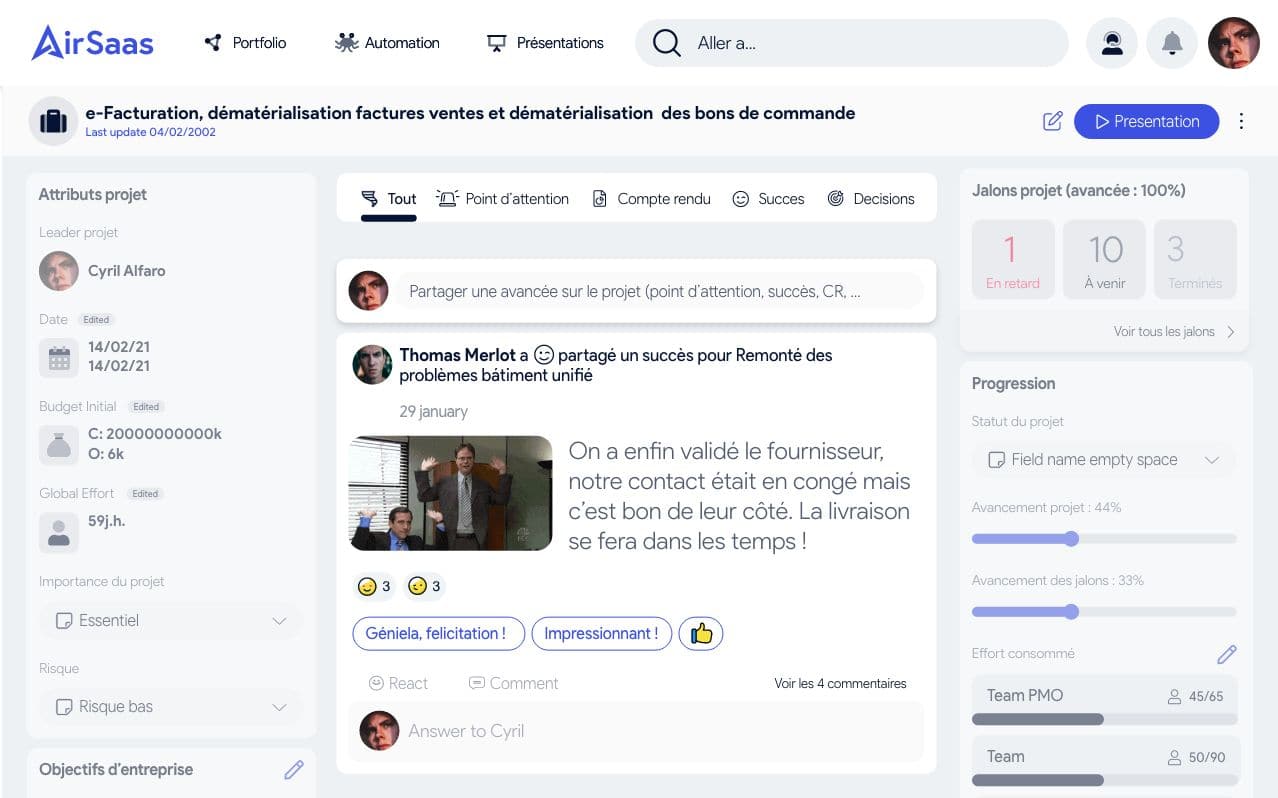
Project management that celebrates every team success
Use every project milestone as a success point. Pull, via the dedicated platforms, the screenshot(s) of the shares written by people other than you: it's even better when it's said by someone other than the PMOs or project managers :-)
The principle behind this practice is the following: "what we focus on grows". This approach, theorized by management consultants, is more than a tip: it's a philosophy. Because focusing a committee's attention on the positive will not only value the work and the project actors involved, but can also help develop a culture centered on the organization's and its management's strengths.
In short: showcase the entire project team, especially the business teams. Without forgetting to recall the key benefits for the end users - the company's customers!
Tip 5: Decide... how to decide
"A company is a collective. You have to accept getting into a rugby scrum and pushing in the same direction! The time you take to align isn't wasted time... it's important that everyone has been able to speak, and understands the choice and the decision that was made."
Establishing or reiterating the governance process is fundamental. It's in a way the algorithm of a project's steering committee. Making sure each committee member understands the methods and phases needed to make decisions is essential for effective management.
Below we recall the equation popularized by Olivier Bas, vice-president of Havas, author, speaker and teacher:

Title of a chapter of the book Like ton job published by Dunod.
The stakes are project decisions that stay shared and inclusive, and that gain in speed!
The upshot: a company steering committee culture radically different from what may be done elsewhere.
Without going into all the details of the implementation (the pros and cons of each will be the subject of a dedicated article on this blog), let's recall that the main decision-making methodologies in business management are:
- Autocratic decision: I decided alone!
- Consultative decision: I listened to you
- Consensus decision: I have a general agreement (tacit or explicit)
- Consent decision: I have an absence of major objection.
Bonus tip: Post the checklist of the project steering committee's role and accountabilities
Beyond the tips, wouldn't the ultimate practice be to keep firmly in mind, and to remind the steering committee if needed, of the framework: the general roles and accountabilities of the steering committee in project management?
Alongside the project manager, its accountabilities are:
- Make decisions and trade-offs regarding the running of the project.
- Ensure the project runs smoothly and check that it is aligned with the company's overall strategies.
- Assess the quality and health of the project at each meeting. If certain issues need improvement, the key stakeholders can raise them so they get resolved.
- Give the project manager the power to act and to use the company's resources to drive execution and the project's progress.
- Resolve conflicts between departments, issues related to budgets and costs, planning, risks, resource management, quality and scope.
- Monitor the project's progress against the agreed objectives and resolve the problems preventing the project from progressing on time.
With this selection of 5 tips + 1, you're set for your project steering committee to become a moment of decisions, a more effective project-management process.
If, however, you're facing a stormy committee and everything falls apart in terms of tensions between two participants, good news: the Transfo Pro Blog has thought of you. Discover how to handle aggressiveness in steering committees? Difficult personalities, how to react to aggressiveness? Discover the 7 tips selected to make your office life easier.

An effective project steering committee will rely on good project reporting
What if you took back control of your project portfolio?
Book a demo and discover the tool in 30 minutes.