June 12, 202214 min readJérôme Dard
How to master steering committee decision-making?

Contents
Ever had projects stall because decisions just weren't made? Or found yourself wondering why a particular decision was ever taken? We all know that in steering committees, decisions can sometimes be hard to reach. We've all got someone in mind who monopolizes the floor for ten minutes. Someone who asks for one specific detail that keeps everyone from discussing the substance.
If you're a regular reader of our blog for transformation pros, you know the equation "a half-decision = double the mess". A formula coined by Olivier Bas, vice-president of Havas, author, speaker and lecturer, in his book Like ton job.
Without clear governance, projects get launched, stopped or extended irrationally. The IT department and the Transformation office sit at the center of this challenge.
Yes: of all the responsibilities of a project steering committee, making sound decisions is probably the hardest. How do you make the right decisions quickly and with strong commitment from all committee members?
In the lines that follow, we'll shed a different light on what's really at play in this type of meeting, along with tips to better handle certain deadlock situations.
Get ready to discover — or revisit — the pros and cons of five possible decision-making methods for your steering committee. You'll also find two traps to avoid and two prerequisites to respect. Real-world project management lessons that can help you pick the method best suited to the decision at hand. And maybe find your way back to a steering committee that's useful and as decisive as possible!
Facilitating strategic decisions: a topic every PMO or project director should work on as part of the overall setup. If that's not the case yet, good news — a quick detour through the article Project steering committee: the basics will serve you well.
When steering committee decisions go wrong: two traps to avoid
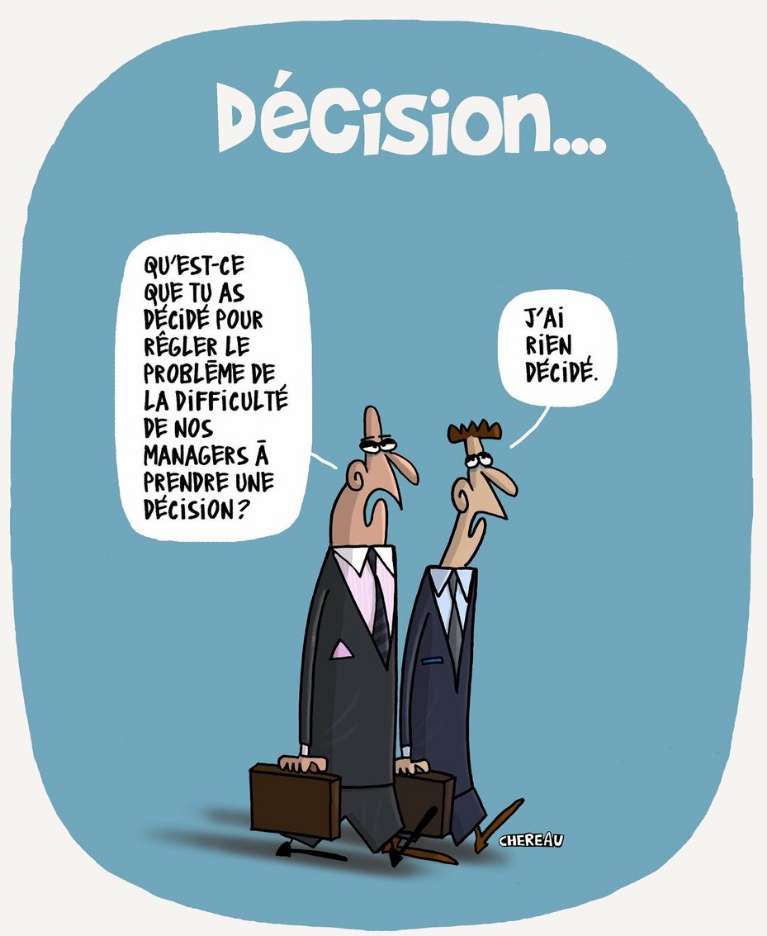
Any resemblance to a project steering committee agenda is purely coincidental. Source: Antoine Chéreau for Courrier Cadres
Lionel M., a former interim CIO we interviewed about his experience with these topics, told us:
I have more experience of non-decisions than the opposite! You often meet without knowing which decisions need to be made. Worse, you sometimes walk out of a steering committee thinking: so what do we actually do? There's a lack of follow-through into action — things aren't said and written down clearly enough. And from one meeting to the next, nobody remembers who decided to do what, who said "go" or not, or why.
We talk a lot about collective intelligence, but far less about its counterpart: collective stupidity! Because here's a conviction: there's no in-between. A bit like with body weight — you gain or you lose. Here, we're either collectively intelligent or collectively stupid. Sorry.
Group polarization in decision-making increases risk
Humans turning into sheep is a phenomenon as old as the world. The group effect on the individual is what psychologists call conformity: when your opinion conflicts with the group's, you tend to align your judgment with the group's. Perfectly normal.
Beyond groupthink conformity, there's a lesser-known "symptom" that's critical in project management: group polarization. It's been shown that group decisions can lead to higher risk-taking than individual ones. The group tends to settle on a more extreme option than the average of everyone's initial positions. This is known as the polarization effect.
It has been identified as a root cause of the failed US-backed Bay of Pigs invasion of Cuba in 1961, and of the explosion of the space shuttle Challenger.
The "HIPPO": a danger for the steering committee
In companies, and especially in project steering committees, many variants can be observed. One of the most disheartening is called the HIPPO effect — an acronym for Highest Paid Person's Opinion. In other words: the opinions of the highest-ranking person among the committee members naturally tend to prevail.
One basic trick to try to counter this bias in a steering committee is to ask the biggest "chief" in the room to speak last in every round of the table. But experience shows that, over time, it's not enough — and often, even when they don't speak, they still express themselves!
Nothing new, serious or irreversible here. That said, now that we've reminded ourselves of this group effect and the main biases, we no longer have any excuse not to improve this process in our project management.
Data access and project authority: two prerequisites for better decisions
Management is the art of making decisions with insufficient information.
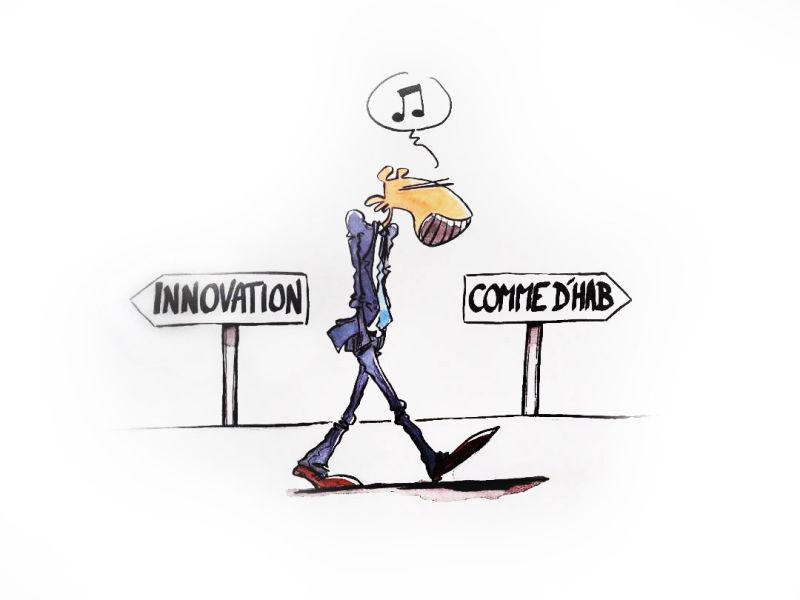
A project manager leaving a steering committee. Image credit: FX Dessinateur
What if you had access to every pending decision and its key history during the meeting?
Before any best practice, the absolute basics: make sure the stakes attached to the decision are fully understood by the stakeholders, the sponsor, the IT and business project managers, and management.
There's nothing worse than having to discover and analyze — live in the meeting — the often complex data behind a strategic choice you're expected to rule on.
On this very issue, here's what the company OCTO Technology learned:
Ludovic Cinquin, CEO of OCTO Technology — one of the companies inspired by Sociocracy 3.0
There are a few topics where we never found a sustainable way of working. The first is the decision log. It may sound anecdotal, but we run into it regularly. Even though most of our governance bodies produce minutes where debates, actions and decisions are recorded, combing through them to find all the decisions that were made is tedious — especially on topics (and there are many) that come around every year. And the rationale behind decisions (probably the most important part) isn't always clearly recorded either. A centralized log accessible to everyone would probably be a good idea, but despite a few attempts, we never managed to anchor the habit. "Devenir une entreprise agile - Les leçons de 20 ans de transformation"
Building agile and/or effective governance isn't something you improvise alone. Software is now our ally to objectify and facilitate trade-offs. Organizational coaches say it themselves: these platforms are a must have!
Project leads must be able to surface the decisions to be made in a simple, concise and precise way to keep the project moving.
And internal clients, sponsors, steering committee and/or executive committee members, etc. must be able to make decisions within the allotted time so as not to delay project execution and delivery.
For management, it's often hard to get a clear view of all the decisions to be made, with concise, precise context. And a posteriori, it's hard to retrieve the history of the project's important decisions (formalized or not). Hard, too, to understand how you got there.
Using a platform will simplify your governance (list of pending decisions, steering committee view, etc.). You'll no longer be caught off guard because you don't have the right information.
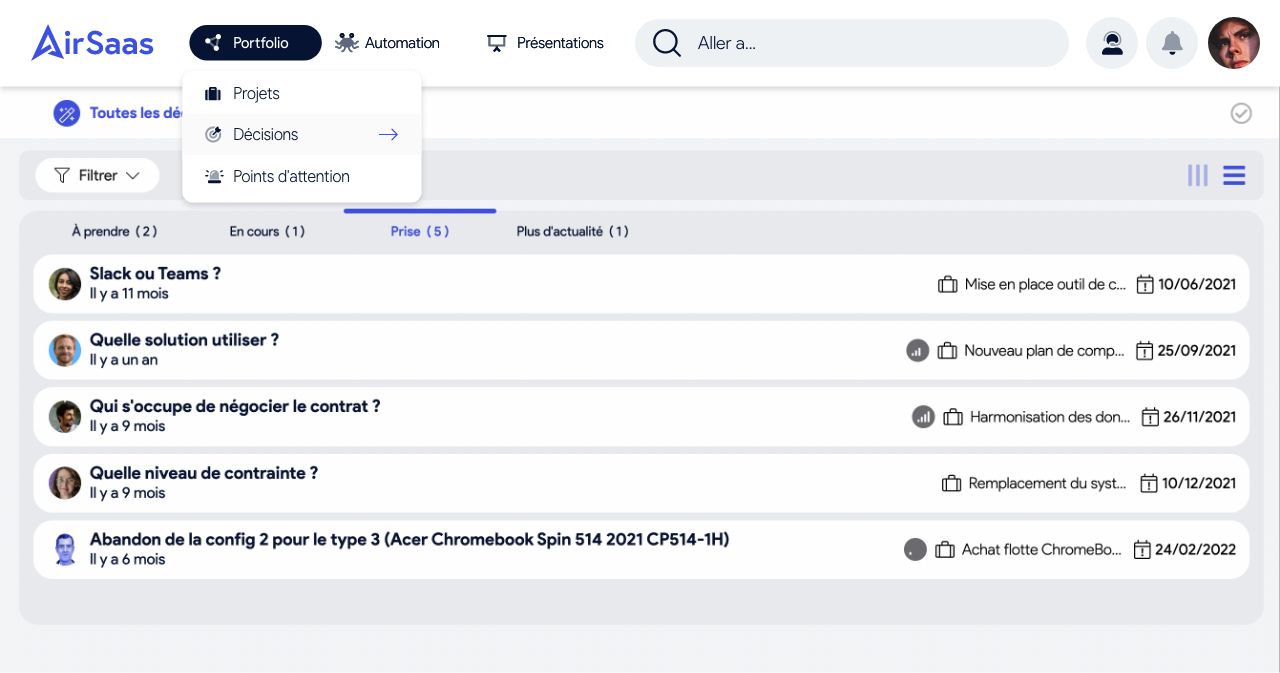
Filter the decisions that concern you, the most important ones, the overdue ones...
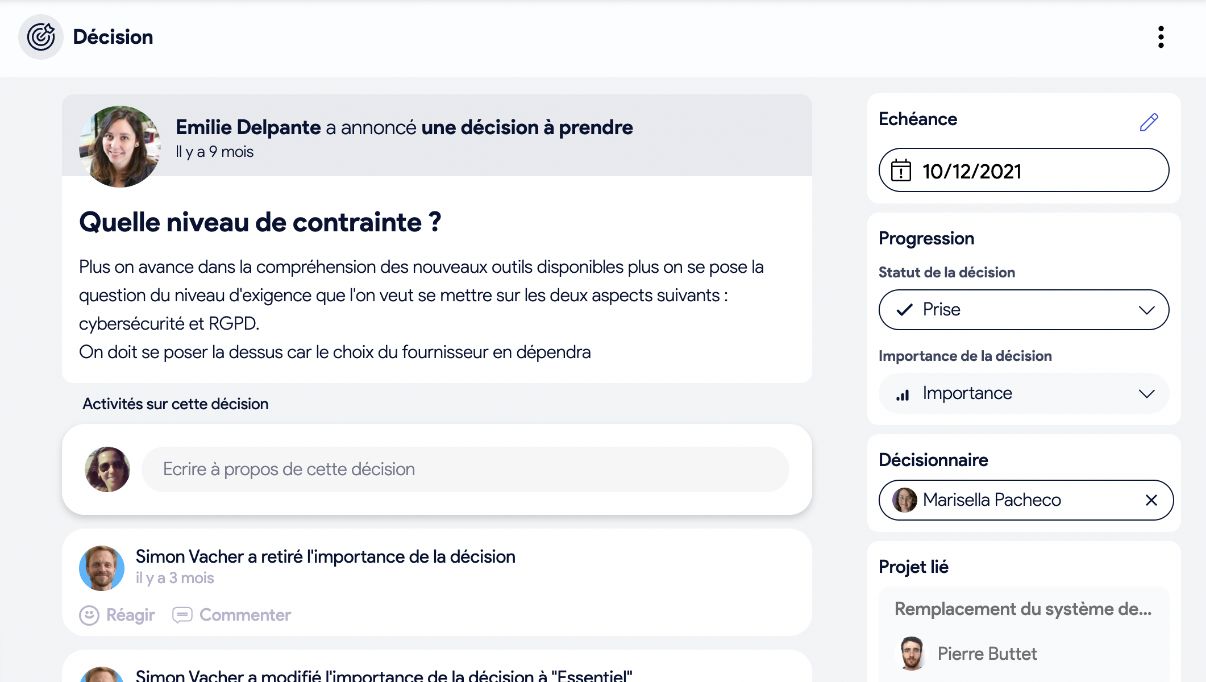
And above all, access the history of exchanges around a decision — and its context — in one click.
Every decision has a status (under review / in progress / made / no longer relevant). Once created, each decision gets its own page where you can post, comment, change the decision's attributes, and find the related project.
A decision Kanban: it's a game changer!
Define the criteria of authority in the project to make co-steering work
You have access to the data. Great! The second prerequisite is to set the framework and the limits of each team's, body's and stakeholder's power. "Good fences make good neighbors."
Broadly speaking, the three main accountabilities of a steering committee are to make decisions and trade-offs, ensure the project runs smoothly and make sure it stays aligned with the company's overall strategies. Not to decide everything! Yet we've all seen a steering committee busy with the website's color scheme instead of trying to resolve conflicts between departments, or actually giving the project manager the power to act and to use the company's resources, for example.
To defuse the steering committee's natural tendency to meddle in what's none of its business, pay close attention to the boundaries of authority in the project, and to each body's role and accountabilities. Executive committee, steering committee, IT project manager, sponsor, business project manager... your project governance deserves a clear design!
Concretely, the idea is to charter responsibilities. Alongside the project RACI, you can for instance set key criteria to define who decides on what. One example: a budget waterline above which the steering committee is consulted and decides. Below it, subsidiarity applies. And above all: once the principle is set, you'll back your teams' choices whatever they are. Because let's remember: 8 times out of 10, it will be just fine! Initiative-taking will genuinely be encouraged.
Deciding how to decide: 5 decision-making methods for your steering committee
As numerous research findings have shown, individuals accept and commit to decisions made by the group (authorities or governing bodies), even when those decisions go against them, as long as they believe in the "value of the group". In other words, as long as they feel they're dealing with honest, upright and competent people. Social trust, however, is never fully won. It depends, among other things, on information about how the group proceeded to reach the decision. Groupe et décisions collectives, by Ewa Drozda-Senkowska, François Ric and Dominique Muller.
Below we've consolidated 5 approaches, from the most authoritative and fastest to the slowest and most consensual. A tour of the different governance approaches for a corporate project.
Authoritative: "I've decided!"
- What it is: a fast decision based on the principle of authority domains. Each member of the organization has authority over certain aspects of the business. They may — or may not — ask the committee and stakeholders for input before ruling.
- Pros: speed. The project manager has authority over a series of domains.
- Cons: you can be a powerful locomotive for the project... with no team wagons attached. Alone you go faster, together you go further, as the saying goes.
- Our take: as you read above, the group effect can sometimes be toxic. Used wisely, this project governance method can prove the most effective — even if it's not the most popular in meetings.
Consultative: "I heard you"
- What it is: seeking the group's input, in writing and/or orally.
- Pros: if group cohesion is good and people speak freely, this decision method gives the decision-maker useful, challenging and well-meaning input.
- Cons: you can be consulted yet not heard. Stakeholders are asked to weigh in on complex topics. Sometimes rhetoric and politics win out. Many biases can creep in (polarization, the HIPPO effect, sampling bias...).
- Our take: probably the most used in steering and executive committees. This process gives everyone's ego plenty of room throughout the project life cycle.
Majority: "the votes are in!"
- What it is: a majority or unanimity vote.
- Pros: a form of project democracy.
- Cons: much like in politics, this voting system can breed frustration. If a decision passes with 51% in favor, 49% of the group were against it and will have to live with the decision.
- Our advice: voting sits halfway between the excesses of authority and consensus. If the various group-effect biases are avoided, voting can prove a modern, engaging practice in committee meetings.
Apparent consensus: when everyone says "yes"
- What it is: tacit or explicit agreement. A group manages to choose without resorting to a vote.
- Pros: there's plenty of discussion, and every point of view is respected.
- Cons: the longest and hardest process. Winning over every stakeholder, every committee member, can become an endless quest for the project manager. Worse: the initial idea too often gets modified and distorted. Implementing the steering committee's decision becomes counterproductive compared to the original intent.
- Our take: the least advisable of the decision-making methods — in particular because the successive amendments to the initial idea create distortion.
Consent: when nobody says "no"
- What it is: you decide by making sure a proposal raises no serious objection, rather than trying to please everyone and sliding into soft consensus. As the saying goes: "better firm and sure than soft and vague!"
- Pros: you don't devalue the proposer's idea by chasing consensus. Decision-making that's agile by nature. Egos stay in check, and dedicated speaking time lets everyone "question" and react.
- Limits: the main one is participants' good faith. Also beware: if too many "operational" decisions go through consent, it can become time-consuming and limit project team members' autonomy within their roles and authority domains.
- Our advice: try consent with a facilitator the first time, ideally. Agile methods and governance models inspired by liberated companies and holacracy have long used this decision-making method.
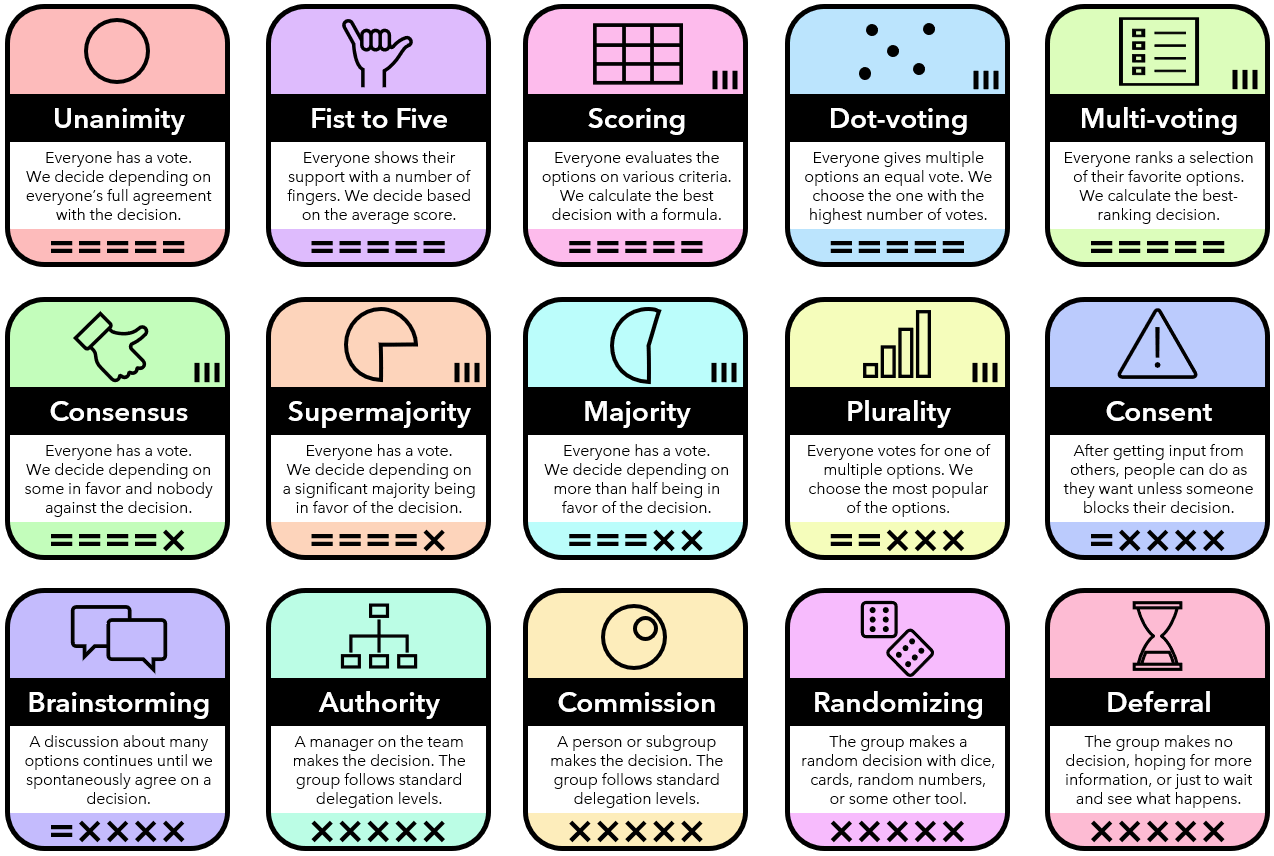
Overview of decision-making methods for self-organized teams - Source: Jurgen Appelo, Management 3.0
A checklist for durable steering committee decision-making
A tip to avoid one person's 10-minute monopoly: start with uninterrupted speaking turns. Then, keep the steering committee to around 10 members... Otherwise, plan a committee with 2-3 decisions to make. If the company culture is very top-down rather than collegial, identify only the one or two actual decision-makers. To avoid the "we don't have enough information, we can't decide" effect, the decision appendices must have been sent in advance and (for project decisions) a consensus or the 2 alternatives prepared. And finally, above all, make the question(s) explicit — and don't move on to something else until you have the answer.
Your steering committee deserves a clear decision protocol
- Examine the problem. There's only a choice if the problem offers several possibilities. Prepare several choice scenarios, several project options. This is when you'll decide on the most suitable decision-making method, based on the time constraints and the level of commitment you're aiming for.
- Weigh the pros and cons — the value/risk ratio (for the project, not for yourself!) of each option. Seeing clearly through all your data lets you decide with "full awareness". Making sure every committee member understands the methods and steps needed to make decisions is essential to effective management.
- Choose. This is the key step — the one that pushes us toward one solution by giving up the others. Rather than giving up, let's accept that "to choose is to move forward!" Moving forward by accepting you can't have everything, stepping out of the committee's omnipotence, taking a risk and owning its consequences. With the deep conviction that the choice we're making is the best of the available options.
- Track execution and implementation. This is the step where we truly own our choice. You know it: the Devil — and God — are in the details. That American architect's proverb should be engraved on the cover page of every one of your PowerPoints.
- And what if you didn't decide? Recording the committee's non-decisions matters just as much. Write it down, formally: "The steering committee has decided not to decide. The project will be blocked on this axis." Every project manager knows it: "What isn't written down doesn't exist."
One last word: behavior is created by the frame! Act on governance, and better project management will follow.
You now hold all the cards to better handle situations of indecision. To go further and finish upgrading your next steering committee, we recommend reading this article: How to prepare a steering committee well? Because yes: it's all in the preparation! The article to read to strengthen your prep: setting objectives, interactions with the sponsor, the place of personal interests, handling risks and disagreements beforehand...
A company is a collective. You have to accept forming a rugby pack and pushing in the same direction! The time spent aligning isn't wasted time... it matters that everyone got to speak... and understands the choice and the decision that was made.
What if you took back control of your project portfolio?
Book a demo and discover the tool in 30 minutes.