September 30, 202211 min readJérôme Dard
Why develop project portfolio management in an SME?

Contents
SMEs have the same digital transformation expectations as mid-sized companies and large corporations — with one key difference: their resources and budgets are smaller, and in-house skills are sometimes less clearly identified or dedicated.
Digital acceleration is here, and it is now vital to equip yourself to steer and ride this wave with something other than an Excel spreadsheet and a PowerPoint presentation!
A move to standardize project steering, supported by a platform, can prove a smart choice.
According to INSEE, in 2022 SMEs accounted for 3.8% of companies in France — around 144,400 SMEs in total. Large and mid-sized companies made up only 0.2% of French companies, i.e. 7,600 companies in all.
SMEs truly are the backbone of the French economy.
And here is the good news: project portfolio management is not reserved for mid-caps and large accounts!
Project portfolio management: definition and use cases
Portfolio management — also known as "Project Portfolio Management" or PPM — is defined by Wikipedia as "the discipline dealing with projects taken from a global point of view, for the purposes of selection and trade-offs".
While project management is about "doing projects right" — the operational side — project portfolio management is about "doing the right projects" — the decision-making side.
You have to go back to fundamentals: question the business, the business constraints, where flexibility is really needed, and so on. So you can properly list all the expectations, classify them and prioritize them — in order to see clearly.
The functional coverage of the software platforms that support project portfolio practices varies from vendor to vendor; it can include:
- Time management
- Resource management
- Project management
- Budget management
- Decision management
- Unified reporting
- Project portfolio management
- Incoming request management
- Collaboration management
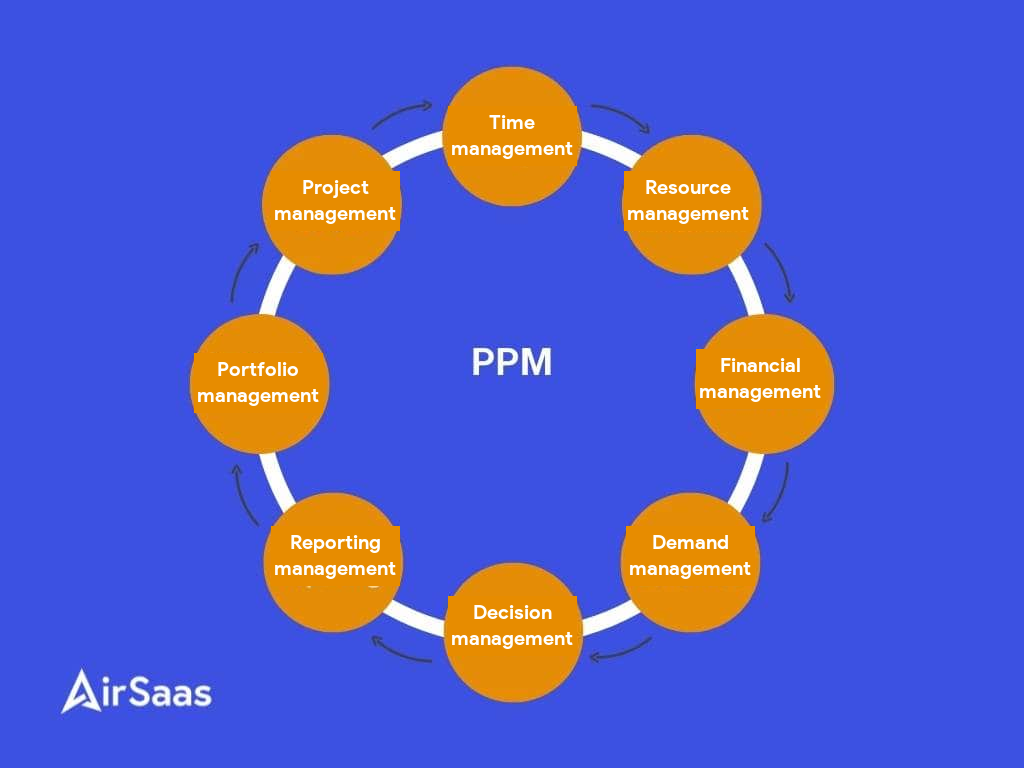
Functional / product coverage of project portfolio management solutions
Much like the ERPs of the 2000s/2010s, some solutions are very — even too — broad... however tempting the "all-in-one" promise may be. Watch out for adoption and change management in your rollout. Paradoxically, feature sprawl and a dense software menu are a sign of future problems once the tool is used across the company.
In the lines that follow, we tell you more about what this covers and share a pragmatic strategy for implementing a project portfolio management solution effectively in your SME.
Managing a project portfolio in an SME: what benefits, and for whom?
Closing the gap between vision and execution. And tracking all your initiatives in one place. That is the promise of project portfolio management practices and tools!
In an SME, you sit halfway between operational needs and strategic needs. You have to be able to do the splits every single day.
With a platform like AirSaas inside your company, you will benefit from five key advantages:
- Project charters — collaborative and consistent
- Automatic, decision-ready reports
- Focus on decision-making and attention points
- Steering by milestones
- Project reviews in a single platform.
Indeed, one consequence of the accelerating digital transition is a growing flow of initiatives and projects.
Tracking your workstreams and project management with an Excel spreadsheet is no longer an option!
To track your investments and your strategic objectives, modern project portfolio management can help you define a clear scope of initiatives AND execution.
If you don't run this prioritization exercise based on payback, you can end up spending quite a lot of money on digital transformation for projects with little business impact on the company. The idea is to have each department surface its projects, then prioritize them according to the payback they can represent for the company.
The goal is very much to concentrate and prioritize your efforts! Otherwise you risk sliding not into process agility, but into agitation and non-prioritization.
Modern Project Portfolio Management tools therefore sit at both the strategic and operational levels of your organization.
It is precisely on these two axes that implementing a project portfolio management tool will bring you added value and benefits, both direct and indirect:
- More transparency in how things run
- A clear, single framework for tracking the progress of initiatives
- Capitalizing on the projects you run, from framing to execution through to the project review
- A Kanban of pending decisions, driving new efficiency in how you govern your organization's transformation
- Effortlessly spreading a strong project culture across the whole company
- And finally, more enjoyment day to day: say goodbye to your 1,200-column Excel today!
And it may be for you, SME managers and executives, that pragmatism matters most! No need to read yet another white paper: just get started.
The project portfolio approach in SMEs: a lever for engagement and business
The most-cited failure factor for cross-functional projects that fail to deliver the expected results is the lack of alignment and communication between IT, business teams and the leadership team.
To put it simply: without transparency, there is no engagement.
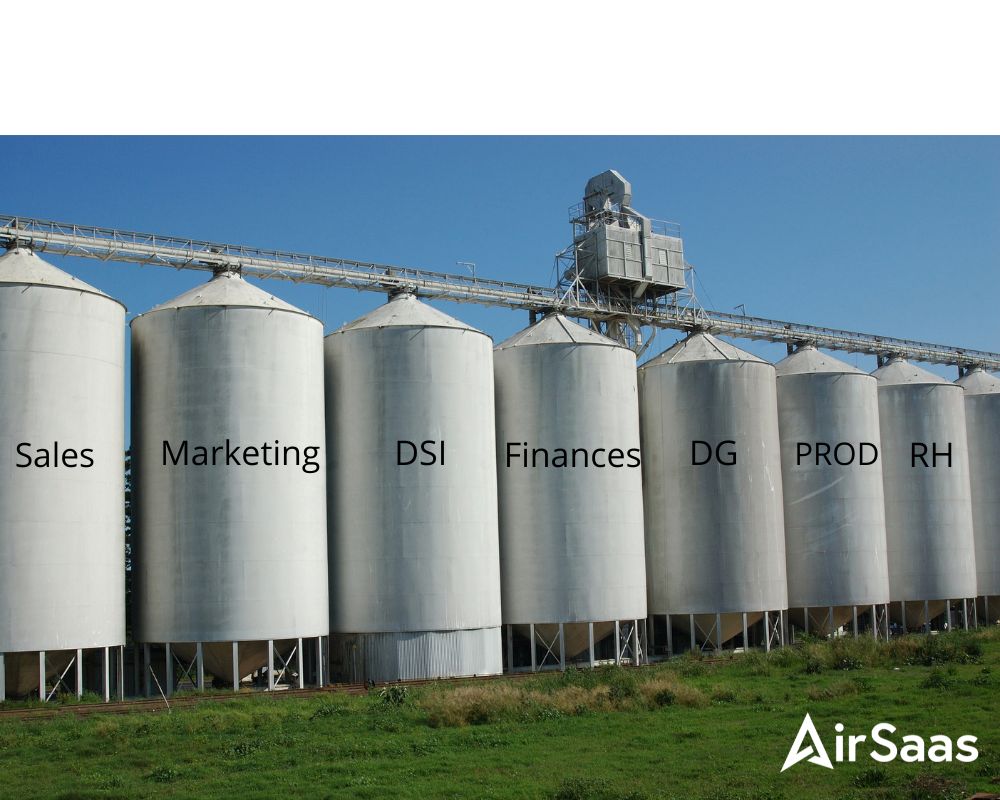
A set of organizational silos — the number is not representative :)
AirSaas was built on that very observation, and on the desire to help mid-sized companies and SMEs work "cross-silo" both horizontally (IT — business teams) and vertically (project managers — PMO — leadership).
One essential point in transformation is communication. You can never communicate enough — at least not in a targeted, effective way. Transformation is something that can frighten people. If you don't communicate, projects can be perceived as a threat: "Uh-oh, they're going to replace my job." It's key to the success and adoption of change. When you communicate continuously on topics, everyone has the chance to react. That creates a dialogue that is very healthy for the success of structural changes like the ones we're driving.
You have a company strategy? That's all you need to get started with AirSaas!
Three work areas will then need to be addressed to bring about more cooperative project management — the kind that generates performance, versus an "over-control" mode meant to keep activities from drifting.
Strengthen meaning and vision
Build good storytelling around your transformation programs / strategic axes. For example: "the 2022 commercial excellence program (CRM project, behavioral analytics project, predictive analytics project, website project...) must take us into the European top 3". Otherwise, after a few months the projects will lose their meaning, and the teams' lack of motivation will quickly be felt.
Redefine the roles and accountabilities of your people
What is a sponsor? A project manager? A business lead? What are everyone's rights and duties in project management? Without rules of the game, no one will be accountable for anything.
Evolve the rituals and communication around project tracking
For example:
- Every Tuesday, a project manager + business lead meeting — 5 minutes per project: decisions to make, attention points
- Every Friday, send the flash report to all stakeholders
- Every month, a steering committee on next month's stakes, with alignment on available business-team time
With this strategic approach and a modern project portfolio management software, you will be better placed to evaluate the projects that contribute to your strategy AND deliver the targeted objectives and results in an engaging, cooperative way.
Digitalizing the SME project portfolio approach to innovate despite limited resources
Is project portfolio management reserved for large companies? Certainly not! On the contrary, SMEs can sometimes play their hand even better. Why? Because they are intrinsically more agile — and sometimes, let's say it, more motivated — than a mid-sized company or a large group.
Yes: an SME's decision cycle is generally different from that of a mid-sized company or a large group. Most organizational silos have not yet become entrenched.
The first piece of advice I could give an SME executive is to identify their value drivers. How can we create value through digital?
You don't have resources or skills available to work on transformation? All the better. You can absolutely build a strong project culture by leaning on tools and a method. Platforms will provide valuable assistance in steering.
The parallel with the electric bike is spot on! Yes: even in an environment constrained by a lack of time and resources, adding a motor to your project steering is possible.
Beyond your "tooling", steering remains a major challenge. Another possible route is to bring in a fractional PMO/CDIO/CIO.
SMEs have two options. They can hire a heavyweight CIO, built for the job, who will get bored because there aren't enough projects to steer. Or they can bring in a younger IT manager they'll grow with the company — but by the time they become CIO, they are far too deep in the operational side. Our goal is to offer a third option: supporting these CIOs one or two days a week.
Conclusions & recommendations
SMEs: 10 key criteria for choosing your PPM tool
1. Interface design
For genuine adoption by everyday users, this is criterion number 1! Go for a "light" solution versus the "obese" all-in-one project-ERP suite.
2. Innovative key features
If you need to get started quickly, steer clear of solutions with an overly broad functional footprint. Aim for the fundamentals of PPM plus a few key automations — for example, standardized one-click reporting.
3. The collaborative dimension of the solution
Across the project life cycle, how are interactions between cross-functional players designed? The software that stands out notably strengthens both synchronous and asynchronous collaboration.
4. The vision and philosophy behind the tool
As methods evolve toward ever more hybrid blends of agile and waterfall, you will need a flexible take on the methodological canvas the tool proposes. Today, everything is a project — from 3 days to 3 years...
5. The openness of the solution
Stop wasting time re-entering data. Modern PPM platforms are designed as true "hubs" that let the applications already in place across your organization talk to each other. Whether with your project management tools (Wrike, Jira, Asana, Trello) or your communication tools (Teams, for example), AirSaas brings your project data together in one dashboard.
6. GDPR and Cloud Act compliance
This point is no small detail in project management. And it is too often forgotten during pre-sales.
7. Reversibility
It can be costly — or even impossible. This point is no small detail either, and it too is often forgotten. Our advice: ask vendors about their practices and run a "rollback" test (data export) before signing the contract.
8. Security
A check by your CISO can confirm everything is in place to identify and protect access to strategic data. Encrypt the data where possible for a little extra peace of mind.
9. The price of every license type and of the set-up pack
Not just the sticker price of active-user licenses, but also the price of licenses for secondary profiles, such as business ambassadors.
10. The vendor and its user community
Last but not least of the 10 criteria: the people behind the tool. What support, what advice and what relationship does the vendor offer before, during and after the sale? Do they run a user community? What market vision do they carry? How do they communicate about their roadmap?
PPM: prerequisites and tips for getting started in an SME
- Identify and select a few PPM platforms — not only via directories like Capterra: they have blind spots. Ask your network too!
- Shortlist 2 to 3 tools,
- Contact the vendors for an RFI (Request for Information)
- Set your priority criteria from those proposed and from your organizational context
- Ask vendors for internal or external integrator contacts: avoid going it alone as much as possible, without the support of a general facilitator.
- Create a pilot group of project managers / business leads / a sponsor you already work well with, and who want to change their project approach.
- For this kind of rollout, favor a progressive approach to start with — a positive implementation tactic on a small number of projects so it can spread organically toward company-wide use.
- Set yourself limits! Pulling off a cultural and governance transition is a challenge worth taking on... but at the right pace!
The takeaway: developing project portfolios in an SME can smooth your digital, environmental and organizational transitions. For better strategic alignment, more efficiency... and more enjoyment too!
What if you took back control of your project portfolio?
Book a demo and discover the tool in 30 minutes.