October 8, 20216 min readBertran Ruiz
Kanban project management: the method to optimize your project tracking


Contents
The tracking of a project is often done with tools that give you a big-picture view (like a Gantt chart, for example), but sometimes you need to dive deeper into the details.
Kanban is one of the best tools for that — and on top of it, it's an excellent communication aid for your team meetings!
Here's how to actually use Kanban in your project management.
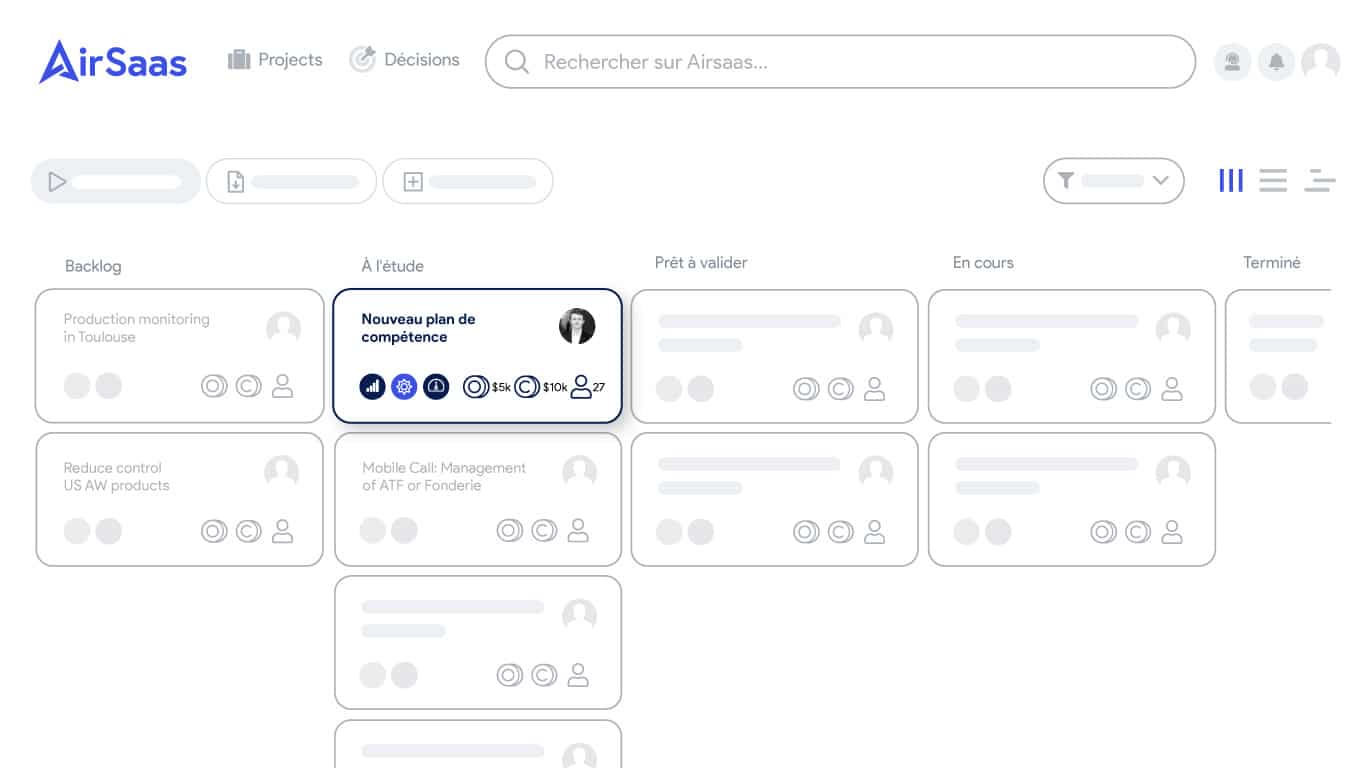
Project Kanban
What is the Kanban method?
Kanban is a tool that comes from lean manufacturing. The original purpose of Kanban systems was to enable just-in-time production and to keep production balanced with demand.
The name Kanban comes from Japanese: it means "card" or "label". More precisely, it was the card used to tell a production station whether it should keep producing or rather stop. The goal was to limit surplus parts relative to customer demand and thus reduce waste — especially when a defect had been detected on a batch of parts.
Today, Kanban is widely used as one of the flagship methodologies of agile project management — but its use isn't limited to IT projects. Any project manager, whatever their field, can use this highly functional, collaborative tool to track project progress.
The Kanban method relies on a system of concise cards that let every team member know:
- Which tasks need to be done
- When they need to be done
- What has already been done
Kanban is therefore the perfect tool to keep every task a team is responsible for in plain sight, and to let each member coordinate their efforts to maximize productivity.
It's also a visually compelling tool: at a glance, everyone can see how the team's tasks are organized at any given moment. Kanban thus optimizes communication and the smooth flow of information about the tasks at hand across your teams.
To make things even easier to read, Kanban boards are usually divided into three sections:
- Tasks "to do"
- Tasks "in progress"
- Tasks "done"
Each status is often color-coded, so everyone can see what they need to do and what's already done in just a few seconds.
The Kanban board sometimes includes a space where every team member — and sometimes even clients — can suggest ideas for the project. The team can then pick up these ideas and integrate them into the project if they're deemed relevant.
In short, Kanban is widely considered a far more effective project management tool than traditional boards and to-do lists, and adopting it day to day brings many benefits.
Why use Kanban in project management?
Using Kanban in project management has many advantages that should convince you to adopt this tool.
Here are a few of them.
- Shorter lead times and lower costs: thanks to better communication and more effective prioritization of the tasks at hand.
- Better visibility into project execution: you can check the status of every single task in a matter of seconds.
- Greater flexibility for your team: fine-grained visibility into what everyone has to do makes it easier to change course when something unexpected happens — for example, when your client's needs evolve.
- Fewer bottlenecks: since everyone knows what the others have to do and by when, the risk of being blocked by a colleague's unfinished task is considerably reduced.
- A tool for corrective collaboration: team members are encouraged to communicate and solve problems as soon as they appear.
- Better quality: the Kanban project management method helps maintain a consistent level of quality — and to do so collectively.
- Simpler continuous improvement: being able to easily visualize how your team works lets you constantly reflect on areas for improvement.
- More flexibility in execution: changing priorities, reassigning a task owner, or simply shifting deadlines becomes easier.
- Visual management: every member of your team has the same level of information (progress, constraints, everyone's difficulties…). By giving them a global view of execution, you fully integrate your team into the project — and people feel all the more involved.
- An intuitive method: the Kanban method is easy to use and therefore quick to set up. On top of that, the benefits are almost immediate.
- A motivation boost for your teams: one of the main reasons a team loses motivation is having to handle a task that feels too big — insurmountable. The Kanban method is ideal for breaking any project down into a set of small, achievable tasks. This proven trick helps you keep people motivated, all the more so when each task is assigned to an owner.
- A great meeting aid: the Kanban board is a presentation aid for your team meetings. It's particularly useful for the daily check-ins at the start of the day.
Physical Kanban vs. digital Kanban
Kanban boards can be used in digital or physical form, and each has its advantages. Here are a few to help you make your choice.
The advantages of a physical Kanban
Some teams (notably software development teams) choose to set up a physical Kanban board in the company's offices, to spur people on during their agile sprints. This format has a few advantages:
Always-on visibility: a physical board is "always on", so everyone has what's left to do right under their nose.
Engaging your teams: a physical board is colorful, adds a friendly touch to your office and has an impact on your teams' involvement.
Encouraging communication: the physical board provides a ready-made spot for conversation and reflection. Your team members can talk things through with the board as their support.
The advantages of a digital Kanban
Easier to keep tidy: forget illegible handwriting and sticky notes that fall off.
Traceability over time: no sticky note gets thrown away without being archived, and you have visibility into every task throughout your project's execution.
Accessibility: everyone can access the board, at the same time, wherever they are. That's particularly handy when you collaborate with freelancers or remote colleagues.
Real-time updates: every member of your team sees up-to-date information on their board, with no delay and no need to brief them to keep them posted.
Centralized information: all the information relevant to a task can easily be attached to the board (attachments, long descriptions, etc.).
Stronger security: you never lose a sticky note, and apps often provide authentication processes that keep confidential information protected.
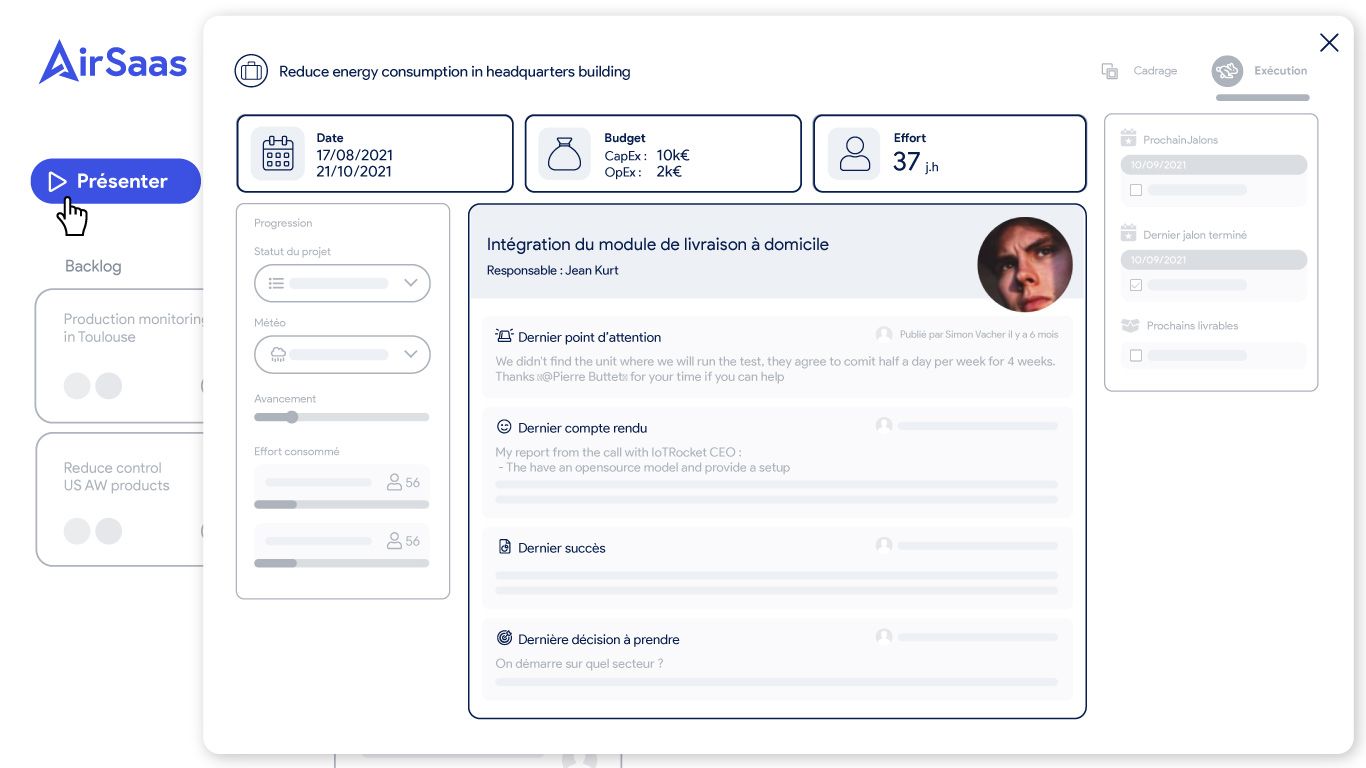
Switch from the Kanban to the project one-pager in one click
Kanban as an intermediate communication tool
Kanban is therefore an effective method to involve your team and keep detailed track of your project's execution. It's important to understand, however, that depending on the situation, Kanban is sometimes too detailed — and sometimes not detailed enough.
For example, if you're running a project review to validate moving on to the next phase of your project, the Kanban will serve as a springboard for your discussions — you'll inevitably have to go deeper into the details as you talk, but it's a good support for the debate.
Conversely, if you want someone who doesn't know your project to grasp its broad outlines very quickly, the Kanban may be a slightly too granular medium for them. Point them instead to the project one-pager, which is a more concise format and therefore ideal for people outside the project.
Now that you understand Kanban's limits, you can unlock its full potential by using it in the situations where it fits best!
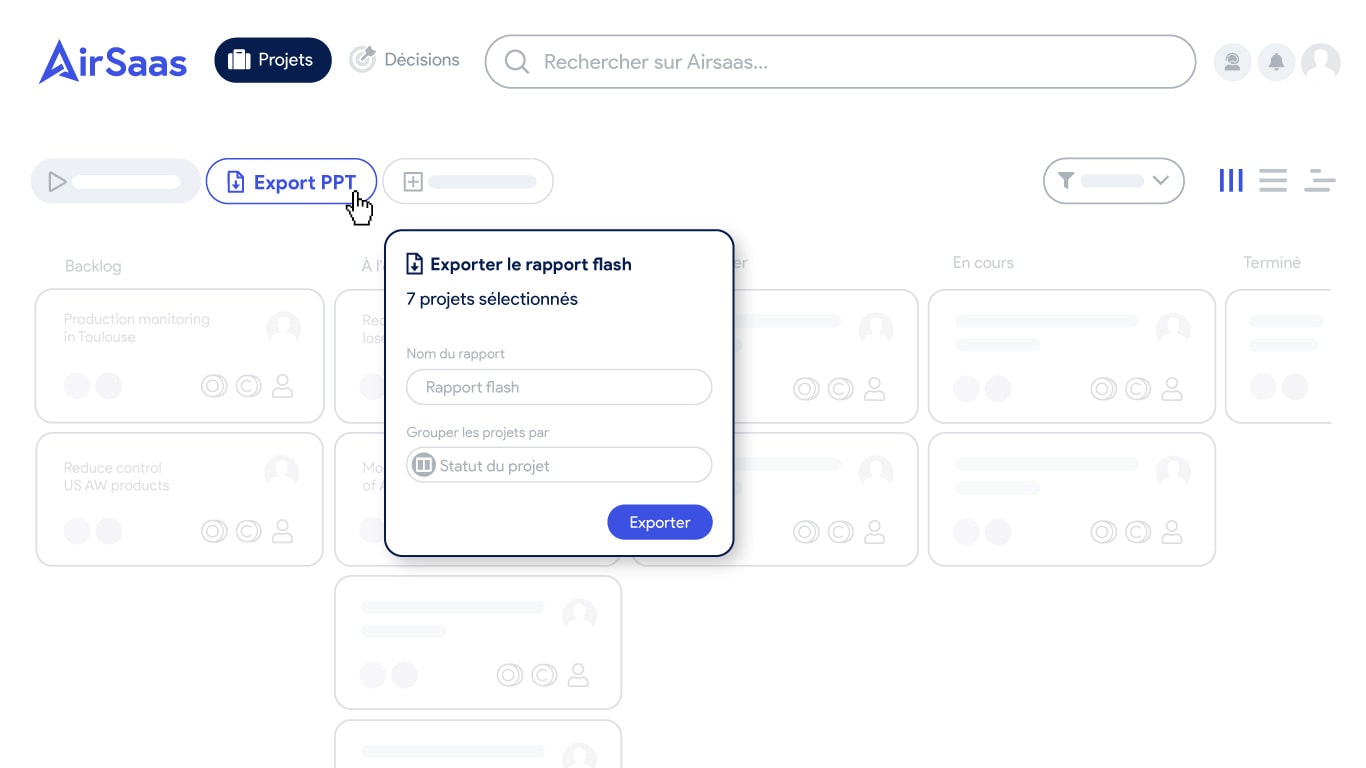
Export your project one-pager in one click
What if you took back control of your project portfolio?
Book a demo and discover the tool in 30 minutes.