

Contents
Capacity Planning: definition and key concepts
As a CIO or PMO, you juggle a large portfolio of projects on a daily basis, in which you have to manage both ongoing projects and incoming requests.
However, no matter how much you plan the available resources, prioritize the various projects, align the teams… demand keeps pouring in, and your entire schedule ends up falling apart.
What if one of the answers to this daily challenge came down to two words: Capacity Planning?
In this article, discover a clear definition of Capacity Planning, as well as its basic principles to start managing the capacity of your resources with the greatest care.
The definition of Capacity Planning is simple. It is a method for assessing, planning and managing the resources needed to meet an organization's needs over a given upcoming period. It is also known as capacity management.
The main objective of Capacity Planning is to align the capacity available in the company with the demand you have collected. Thanks to this approach, you prioritize your projects strategically, launching the right initiatives, at the right time, and with the right resources.
So, with a well-crafted Capacity Planning, you can answer questions like:
- Could we take on more projects next quarter?
- Should we recruit?
- How much overload are we willing to accept?
In this sense, this method is ideal for organizations that have to manage a large portfolio of projects, and that need to find the balance between the company's strategy and the reality of what it can achieve over a given time. The good news: it is possible to do Capacity Planning for any sector of activity — IT, retail, industry… — or any type of project: an IT project, a headquarters move, the implementation of a new HR process…
At Airsaas, we generally focus on human resources — the most complex element to manage in a capacity plan, at a time when the majority of business transformation projects are cross-functional.
Why is Capacity Planning valuable for your business?
To optimize your resources
Thanks to Capacity Planning, you allocate your available resources better according to the company's priorities, and thus avoid waste.
To give your projects a better chance of success
How many projects have you already had to abandon, and how many projects slip from month to month for lack of sufficient resources, or of a good prioritization of initiatives? Your Capacity Planning gives you a global vision of resources over the coming period, which helps limit delays on your projects.
To prepare for changes in demand or unexpected events
By forecasting team workloads, you can anticipate bottlenecks or, conversely, the recruitment or outsourcing needs you might have to move your projects forward.
For better alignment with the company's strategy
To design a Capacity Planning that holds up, you necessarily have to prioritize the resources to allocate to the various projects. This methodology invites you to prioritize the progress of projects based on your company's strategic objectives — your leadership will love it!
To optimize your costs
Your Capacity Planning lets you predict what budget should be allocated to each project or each team, and therefore anticipate upcoming costs. Enjoy better overall budget management.
To improve the productivity and profitability of your teams
As a consequence of all the previous benefits: better anticipation makes it possible to better distribute the tasks and deliverables to be carried out, and therefore to optimize everyone's productivity.
To improve relationships between your stakeholders
Thanks to your Capacity Planning, all your stakeholders, from leadership to employees across all teams, are more satisfied with the way you manage projects.
On the one hand, you improve your skills management by assigning the right tasks to the right resources. The result: teams no longer face work overload, and are valued more according to their real skills. Enough to make your employee satisfaction blossom.
On the other side (that of the end customers), you deliver the expected product or service as quickly as possible. And since it is produced with the best available resources, its quality is optimal.
And for IT teams, no more constant chasing to launch that project — so important to the business teams — that you keep putting off because you couldn't prioritize it in the roadmap!
You now know the definition of Capacity Planning, and its benefits. So where do you start to deploy it in your company?
The basic principles of Capacity Planning
Assess current capacity
First of all, you need to identify your company's current capacity in terms of human skills — the bandwidth that can be devoted to projects.
This step requires you to have a precise vision of the current use of these resources, on planned or ongoing projects, as well as on the daily work outside those projects.
When doing your Capacity Planning, you will quickly notice that the most complex element to manage is estimating the workload available for each individual — and therefore the time they will be able to spend on projects.
When you analyze your team's bandwidth, identify everyone's recurring tasks and group them into dedicated blocks of time, such as half-days. This approach concentrates effort and improves efficiency, rather than simply spreading tasks as they come, or managing by percentage of availability.
At this stage, you can also spot the bottlenecks already present in projects, which Capacity Planning will help solve.
Predicting future demand
In a second phase, the objective is to identify the projects that will need resources in the future, over a given period, and to estimate the resources that should be dedicated to them.
To do this, rely on the vision of the overall company strategy, and on the projects that are being framed or still at the discussion stage. This vision guides the prioritization of projects in your portfolio: it is what justifies assigning certain resources to a given project first. We know: it's easier said than done, but that's the goal!
Historical data on past projects is often difficult to obtain (unless you already have Airsaas in place, of course). But a key point for a good Capacity Planning is to analyze the overall pace of the organization and that of each specific area — HR, finance, IT, operations, etc.
Each function has cycles and constraints that directly influence the time available for projects. For example:
- HR: intense periods during recruitment campaigns or annual reviews.
- Finance: heavy mobilization at the end of the quarter and during accounting closings.
- IT: peaks of activity during production releases or security audits.
If you don't take these natural rhythms into account, you risk assigning unrealistic workloads to teams, leading to delays and a loss of efficiency. By understanding these variations, you can better anticipate actual availability and plan projects accordingly.
To dig deeper into the subject, check out our article "Demand planning and Capacity Planning: what are the differences?".
Aligning capacity and demand
At this stage, you get to the heart of Capacity Planning: you must align capacity and demand based on the strategic objectives of your organization.
To do this, you have several strategies in your arsenal:
- Increase capacity, by identifying the upcoming or necessary resources to add. Plan additional recruitment, or think about upskilling certain employees on a subject you might need in the coming period
- Adjust demand, by prioritizing projects over time, based on their strategic impact on the organization.
- Adjust capacity and demand in a tailored way, based on priority projects and the skills at your disposal.
In any case, with a very large project portfolio, be ready: this alignment between capacity and demand will often require negotiation with business teams and leadership. The good practice: align everyone on the priorities to set, using methodologies like PI Planning or the Quarter Plan.
These methods require moving from planning over a short period (by week or month) to projecting over a longer one, such as the quarter, the semester or the Program Increment (PI). By doing so, you make sure you create a capacity plan suited to the scale of your organization and to the cross-functional nature of your projects.
And remember that the whole art of Capacity Planning lies in setting up planning that is flexible AND synchronous, able to adapt to organizational or strategic changes. A big challenge, but one that is well worth it!
To go further, discover the key steps to create your capacity plan.
Want to learn more?
Continuously monitor and adjust
Once your Capacity Planning is established, it's not about leaving it as is. With demand varying and available resources fluctuating, your capacity plan will necessarily evolve over time. Hence the value of monitoring and adjusting it continuously.
First, use key performance indicators (KPIs) to assess the effectiveness of your Capacity Planning, such as:
- The progress rate of the Quarter Plan
- The project completion rate within the planned deadlines and budgets
- The rate of interruption or delay on projects linked to poor capacity planning
- The level of stakeholder satisfaction (employees and customers) with the Capacity Planning
At the same time, set up regular checkpoints to adjust demand management and the capacity plan over time.
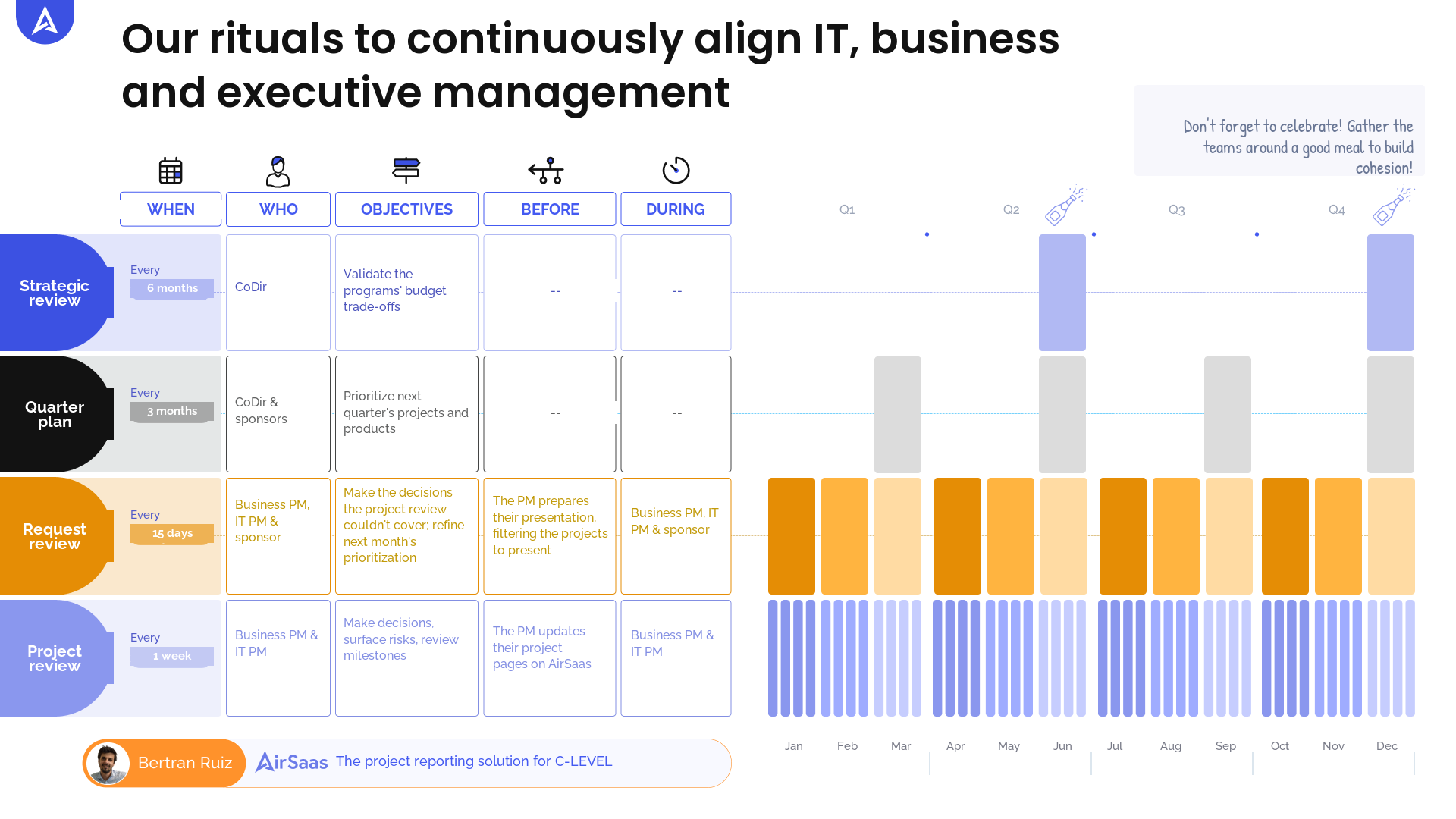
And for a successful Capacity Planning, apply our best practices for successful capacity planning.
Which tools should you use for your Capacity Planning?
Setting up a capacity plan is often a heavy, time-consuming process. Many companies do it in an Excel spreadsheet, which is generally impossible to maintain over time.
So should you completely abandon the idea of having a truly effective capacity plan?
Not really. To address this problem, at Airsaas we take a clear stance: we would rather have a capacity plan that is approximately right than precisely wrong. And it is to bring this stance to life that we developed a team-based Capacity Planning platform.
Thanks to Airsaas:
- You estimate the time needed for the deliverable, not for the task. Workload estimation is done with t-shirt sizing, to avoid going into micro-level detail and thus simplify your Capacity Planning.
- You anticipate the time needed and available per team. This way, you avoid projecting at the individual level, and rely instead on the team level, to really project yourself onto the build.
- You set up a capacity plan by quarter, semester, or PI. This methodology lets you align with time scales that reflect the reality of the work to be done — which is often not done within a week, but rather over a longer period.
On the Airsaas platform, the Capacity view is simple and actionable. It helps you know what the capacity is in each team, which deliverables are weighing down the progress of your projects, and what your needs for additional resources are.
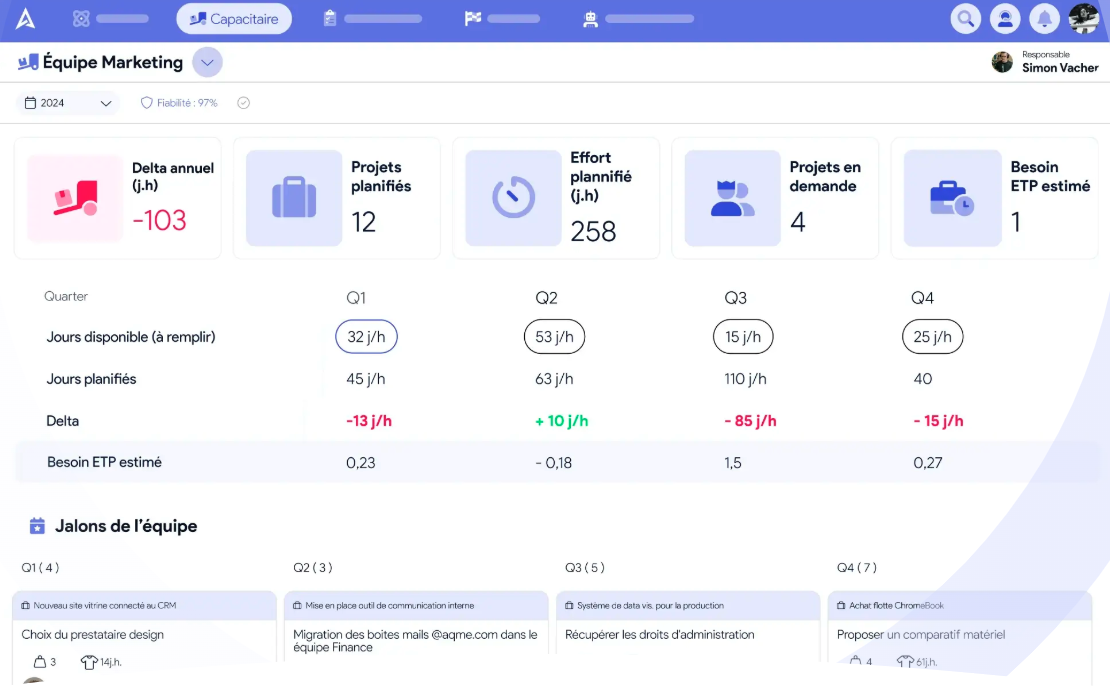
The result: you set up a pragmatic capacity plan, at the macro level, which lets you prioritize with Top Management which projects to launch or not. This doesn't prevent you, in parallel, once your projects are organized over time, from producing a person-level capacity plan over 2 to 3 months maximum… one you can actually stick to!
Enough to make better decisions in terms of prioritization and capacity planning.
Interested in Airsaas' team-based Capacity Planning solution? Request a demo today, and streamline your project portfolio management while building engagement in your teams.
What if you took back control of your project portfolio?
Book a demo and discover the tool in 30 minutes.