
Contents
How many times have you had to urgently reallocate resources to a priority project, at the expense of another equally strategic one?
How many times have you struggled to justify why you couldn't launch those three new tactical projects?
How many times have you felt the frustration of the people you were talking to as you explained, saying "we can't do everything"?
For you — CIO, PMO or project manager — poor capacity management leads to uncomfortable situations and strained relationships with the rest of the business. Not to mention the teams that can burn out from chasing every rabbit at once…
For the company, it means a financial black hole. Mismanaging your resources wastes a huge amount: delays and financial losses… not to mention the stress of situations like these!
The solution? A well-designed capacity planning that helps you avoid these pitfalls by optimizing the use of your resources according to your company's shifting priorities.
The thing is, at Airsaas we know how easy it is to lose your way and end up building either an over-engineered mess… or nothing at all!
Don't panic! This guide gives you all the keys to building an effective capacity planning and mastering your production capacity: the steps to follow, best practices and tools.
What is capacity planning?
Start your deep dive into the capacity planning method by looking at its definition — a good way to get off on the right foot!
A clear and simple definition of capacity planning
Capacity planning is a method for assessing, planning and ensuring optimal resource management to meet the needs of a company's project portfolio / initiative portfolio. This methodology takes both human and financial resources into account. It also goes by the names capacity management or capacity plan.
The ultimate goal of capacity planning is to align the capacity available in the company with the forecast demand, finding the balance between the company's strategy and what it can actually produce over the period.
This methodology tells you what workload to assign to your teams, and whether more human resources are needed to deliver the projects.
Be careful not to confuse capacity planning with a simple short-term resource planning method, where you match the company's capacity to its current needs. Here, the aim is to forecast resource allocation over a longer horizon, to meet future demand.
For a more in-depth definition of capacity planning, head this way.
The difference between capacity planning and demand planning
As a project manager, CIO or PMO, it's common to get your wires crossed between different concepts. And here, it's important to understand the differences between demand planning and capacity planning.
On one side, capacity planning lets you plan the resources needed to meet needs that have already been identified (on ongoing or approved projects), and check whether or not the workload is manageable for the teams.
On the other, what's generally called demand planning (or demand management) consists of forecasting future project demand coming into the portfolio pipeline.
These two concepts differ in a few ways:
- They don't pursue the same objectives. Demand management organizes the different stages of qualification, understanding and prioritization. And yes: there are far too many "requests" to handle them all in parallel. So this pipeline has to be organized. Capacity planning, on the other hand, focuses on managing resources to meet current needs.
- They don't use the same data. A capacity plan uses the company's existing capacity, whereas demand planning is based on prioritizing project or evolution requests coming from the company's various departments.
That said, despite their differences, these two methods are fundamentally complementary. On one side, by planning demand, you answer the question "Which projects should we do?". On the other, your capacity management answers the question "Can we do these projects?".
In short, demand management lets you channel projects so you launch the ones that can genuinely be delivered, rather than embarking on a thousand initiatives that — however good — may well never see the light of day.
At Airsaas, we always recommend scheduling demand management meetings (or request reviews) every two weeks, to collect demand.
A good practice is to create pairs by domain and solution — for example: HR IT Leader — HR Business Leader. The Business Leader analyzes the requests and meets every two weeks with their dedicated IT Leader, to qualify the requests and steer how they're handled: already done, request not aligned with the organization's objectives…
To go further, listen to the episode of our podcast where we discuss Flash Design with Isabelle Perussy.
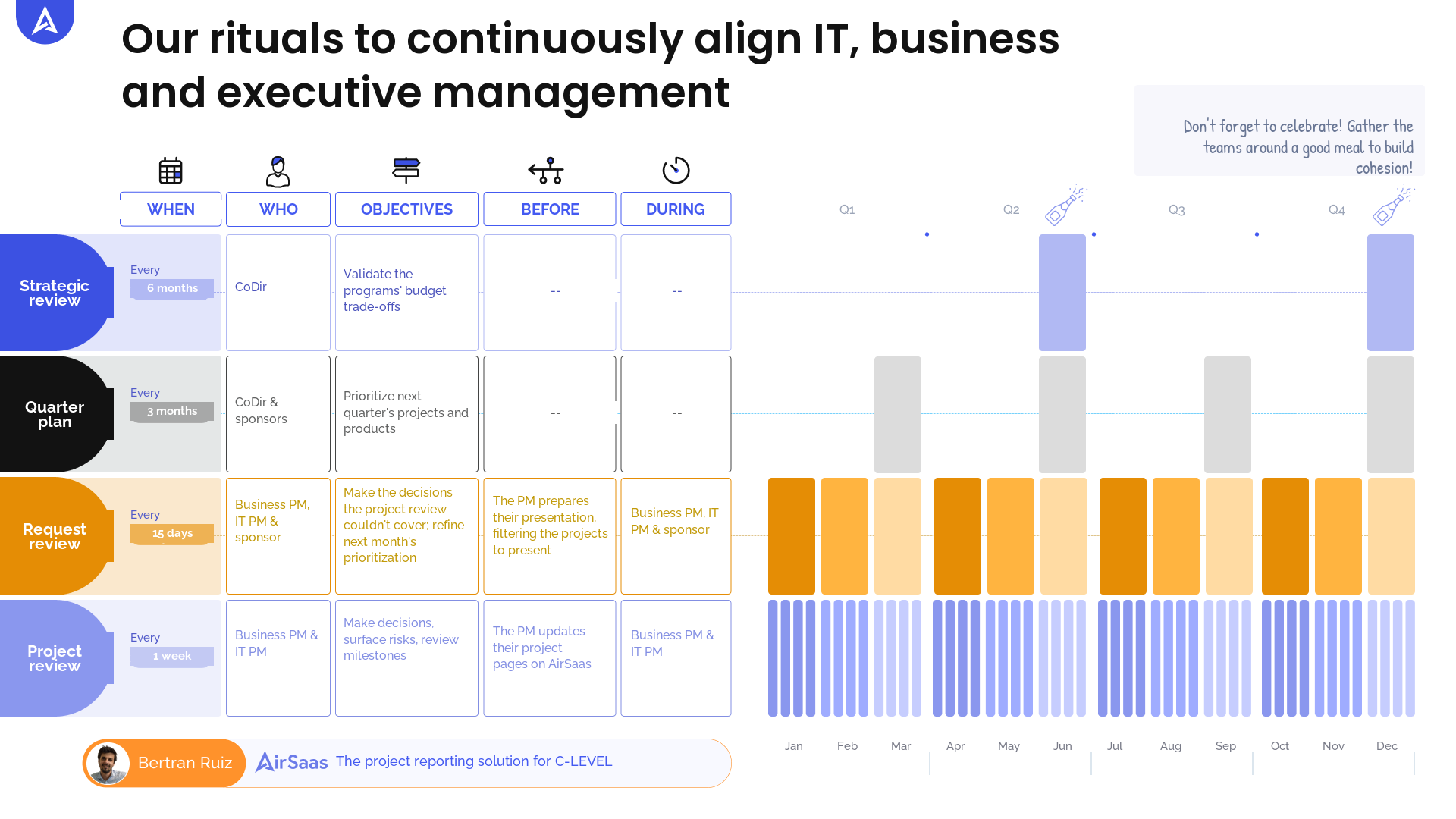
So, together, these two methods balance needs and resources, and maximize the operational efficiency of the company.
To fully understand these differences, read our article "Demand planning and capacity planning: what's the difference?".
The 7 benefits of a well-crafted capacity planning
In an organization where company projects are mostly cross-functional, capacity planning becomes a crucial tool. How many projects — which carry so much value for the company — get pushed back month after month for lack of cross-functional human-resource planning?
In this context, a capacity plan makes it possible to prioritize the projects to run collectively, aligning everyone around a positive dynamic.
So, thanks to a well-oiled capacity planning, you get:
- Optimized resources. Better resource allocation ensures every project has the skills and means it needs to move forward efficiently, avoiding both waste and overload.
- Projects that are more likely to succeed. By anticipating resource needs, your capacity planning limits bottlenecks and blockers, and keeps project deadlines on track.
- Better relationships between the various members of management, thanks to improved strategic alignment. Resource allocation decisions are made according to the company's priorities, which ensures execution in step with strategic objectives, and better communication between stakeholders. You can finally launch (and finish!) those non-strategic projects, so often ignored by leadership but which the business teams are waiting for so impatiently.
- Solid preparation for swings in demand. A clear view of capacity makes it possible to anticipate the need for extra resources and adapt the workload to fluctuations in activity.
- Optimized costs. By accurately planning the budgets each project and team needs, you avoid unnecessary spending and improve your return on investment.
- Improved productivity and stakeholder satisfaction. A balanced workload lets teams be more efficient and deliver quality projects, while reducing stress and fostering employee engagement.
In short, the capacity planning method means less wasted resources, more projects reaching the finish line, and more engagement from all your stakeholders.
Enough to make you want to get started, isn't it?
The steps to create your capacity plan
Here you'll find a summary of the different steps to create your own capacity planning. To go into detail, feel free to read our article on the 7 steps to create your capacity plan.
Create homogeneous skill groups
First, you should organize things into teams that map to homogeneous skill groups. For example IT Security, IT Data, IT Infra, Finance ERP, Finance Corporate… this lets you break your initiatives down by homogeneous skill group, which is very handy for building a quarterly capacity plan.
Define your current capacity
Next, for each homogeneous skill group, you'll need to define run time and build time.
Be careful here: you have to clearly redefine run and build collectively. For instance, it's dangerous to leave change requests in the run: they're better placed in the build. The run should rather be seen as first- or second-level support. Anything that creates value through "building" is build — otherwise, how do you account for its worth?
Collect demand over the period
Then it's about identifying the priority projects in light of the company's strategic objectives. To do this, you can draw on the decisions made by the various business teams and by leadership, but also on the company's historical data and market trends.
Identify the gaps between demand and capacity
At this stage, closely compare the teams' current capacity with the forecast demand over the period. Here you'll be able to spot the bottlenecks and the teams that have more time available.
Balance capacity and demand
Here you get to the heart of capacity planning. It's about putting strategies in place to balance capacity and demand.
To do this, you can choose to modulate demand, by deprioritizing certain projects or deliverables to a later date or, conversely, by prioritizing other projects.
But often, it will be more a matter of adjusting capacity. Several levers are available to you here: recruiting people, training on the skills you need, outsourcing certain deliverables, putting supporting technologies in place…
Various capacity-adjustment strategies exist, including:
- The "Lead" strategy, which consists of increasing capacity to anticipate needs ahead of a rise in demand.
- The "Lag" strategy, where you increase capacity only once you spot a lack of capacity.
- The "Match" strategy, which combines the Lead and Lag strategies, gradually increasing resources until they meet demand.
- The "Adjust" strategy, where you build scenarios from demand and resources, then compare them to find which strategies deliver the most profitability and operational efficiency.
We recommend applying the last strategy, which is the most ROI-driven without harming your company's production capacity.
Implement your capacity planning
Now, roll out the actions identified in the previous step. Also put a tool in place that lets you track how demand and capacity evolve over time, so you can adjust the capacity planning as needed.
Good news: we reveal more about this in the last part of the article!
Track and adjust your plan continuously
Once your capacity planning is created, the point is to know whether it's producing the expected results.
To do this, track the key performance metrics that tell you whether your capacity plan is effective, such as:
- The completion rate of planned deliverables
- The capacity utilization rate
- The project completion rate against the planned budgets and deadlines
- The rate of interruption or delay caused by poor capacity planning
- The satisfaction level of your various stakeholders (employees and customers) with your capacity plan
Also remember to gather your stakeholders regularly to take stock of demand and resources — then run through each of these steps again for good, ongoing management of your production capacity.
Best practices for a successful capacity planning
The previous steps give you a solid methodological foundation for creating your capacity plan. Now discover the best practices for building a capacity planning that genuinely engages your teams and aligns them with the company's strategic objectives.
If needed, these keys to success (and more!) are detailed in our article on best practices for a successful capacity planning.
Encourage cross-team collaboration
A capacity planning is necessarily political — because, after all, prioritizing always means giving something up (even if only temporarily). So your primary goal should be this: to make your capacity planning align everyone around the company's strategy.
To do this, hold a collective session to align all stakeholders (including leadership and the business teams) around this vision, and the priorities that flow from it in terms of deliverables.
During this collective session, everyone can also spot the risks and dependencies between the different projects, and think about how much capacity their team can genuinely allocate to each project.
To dig deeper, discover two collaborative methodologies for prioritization and organization:
Thanks to these methods, you avoid scattering your energy across one-to-one meetings, and instead capitalize on one big meeting where everyone aligns. Nothing but upside!
Want to know more?
Set up a capacity plan over a long time frame
Roll out your capacity planning over a period longer than a week. Why? Because it lets you get a capacity plan that's approximately right rather than precisely wrong.
Indeed, with the fluctuation of demand and capacity, a week-scale capacity plan quickly becomes wrong, and has to be revised non-stop.
With a capacity planning at the scale of a quarter, a semester or a PI, you align yourself with the reality of the work the teams have to deliver.
What's more, organizing your project portfolio over a longer time frame creates positive pressure. Teams make sure to finish their deliverables before the end of the period, and to properly frame the needs they'll have for the one to come.
Not to mention that you cut out plenty of pointless meetings: one meeting a month is enough — no more painful weekly meeting — so everyone can focus on "doing" rather than on "meeting".
And of course, that doesn't stop you from then breaking things down into task-level, week-scale agendas for each team.
Estimate the time needed for the deliverable rather than the task
When building a capacity planning, it's common to get lost in the detail of micro-tasks… which should actually fall under each team's own project management!
To avoid this, take a pragmatic approach and design a capacity plan around deliverables, not tasks. Faced with this capacity planning, each project manager then handles their own breakdown of tasks — while you keep steering your project portfolio at a macro level.
Think at the team level rather than the individual
At the scale of a (small) team, and over a fairly short period, a capacity planning designed at the individual level can work. But if you want to define a capacity plan across your whole organization, you'll quickly end up pulling your hair out…
So favor a capacity plan that accounts for capacity by team, not by individual. This lets you focus on what really matters in project portfolio management, namely: the build.
A note: by "team" here we mean "a grouping of homogeneous skills". For example, you can choose to segment the IT team into several skill groups, separating IT Security, IT Data and IT Integration. For the marketing department, you can segment resources between a Content marketing team, a CRM marketing team, and the other marketers.
Thanks to this tip, your capacity planning becomes more flexible, and lets each team adapt its workload to the planned schedule.
Stay flexible
Build into your capacity planning margins that let you cope with the unexpected that every company runs into — because a project almost never goes exactly as planned!
So adopt an iterative approach, regularly convening your stakeholders to review your capacity planning. Here again, that's exactly what the Quarter Plan and PI Planning methods allow, to be adapted to your organization.
Want to know more?
What tools should you use to set up your capacity planning?
If you've already set up a capacity planning, you know how quickly relying on an Excel spreadsheet alone can become unmanageable. Good steering requires a collaborative tool that can adapt to fluctuations in demand and changes in resources in real time.
It's precisely to support CIOs, PMOs and project managers in managing their production capacity that we developed the Airsaas Capacity Planning feature.
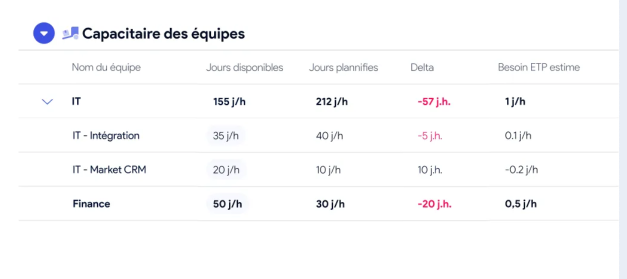
With Airsaas, you build a Capacity view per team over the period of your choice: quarter, semester or PI. This approach lets you focus on the company's real build. Each team enters directly into Airsaas the resources available to contribute to ongoing projects.
Then all you have to do is simulate different scenarios to adjust resource allocation according to your strategic priorities. Thanks to the Capacity view, you instantly identify the blockers and the needs for extra resources.
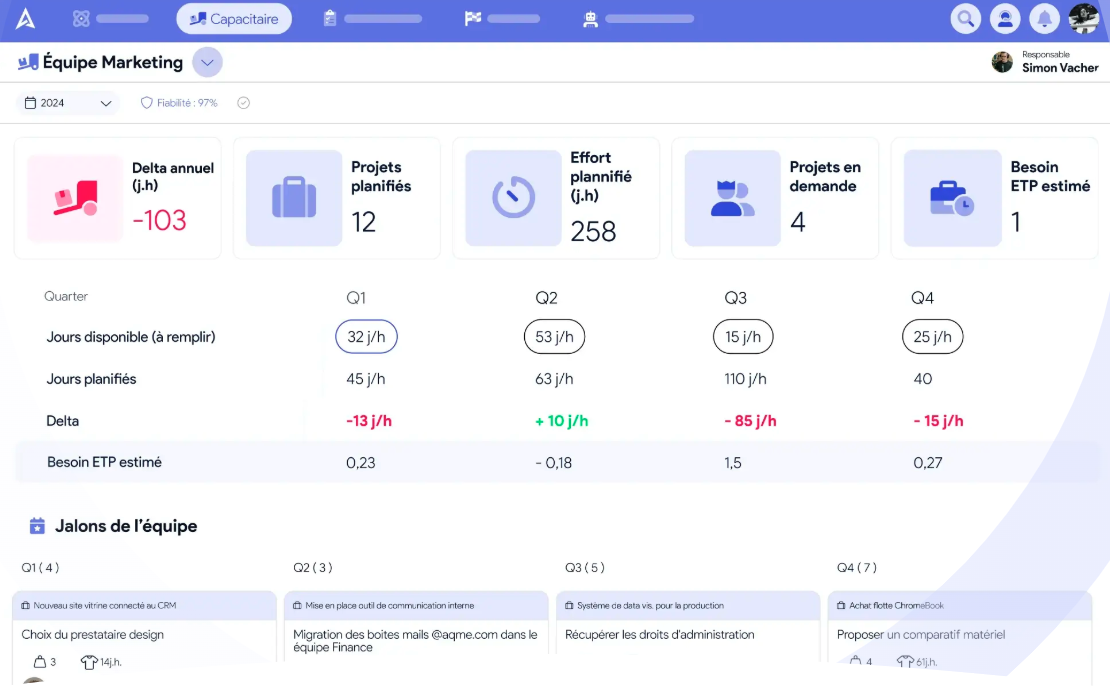
Stop wasting precious time on complex, time-consuming tracking: adopt an effective, pragmatic capacity planning with Airsaas!
You're now equipped with all the steps and best practices to build your capacity planning. Request an Airsaas demo today, and make this task simple and collaborative, for capacity management that's truly aligned with your business strategy.
What if you took back control of your project portfolio?
Book a demo and discover the tool in 30 minutes.