May 28, 202211 min readJérôme Dard
How to run an effective project status meeting?

Contents
"The project isn't working! We'll report on progress once it's back on track." That's the kind of thing you still hear far too often in the hallways. And it's exactly what you should keep doing if you want to be absolutely sure of missing the point.
In the lines that follow, you'll discover the ingredients of a modern, transparent and effective project status meeting (and, along the way, methods to succeed in your project management).
Beef up your progress tracking: that really is the key message. It may sound like a simplistic lever for success, and yet running these check-ins well can make all the difference between a project succeeding and failing. Good news: it doesn't have to be complicated!
What are the common mistakes and the warning signs to watch for? How do you run this process so it becomes a ritual that's both simple and engaging? We've collected and annotated 12 best practices and lessons learned from PMOs and CIOs. In short, let's look at how to help you move your project forward effectively.
The pitfalls to avoid in project status meetings
Every project needs regular sync-ups where stakeholders come together to discuss goals, quality, milestones, tasks and work progress.
Beyond reporting to the relevant governance bodies, a well-facilitated status meeting also helps align the teams involved.
A lack of context
Progress data that's isolated from its context doesn't allow project stakeholders to get their bearings — and therefore to make sound decisions amid complexity.
As a reminder, to be effective, the three ingredients of a project status meeting are:
1️⃣ A quick reminder of the project framing (why are we doing this? on what scope? etc.)
2️⃣ The current state of progress (progression, attention points, decisions to be made, etc.)
3️⃣ And the time-based reminder (what's coming next?)
Collecting and sharing this information well is one of the keys to making this process work. By recalling the context and the timeline, you make it easier for everyone to find their bearings. You actually need all the ingredients above — plus the context around that data — to grasp the project's real level of progress.
A lack of concision
We're there for one goal only: to formalize a progress status, not to debate it. Think of triage in the ER. No surgery in the hallway, please!
Imprecision
All too often we see large-scale projects that aren't planned and documented in detail. Actions, milestones and project tasks are sometimes assigned arbitrarily, which makes project tracking difficult.
Each project manager usually has their own way of reporting progress. In a large team, this lack of consistency creates confusion for managers, who don't get identical working templates.
Many major initiatives don't use a real project management tool for effective tracking.
"Responsibility dodging", now an Olympic discipline in project management
Project status meetings are moments of truth — against the initial projection and the expected results — and they make everyone's cooperation (or lack of it!) visible. Tensions there are legitimate and frequent.
Team members may indeed be called on to account for their work and to commit to a goal and new key results. Securing lasting individual and collective commitment is a modern challenge for any cross-functional project manager, who sometimes faces reluctance — or even bad faith.
That said, the widespread adoption of project collaboration platforms has made any disengagement more visible. In this context, your role is to restate the framework, everyone's roles and accountabilities.
If you notice this kind of situation happening frequently, first talk with the person involved, based on concrete observations. Share the general needs that come with your role, then make a clear request. Listen carefully to the answers and the needs expressed. If there's a genuine deadlock, formalize the dispute. A call to the sponsor may be necessary. A reminder: cooperation can't be decreed!
Without judging this trend toward a form of disengagement seen in many large companies, as project manager you nevertheless need to factor it in and keep a measure of discernment.
Too many meetings
Say stop to the overuse of "informational" meetings
Only meet when there's no other practical way to reach your goals in a project.
Beyond the "social" value for a team — which can be handled in another space than the project status meeting — it isn't always justifiable to physically gather people just to share a status or provide information about tasks.
Either way, keep an eye on how often a project's meetings happen. Too many or none at all can both hurt productivity.
12 practices to keep status meetings on track
Make it a team topic
It's people and their good working relationships that move things forward and drive transformation — beyond task tracking and whatever tools you've put in place.
The real challenge is to spread and nurture a culture of shared responsibility: team spirit, in short. To get there, go as far as changing the evaluation and compensation criteria if you have to. Make it explicit that cooperation within the project group is also part of what gets evaluated. #TeamSpirit
Use technology to steer by decisions
Never be caught off guard again because you don't have the right information. With the right tool, you'll have access to all the pending decisions and the key history.
At AirSaas, we built a platform to make governance simpler for you (a list of decisions to be made, a steering-committee view, etc.)
Business teams and IT are sometimes at odds. To move topics forward calmly, a pragmatic solution is to offer a consolidated view through a platform — a shared workflow that brings stakeholders together around a single tool everyone understands. The dashboard: that's the view you'll gather around every X weeks for your status meeting! #CollaborativeByDesign
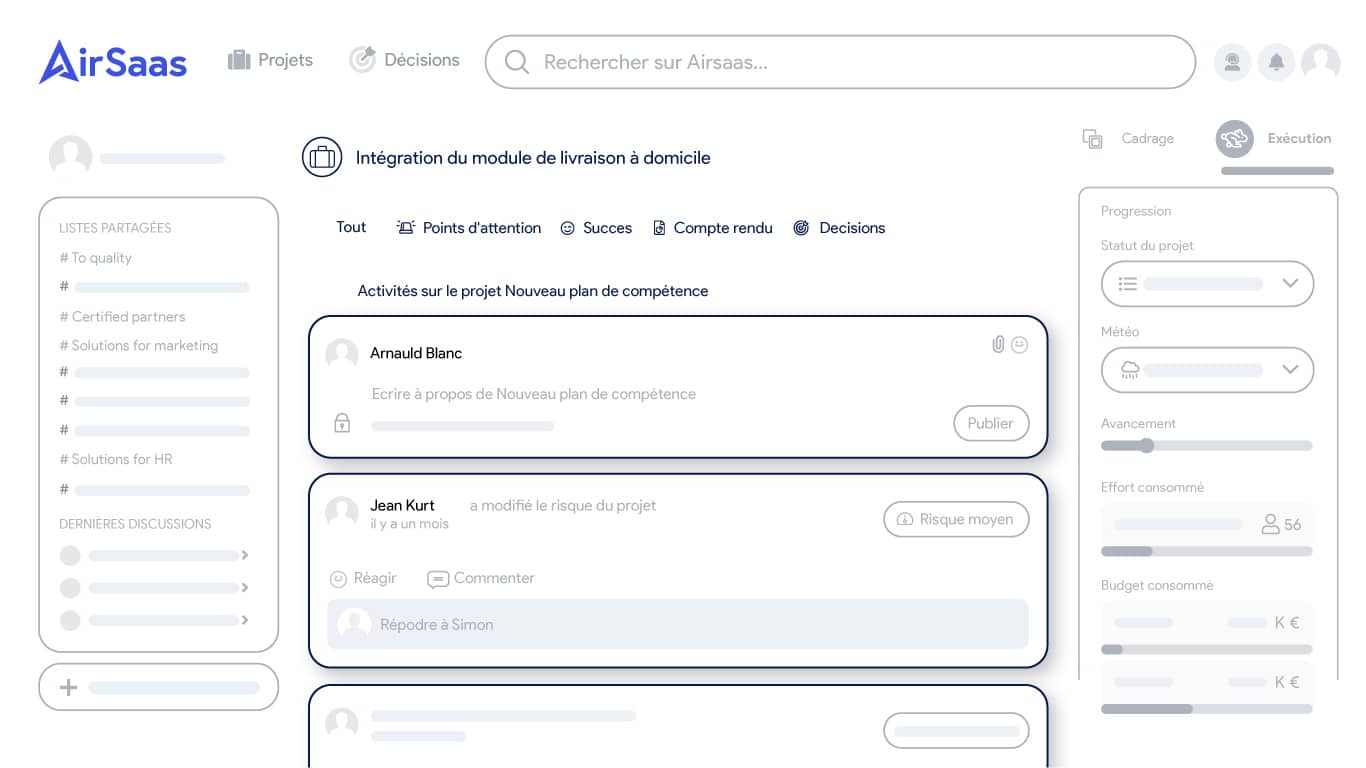
Regular reporting, surfacing decisions made, issues encountered and wins, to engage teams and move forward with confidence.
Automate, using reporting tools to communicate project progress
Project health, progress, attention points, decisions to be made... You've entered all this information? Rather than writing up a report, automate a short, precise weekly email so you don't drown people in information. #WeeklyEmails
Synchronize, by interconnecting your tools to avoid double-entering status updates
Remember how we used to do it: "I copy/paste the project details from the framing sheet, pull the remaining effort from Jira, send a Teams message to get the progress status, milestones..." STOP!
Create your projects in AirSaas, set priorities in the steering committee, and receive all progress information directly in your synced communication channels, like Microsoft Teams.
AirSaas connects to the market's most popular tools (Jira, Azure DevOps, Asana...) to surface the essential information for macro-level steering of your activities. #SmartSync
Say no to information overload — and thank you, milestones
Run formal reviews of progress against the plan at critical points defined in the project plan, when major stages are completed. At the milestones.
Don't drown your teams and stakeholders under a Gantt chart tracking task progress. #ThinkMilestones
Set good objectives
You only succeed against the objectives you set
You can't track progress on something you never defined! Good objectives are realistic, clear and measurable. Whatever method you pick (OKR, SMART, SMAC...), draft an outline of your project's objectives, then review them to check they meet the requirements.
A word of caution though: there's no need to measure everything. Not everything can be KPI-ed or ROI-ed.
Key takeaway: no project should start until its objectives are clearly set! #KPI
Make your project visual
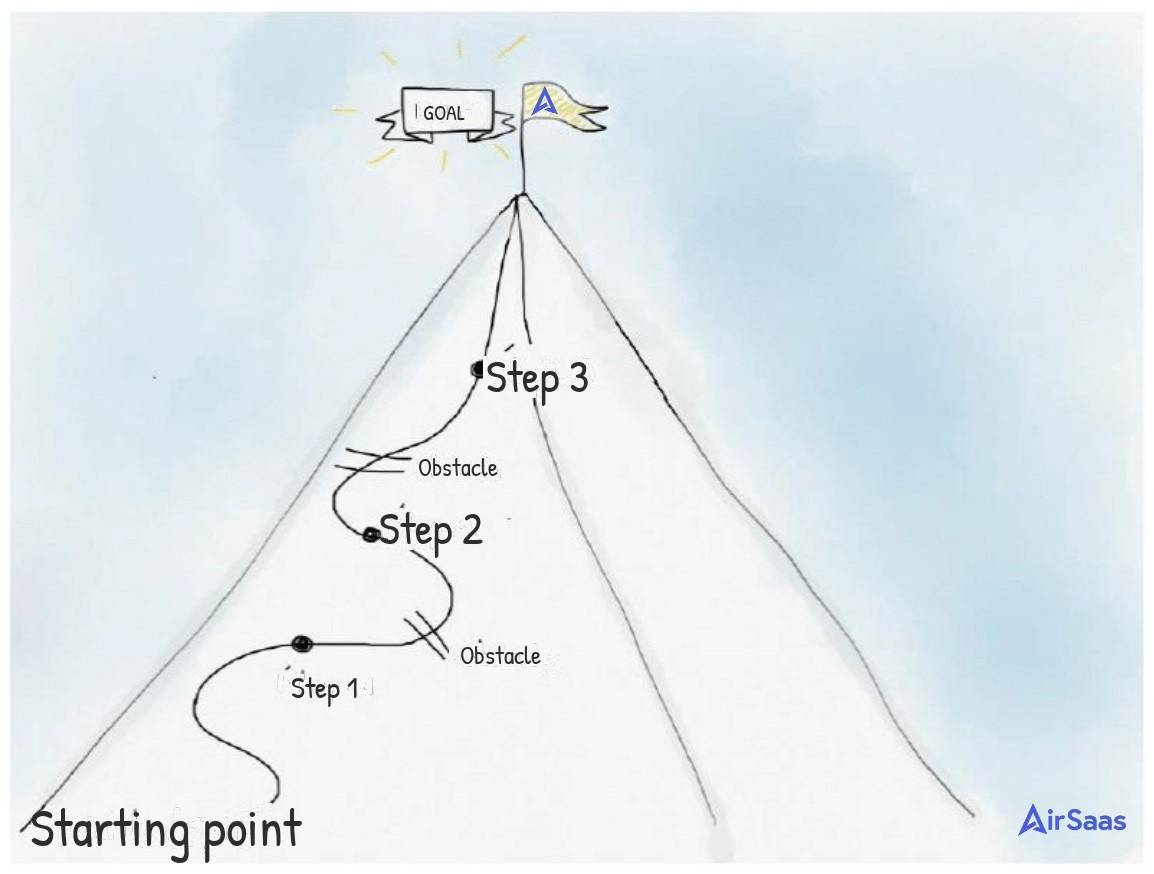
Show a project's journey by drawing a mountain, to tackle projects and missions in several stages
From Lascaux to Instagram: the power of images is a constant
75% of the brain's neuroreceptors are dedicated to processing visual and spatial information. Source: Dan Roam, The Back of the Napkin
Agile, lean and design all share this common root: making a goal, a process and an outcome more visible, clearer.
And in project management, options abound: Kanban, project posters, mind mapping, a platform with a great visual interface... You can keep colleagues up to date on progress through attractive, effective visual management. For example, with the project-health attribute.
Key takeaway: it's highly motivating for a team to visualize the objectives and KPIs it helped define, along with the progress made (or not) toward them. #SimplifyToAmplify
Tailor the project status meeting to your different audiences
Executive leadership has understood that three-year project cycles no longer work and that prioritization now has to be continuous. They increasingly want to understand the reality of work progress across project delivery.
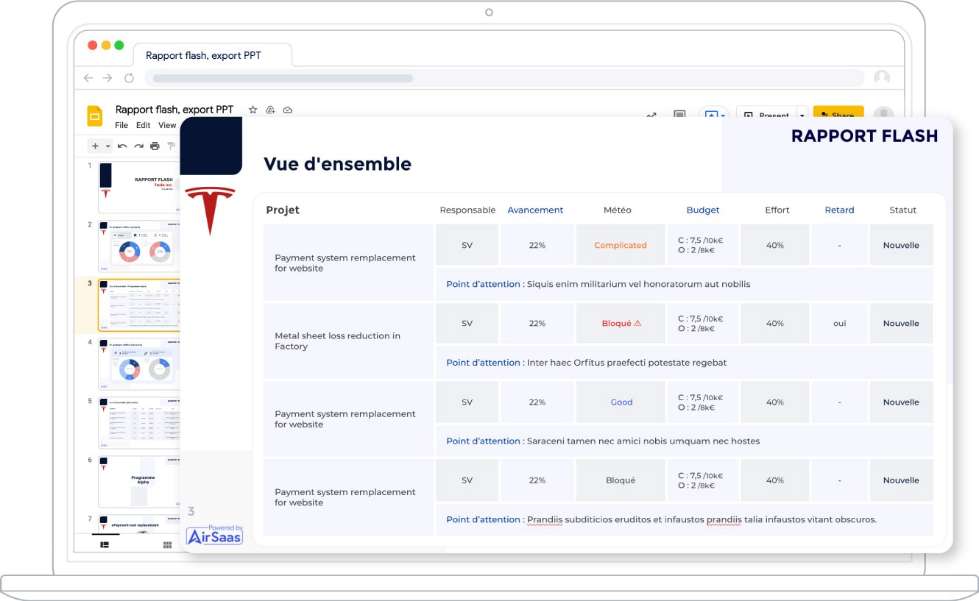
One single update of your project progress, different views for each type of reporting
With a dedicated platform, you only enter progress once. A few filters later, your updates and the various pre-saved progress views in the menu are ready to be fanned out to different readers — as a flash report, for example. #ProduceOnceDisplayEverywhere
An example of how this plays out in reporting:
- On Teams, for "broad" project status communication to everyone who will be affected by the project's outcomes.
- For the project team, regularly sending all stakeholders a flash report in PowerPoint format, with a dedicated tool like AirSaas.
Focus on observable facts
When discussing progress on the various topics, stick to the facts! Ask each person to back up their opinions with facts, illustrated with a concrete example.
The goal is to keep the team focused on making good, fact-based decisions. And don't forget to stay flexible.
If the facts don't fit the theory, change the facts.
Give clear time markers
Presenting project progress means constantly zooming in and out of the data — making it easier for everyone to find their bearings in the ongoing transformation. The problem: with a lot of workstreams, the report quickly becomes unreadable.
Map out the project's critical paths to define a fitting, coherent roadmap. It will let you give visibility on deadlines and on ongoing, past and upcoming actions, and monitor the health of the project's progress. The path to each objective and to the final result.
A timeline that lets you:
- Group report items by project health, risk, objective, status and importance
- Navigate through the project's progress over time (a bit like Google Maps)
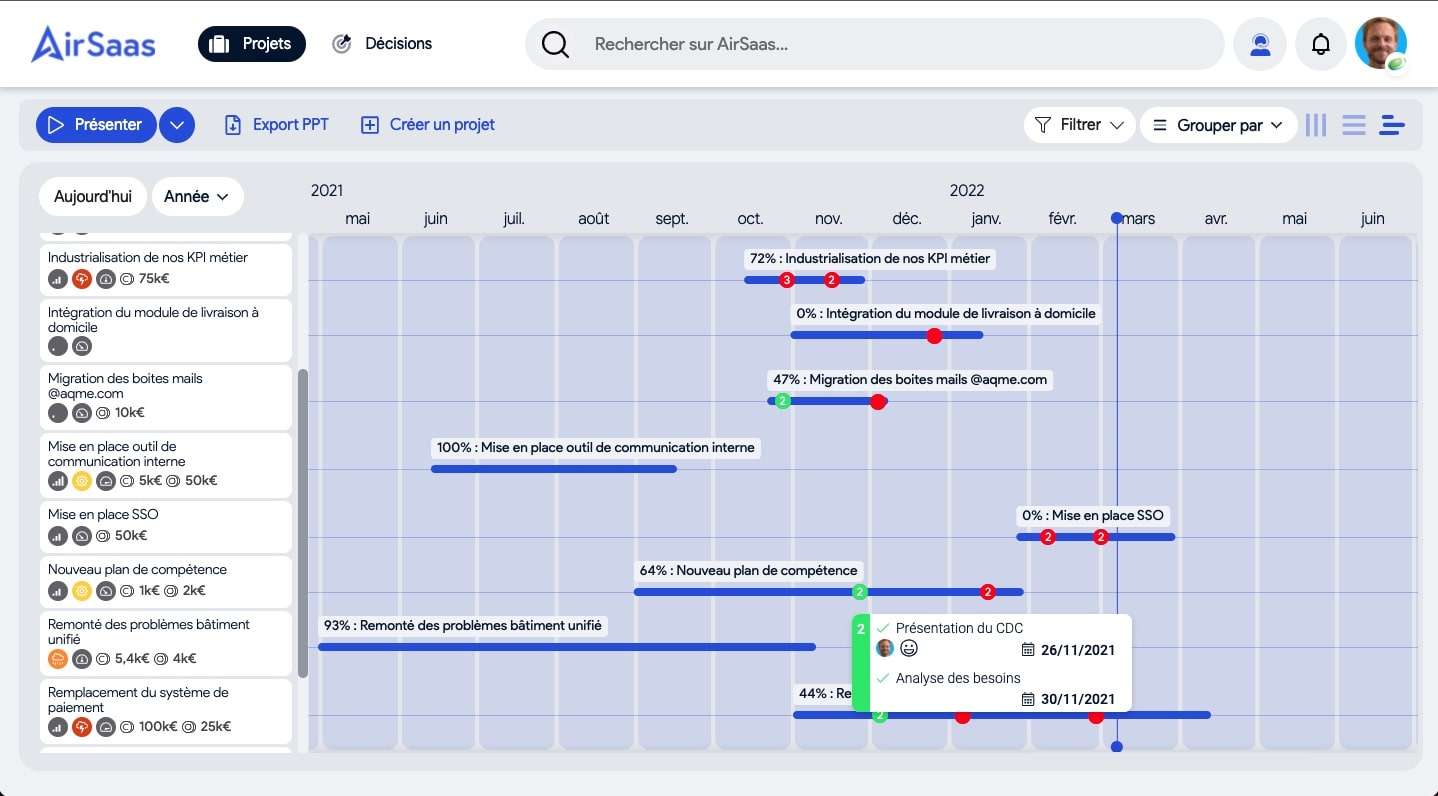
A timeline, for a clear temporal view: essential
One type of project = one type of tracking
Micro-project, cross-functional project, company-wide project, "POC", sandbox project, strategic, legal, division-level, department-level... It's easy to get your post-its mixed up! And above all, you risk the sledgehammer-to-crack-a-nut syndrome: rolling out your heaviest project-management artillery for nothing.
Without losing sight of the fundamentals of a project status meeting — an update on progress — it's important for the project manager to adapt their approach and their tools to the type of project being tracked.
On this topic, check out the definition / classification from Frédéric Navarro, four-time CIO and now independent project director at ESINFO. An excerpt from episode 28 of CIO Révolution, the podcast produced by AirSaas:
"We set up a monthly dialogue with the business, where everyone comes to understand each other's vocabulary and stakes. A dialogue where everyone accepts being challenged. And after 6 months, we have a real picture of each department moving at its own pace, and everyone commits."
Through constant dialogue with all the business units, he categorized each project into 4 levels (strategic, legal, division-level, department-level). Based on the progress of each category, the whole set is reprioritized in dedicated monthly status meetings.
Needs, progress stages, resources, required skills... the project is then presented from every one of these angles. The various business departments step in along the way to discuss the responsibilities they would hold within the project, as well as their availability.
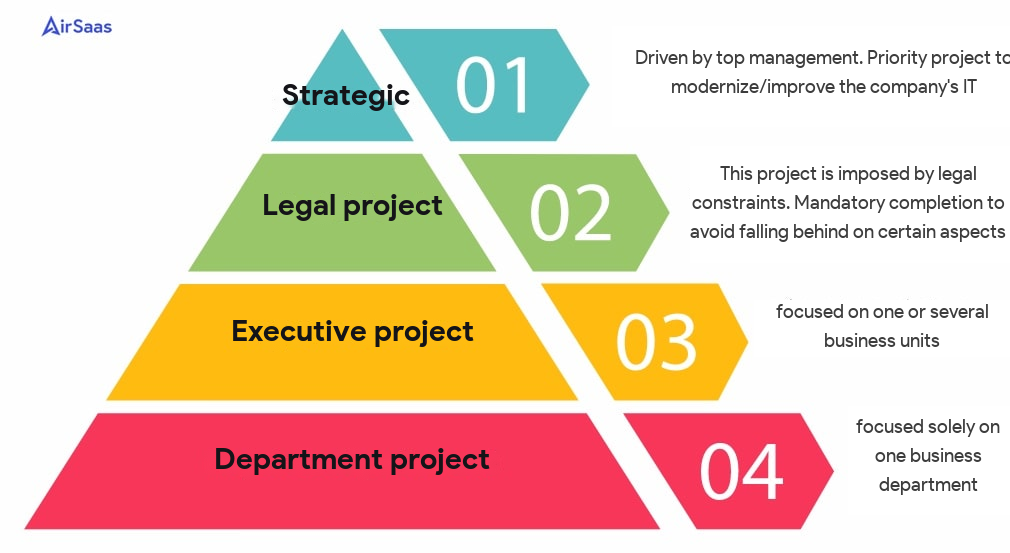
These four levels are a classification baseline, but they're in no way what scores the different projects and their progress
Out of some fifty initiatives led by the IT department, three or four are level 1 — considered major — and are regularly discussed by the CIO with executive management. Five or six are level 2, and then each division and/or department has a number of small missions and small topics to handle. In general, the definition / reclassification process is quick when done this way.
Key takeaways
- The three essential ingredients of an effective project status process are continuous cadence, standardization, and adaptation to your typologies of people.
- A picture-perfect Gantt chart, an endless email, the most beautifully designed PowerPoint report in the Fortune 500 — still not enough? It's people and their good working relationships that move projects forward and transform the company!
- A good status meeting plays a team-alignment role.
Are your project status meetings on track? Then it's time to revisit a classic and refresh your view of project risk analysis.
What if you took back control of your project portfolio?
Book a demo and discover the tool in 30 minutes.