August 29, 202215 min readJérôme Dard
How to achieve pragmatic project portfolio management?

Contents
There will always be more projects than resources to work on them!
As a PMO, CIO or Transformation Director, if you're passionate about your job, there's one task that surely matters deeply to you: managing resources and the project portfolio.
Back in 2006, the Project Management Institute defined it as the centralized management of the processes, methods and technologies of a set of projects. An activity meant to optimize trade-offs and their planning, while assessing each project's risk level and financial viability.
🚫 STOP!
Yes — in the days of five-year IT roadmaps and IT-versus-business standoffs, a mainly financial view of project portfolio management was the norm for a long time.
But past a certain company size, a certain volume of cross-functional projects, and the arrival of fast internal or external change in organizations, "over-control" no longer works! Portfolio management needs to move from a sometimes bureaucratic, over-centralized management style to a freer, more collaborative and faster one, to run an innovation and transformation effort that delivers effectively and continuously.
In the lines that follow, we'll look at what has changed and what can work better in today's project portfolio management. We'll tell you everything about the art of modernizing this practice. To invest upstream so you suffer less downstream. The goal: modernization & efficiency!
One last word before we start... what do we mean by pragmatism? To sum it up... it's the opposite of theoretical or abstract! These are practices that come from the field, that let you spend your resources intelligently, with a proven approach that can be re-adapted to your own context of innovation and transformation.
PPM: the end of the "private preserve"
For a long time this process was the domain of a single expert who owned the creation and management of a roadmap for an entire company!
Planning, execution, reporting and analysis, demand and resource management, tracking, benefits realization... The PPM practice was sometimes equipped with a rather rigid "all-in-one" project ERP — when it wasn't Excel or PowerPoint!
This portfolio management process responded mostly to a need for vision and control at the "center". A CFO-oriented vision, in short :-)
The outcome of this approach? PPM had become an "experts' thing" — a resource management tool that didn't give all the stakeholders involved in each company's transformation enough visibility into the roadmap's execution.
Let's put it simply: this kind of portfolio management worked — but only for part of the company... and within fairly long project cycles.
Then technology became the main vector of agility and innovation. Digitalization arrived... and with it a growing flow of more complex, shorter, more cross-functional projects, which tended to make the central-planning approach obsolete.
More and more specialized SaaS tools appeared — for task management, time tracking, finance, etc. They clearly delivered a better user experience than the all-in-one ERP PPM software.
Business teams started using these competitors of the ERP/PPM tools massively — for their clear added value, going as far as an omnipresent, more or less supervised "shadow IT".
Yes — and beyond any particular tool, the management of innovation and project portfolios has changed on many fronts:
- The culture of collaboration and transparency has become central! Versus a focus on resource management and workload planning alone
- "Adaptation" through fast-result iterations has replaced "over-anticipation"
- Steering by "value" has replaced steering "by budget" alone
- The cost of inaction / the "Risk Of Ignoring" is now much more widely recognized.
- The importance of trust and the need to involve employees is a shared, well-understood stake.
- The decentralization of IT in favor of business teams is one of the strong trends
The diagnosis is partly established.
But which levers should you activate first? How do you facilitate the initial and ongoing management of a project portfolio so it doesn't continuously drift? How do you help the organization make decisions quickly? How do you keep teams motivated?
We re-read our documentation, interviewed our experts... and we invite you to browse this selection of convictions!
Six levers for pragmatic project portfolio management in 2022
Lever 1: Maximize collaboration over control
A project portfolio that moves forward will require creating and maintaining the conditions for a strong culture of cooperation, transparency and shared responsibility across all the teams involved.
The challenge is to move from a management style centered on budget and resource control to one that maximizes stakeholder collaboration and engagement.
Here are a few practices to consider within this first lever to maximize collaboration and trust over control:
- Offer a collaborative space built directly into your PPM tool.
With a platform that directly embeds a collaborative space, you'll make it easier for people to speak up. You'll be able to consolidate the flow of attention points, decisions and wins. It may not sound like much — but it can genuinely simplify your day-to-day and your teams'!
- Use confidence in milestones...!
When you become a PMO / CIO / IT project portfolio manager, one of the first possible pitfalls is falling into micromanagement — wanting to over-control how the teams execute the project.
To help you keep betting on trust, get a platform to back you up.
In AirSaas, the notion of milestone (a key step to achieve in the project by a given date) carries attributes: the owner, the weight and the confidence level.
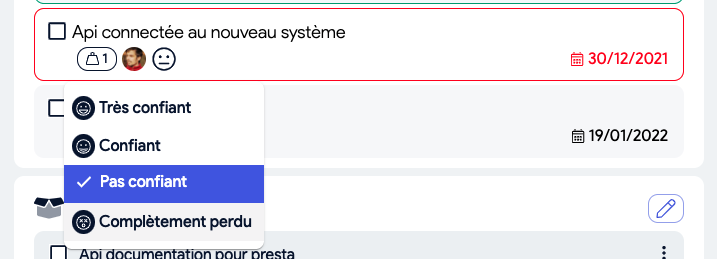
Confidence level on milestones: an innovation that makes portfolio management easier
To follow your portfolio's progress you can look at each project's progress through the completion declared by the project manager, displayed on your portfolio page at the bottom of each project card.
You can also follow milestone progress, thanks to an automatic calculation that takes completed milestones and their weight into account.
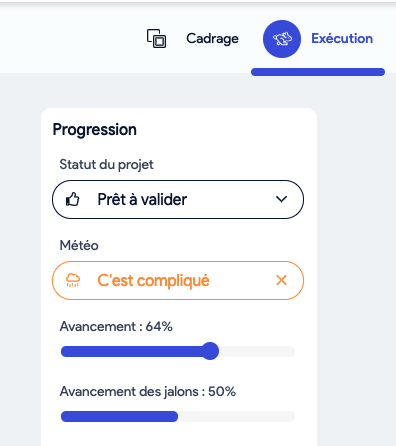
Track the portfolio's execution and delivery with milestones to keep continuous drift in check.
To sum up this first lever, we can't resist sharing a quote we love. One from Ludovic Lajoie, taken from a comment on an AirSaas LinkedIn post.

The goal really is to break through the horizontal silos — between teams and departments — and the vertical silos in terms of decisions.
Yes... cooperation cannot be decreed! It is encouraged, facilitated. These are cultural and human matters that take time.
Lever 2: A different reporting philosophy to reduce cognitive fatigue!
The more the company and its project portfolio grow, the more the ability to keep communication clear, consistent and easy to access for everyone becomes vital.
Whether it's the CEO who no longer quite understands what the teams are reporting, the leadership-team members who no longer speak the same language, or the teams themselves trying to sync up as best they can.
The problem: information — the portfolio's data is scattered across the information system and the various progress updates.
As a result, form gets in the way of substance and everything grinds.
You might think it's secondary, but it's actually one of the fundamental ingredients of informed decision-making at the top. Most of the time, a decision is a trade-off. How can you arbitrate between A, B and C if the information presented isn't comparable?
We genuinely need to standardize reporting.
- Standardizing the form means saying OK: we're going to make our lives easier so we understand each other whatever the challenge we're facing. Incidentally, it also reduces everyone's cognitive fatigue.
- Choose a tool with an interface intuitive enough to ease collaboration between technical and business profiles.
- If you really want to involve a company's employees on topics as technical as those handled by the IT department, better do it on an interface they'll enjoy! One that encourages them to "tend their data garden"!
- The second benefit is to increase the adoption rate of these PPMs. Employees will need only a few hours to get comfortable with these new tools rather than a few days. Which can be a very interesting lever if the goal is to mobilize quickly.
Bonus: by simplifying information gathering and by automating reporting, AirSaas will give you the time to help project managers with their challenges and to ease collaboration between teams.
Lever 3: a selection process to choose the projects that truly matter to the company
While preparing this article, we interviewed corporate transformation leaders and CIOs. One of them — thanks again, Frédéric :-) — shared his take on this question of pragmatic project portfolio management.
Pragmatism? It's rising above individual interests! The challenge is knowing how to choose the projects that are truly worthwhile for the company. Making sure you move "from the customer as king to the company as queen". To rise above individual interests, you can adopt a collaborative, visual and agile approach to create the conditions for dialogue, to rebuild shared meaning and get the company's players to genuinely join forces on the projects that matter — not for each department, but for the whole company.
His experience is fascinating. In his partly agile, "liberated" company, they have — in a way — implemented a discussion-based limit on work in progress.
The real challenge lies upstream. Choosing is moving forward! It may sound obvious, but in this era of project hyperinflation it seems more than useful to remember it!
As a bonus, your project managers will be less polluted by "toxic" workstreams.
It will also remind some people of a universal principle well known in tech and IT: GIGO — Garbage IN, Garbage OUT!
Lever 4: Design your PPM workflow to simplify initiative-taking and decision-making
80% of projects don't need a Gantt chart! The idea is to invest in designing several workflows for each type of project portfolio — and not fall into the sledgehammer-to-crack-a-nut syndrome.
Drawing inspiration, for example, from agile "T-shirt sizing"... to start by thinking about the types of projects that exist in your project portfolio!
We've selected three pragmatic examples of portfolio segmentation to inspire you.
PPM segmentation example #1
- IT projects already well managed in Azure DevOps/Jira, etc.
- important / risky projects where business teams must be strongly involved
- smaller projects where business involvement is needed but with fewer risks.
From this simple segmentation... you can approach a redefinition of the management — and the do's and don'ts — of your project portfolio by category.
What's fundamental is to carefully design the workflow associated with each segment.
Which criteria determine the category a new incoming project falls into? And for each one, what will its "definition of done" (DoD) be?
Then, once launched, how will a project move from one category to another? What will be the criteria and processes attached to that move?
PPM segmentation example #2 - Project Management at AXA
A second example, borrowed from project management at AXA: the use of a simple image — the toll lanes of a project highway — combined with specific workflows:
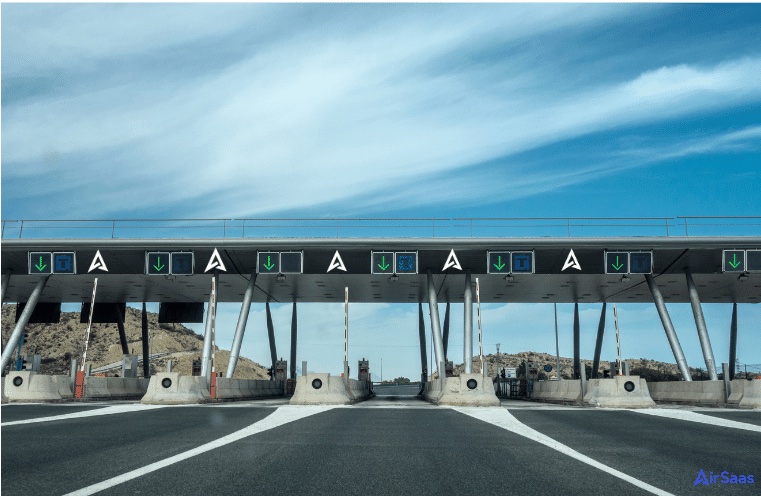
PPM segmentation example, highway-toll style. Your projects sorted in a pragmatic PPM!
- Left-lane projects: more agility and speed, fewer validations
- Middle lane: everyday projects! More volume, medium complexity
- Right lane / heavyweight projects: more safety, resources and regulation, less speed
For each of these categories within the project portfolio, a specific decision-making and operational protocol was designed. Possible lane changes along the way were also thought through.
The key challenge was to move from bureaucratic management to "adhocratic" management.
Adhocracy (from the Latin ad hoc — set up specifically to meet a need — and kratos, power, authority) was defined by Robert Waterman in 1990 in "Adhocracy, The Power to Change" as "any form of organization that cuts across normal bureaucratic lines to capture opportunities, solve problems, and get results".
PPM segmentation example #3 - Frédéric Navarro, CIO
Both a classification method and a process that helps ease the work between business teams and executive leadership.
But above all, an approach to generate engagement around the roadmap.
An ongoing dialogue with all the business departments to categorize a project using four levels (strategic, legal, division-level, department-level), re-prioritized every month!
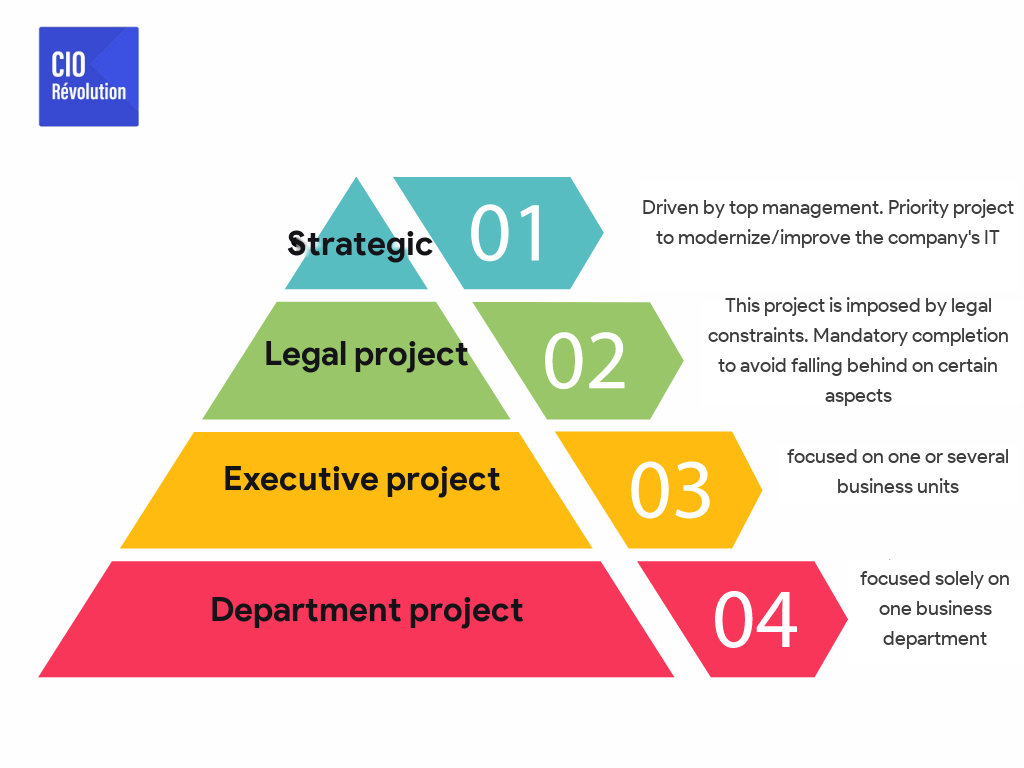
PPM segmentation example - resource management via Frédéric Navarro, ep. 28 of the CIO Révolution podcast
Out of a base of about fifty projects, 3 or 4 are level 1 — considered major — and will be discussed regularly by the CIO with executive management. Five or six will be level 2, and then each division and/or department will have a number of small assignments, small topics to handle. In general, the reclassification process is quick when it's done this way.
These approaches echo the inspiration of lean portfolio management and of the agile philosophy at company scale. Among these frameworks, we can mention SAFe — the Scaled Agile Framework — popularized in 2011 by Dean Leffingwell. Well implemented, it helps establish, within a company of 50 to 150 people, a common language across the different teams involved in developing a product.
Lever 5: Knowing when to stop a project
No one has ever been promoted for ending a project — which is the source of enormous waste in companies. 🙂
Yes — and a healthy project portfolio is measured by its ability to stop a project at the right time!
The question of managerial courage and leadership is central to this challenge.
Many internal or external events do affect the life of a project.
Being dynamic and responsive to change is paramount.
Just like a need for agility, a project can be accelerated, paused, or even stopped. This isn't necessarily a sign of failure — on the contrary, it avoids wasting energy.
Short of being able to stop a project completely, pragmatic project portfolio management can involve giving employees the freedom to pick other tasks/projects from a backlog as soon as a project or feature is blocked.
We can't wrap up this lever without sharing the reference to Arne Roock's book, one of the publishing hits of 2012: Stop starting, start finishing!
In it, the author advocates — among other things — for limiting work in progress and for visual management, and develops the portfolio Kanban approach.

Expression taken from the title of Arne Roock's book published in 2012
Stop starting, Start finishing: it means you can't finish what you haven't started, and you should never start what you haven't committed to finishing. Unfortunately, working on many high-priority projects at the same time can lead to significant problems — inefficiency in particular!
Lever 6: Let everyone see what they (really) need
There are plenty of ways to look at information!
And information is scattered!
If you steer a flow of initiatives involving several teams, you know how hard it is to see clearly.
It's fundamental to stop and agree on what you really want to show in this portfolio. Is it primarily budgets, progress statuses, project health?
Faced with an excessive volume of information, you quickly fall into the Christmas-tree syndrome: an overloaded report — pretty, but not very effective for deciding!
In AirSaas, smart views give you the ability to customize the project view to show exactly what you want to see at a glance.
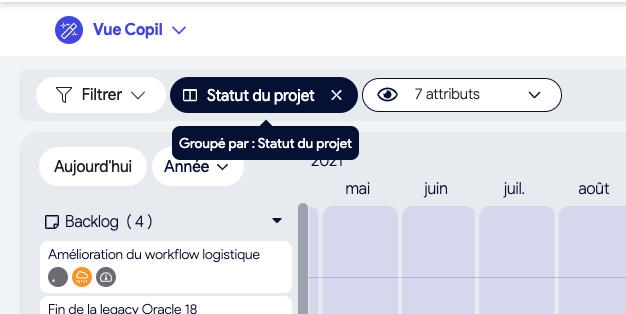
PPM view by status.
A smart view includes:
- A selected filter
- The attributes you want to display (health, importance, etc.)
- A way of displaying the projects (kanban, list or timeline)
- The way you want to group the projects (by program, goal, etc.)
And if you're on the timeline:
- The chosen time scale (month, quarter, etc.)
What matters is to offer not one single portfolio view, but any number of views — and therefore near-unlimited prioritization criteria!
Projects vital to the leadership team, projects that must be finished within the quarter, etc.
On top of the shared views, private views will let each person see better according to their own criteria.
Bonus lever: back to semantics, back to meaning
As you've noticed, this article has touched on the notions of silos, collaboration and cooperation. It's sometimes useful to go back to semantics. A return to meaning, which has the virtue of clarifying the different stakes and degrees in the ways we work together:
- our historically siloed organizations: teams work "next to" the others,
- then we go one step up and we collaborate (co-labor): teams work "with" the others
- and finally the "Grail" we're all after: cooperation — teams "build a common work" for the general common good
Thanks to Isabelle Leroux, Transformation Consultant, for this semantic — and nonetheless pragmatic — reminder!
A completely different mindset ;) and it's possible, with a dash of leadership distilled into management at every level... Higher trust and engagement are the reward.
Pragmatic PPM in 2022: key takeaways
- Pragmatic PPM management will help you better address part of each stakeholder's legitimate frustrations and involve top management by tackling topics that are fundamental: strategy, dialogue and cooperation across silos, budget allocation.
- A pragmatic PPM approach involves a new mindset. You switch between the old and the new approach: control VS engagement; prioritization through collaboration VS data; simplicity VS complexity; primary use VS do-it-all software suite;
- Choose a tool that carries a philosophy close to the one you're currently promoting — with an ultra-simple user interface!
- Transformation cannot work without people's engagement.
- Invest in thinking through your project portfolio framework and workflow, suited to your context.
- Set up a project selection process centered on the company and its people, versus the customer as king!
Do you have all the keys to modernize your PPM approach? To finish the job, we suggest continuing with one of the "Transformation Pros" articles: How to put a project approach in place in my company.
What if you took back control of your project portfolio?
Book a demo and discover the tool in 30 minutes.