July 15, 20237 min readPro. de la Transfo.
CEO-CIO relationship: 10 practices to build trust


With digital transformation, CIOs have become the executive leadership's go-to partners — a real opportunity to get closer to the CEO. But you still have to know how to frame and nurture that relationship.
We asked the "Pro de la Transfo." — a community of decision-makers and doers of business transformation — for their tips on how to build a trusted relationship with CEOs.
The goal: co-create shared practices around transformation!
Building on their hands-on experience, we co-created this list of 10 practices worth considering, from the simplest to the most advanced, from build to run!
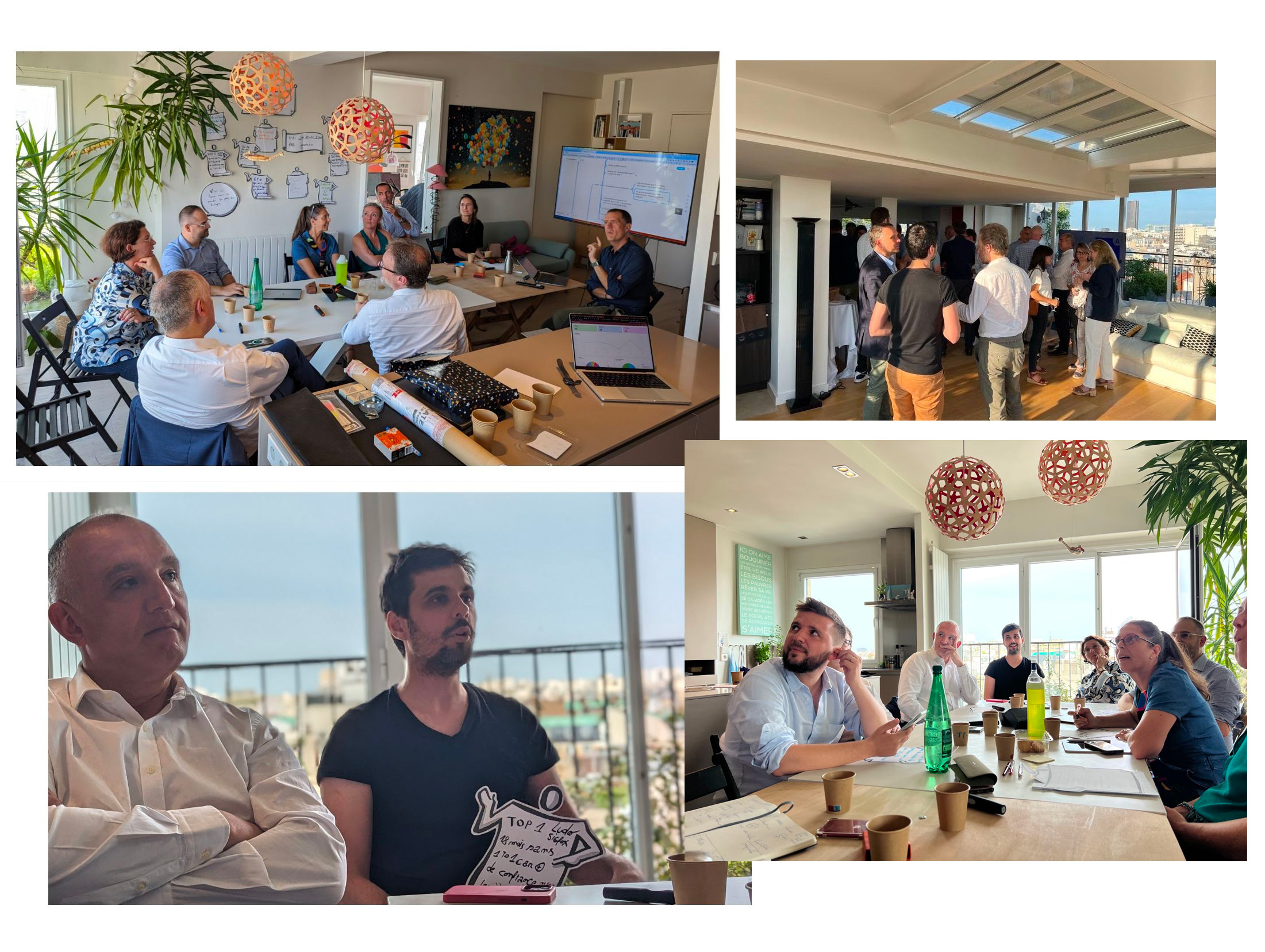
12 pros sharing over an afternoon to create shared practices around transformation. Working on the relationship with CEOs through forum theatre.
Thanks to
- Isabelle Leroux: Organization & Digital Transformation Consulting
- Coralie Stevanazzi: Transformation Consultant
- Caroline Raveton: CIO & consultant
- Elisabeth de Montety: PMO
- Sylvain Bourdette: CIO
- Clément Royer: CIO & consultant
- Benito Diz: CIO
- Stéphane Creach: Consultant
- Simon Vacher: CPO
- Bertran Ruiz: CEO
- Thomas Poitau: CMO
- Jérôme Dard: Consultant
Disclaimer: no "magic" recipes here. Just ingredients, postures and tricks of the trade from the Pro de la Transfo. Management is an art!
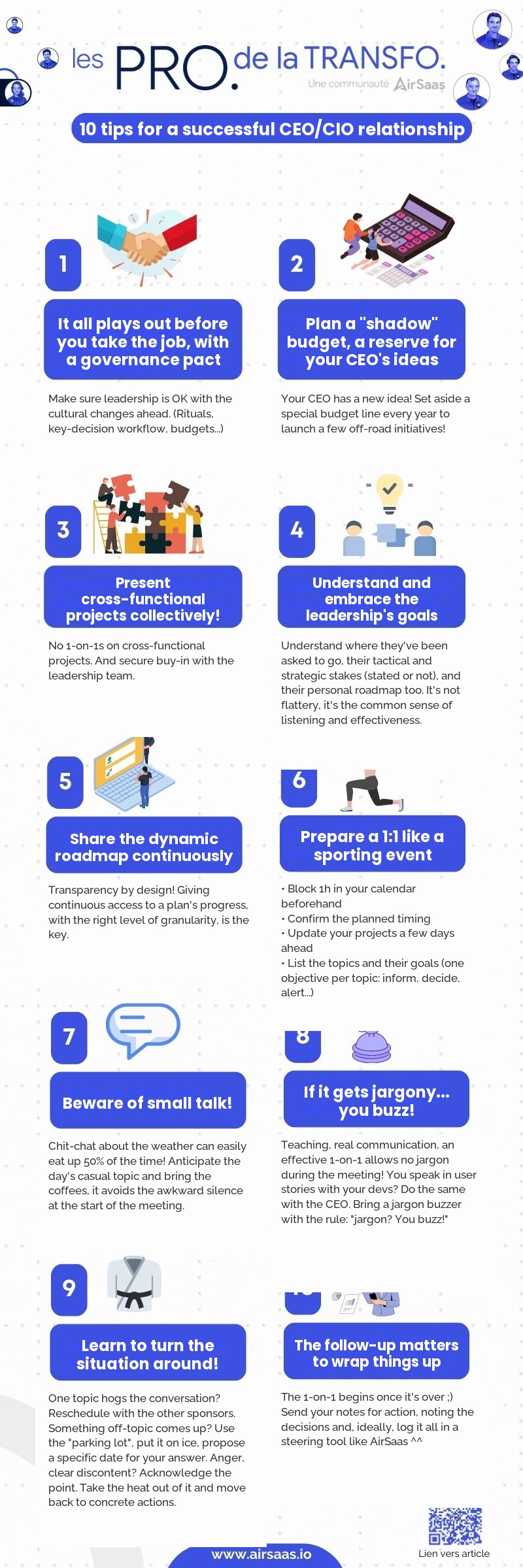
-> Link to the HD, print-ready PDF version
Continuous transparency: give the CEO the ability to co-pilot the organization's transformation
Even before your first contact, what are the pragmatic tips for setting up an effective future framework of cooperation? Discover 5 practices for this "framing" stage.
1: It's all decided before you accept the job

A CIO-CEO pact
Agree on a precise governance and operating pact. Rather than an exchange of vague, overused concepts — "we'll do agile" ^^... — you define a way of working, formalize mutual commitments and accountabilities, and make sure leadership is on board with the cultural changes ahead. (Rituals, key-decision workflows, budgets...)
2: Plan a "shadow" budget — a tactical reserve for your CEO's (sometimes ^^) brilliant ideas
Anticipate new ideas
Your CEO has a new idea! Often picked up that very morning in the business press or on LinkedIn... CIO, don't dismiss it all outright. Set aside a special budget line every year, from the start, to launch a few off-piste initiatives! Aim for the simplest, highest-impact ones. Besides, you might just land a success!
3: Never present cross-functional projects alone!

No 1-to-1s on cross-functional projects
Truly sharing responsibility for a project or a program is how you avoid future dissonance and misalignment.
Golden rule: no 1-on-1s on cross-functional projects. Presentations are shared with the leadership team, and so are the dedicated checkpoints. E.g. you're steering the finance ERP go-live: plan for the CFO to join fifteen minutes before the end of your 1:1 with the boss.
4: Show empathy... understand and take on board the CEO's objectives

Put yourself in the other person's shoes
Executive leadership has its own complexity too — as Captain Obvious would put it! Understanding where they've been asked to go, their tactical and strategic stakes — stated or not — and their personal roadmap too, isn't flattery: it's plain good sense, listening and efficiency.
To understand, you have to ask questions: How much pressure is the board putting on this topic? Do you need serious back-up on this one? Example: "We've had a great win on this part of the transformation plan — would you like to talk about it in the media?" You get it: putting yourself in the other person's shoes is a key posture. After all, we're members of one team, and together we go further!
5: "Transparency breeds trust" — share a living roadmap continuously

Transparency by design!
Transparency by design! Providing continuous access to a plan's progress, at the right level of granularity — that's the key. Offer a choice of weapons: a permanent link in the browser favorites, a summary deck sitting in the inbox, an emergency WhatsApp line...
You still have to optimize how you update your project portfolio with your project managers and partners. But it's truly worth the candle. Word of a governance-software vendor ;)
Optimizing the "run" of your meetings with the CEO
Framework in place? Now the execution phase begins... we've prepared 5 more practices to beef up your meetings!
6: Prepare a 1-on-1 like an athletic event

A champion's routine before every 1-to-1
No ring here... Leave the boxing gloves in the locker room, but adopt a champion's routine before every 1-to-1! It remains a proven basic. Here is our checklist to pin up somewhere in your office:
- Block one hour in your calendar before every meeting
- Double-check the planned timing
- Make sure your teams update your projects a few days ahead
- List the topics and their expected outcomes (one single goal per topic: inform, decide, alert...)
- Prioritize the order intelligently and identify possible trade-offs
- Always stay factual and functional by preparing your back-ups and cheat sheets
- Warrior option: check the meeting right before yours (a tactical postponement beats going in after a painful meeting)
7: Beware of small talk!

The art of small talk
Essential but treacherous, small talk — being able to start a conversation, keep discussions light, chat about the weather... — can easily eat up 50% of the time! Especially with a CEO who knows little about your topics. Anticipate the day's casual topic and come with the coffees; it will spare you the awkward throat-clearing at the start of the meeting.
8: Jargon? Buzz!

Jargon? Buzz!
Tech is jargon-heavy! Useful for moving fast and building a sense of belonging with your team... but this "habit" can backfire. Pedagogy, genuine communication: an effective 1-to-1 doesn't allow a single word of jargon during the meeting! You speak in user stories with your devs? Do the same with CEOs.
The top tip: gift the jargon buzzer with the rule "Jargon? Buzz!" For the first 3-4 meetings, that should do the trick. Worth trying with the leadership team too — plenty of fellow executives love their jargon as well.
9: Meeting turning into a disaster? Learn to turn the situation around!

Turn the situation around
When it starts badly, it starts badly... here are situations the Pro de la Transfo have been through, and their workaround tactics to keep things from festering:
- A cross-functional project monopolizes the conversation: Reschedule a session with the other sponsors or, better, invite them to the next project committee
- Blatantly off-topic: Acknowledge the topic without feeding it, use the "parking lot" or the fridge, and propose a precise date (next 1-to-1, ad hoc session) to bring your answer.
- Anger, outspoken discontent: Acknowledge the point. Take the emotion out of the topic, and move back to concrete actions already in place or awaiting validation to turn the situation around.
- [warrior option] You're being told how to do it: Validate your counterpart's change of role — they become the project manager. It's a different meeting now; rearrange the space. Come sit beside them, take notes, sketch diagrams so the collaboration is effective. You've got an expert ^^ — make the most of it!
10: The after is key to wrapping up

Record and capitalize
What matters isn't the fall, it's the landing! .. The 1-on-1 starts once it's over ;) Send your few notes for action, recording the decisions — and ideally, keep the history in a governance tool (airsaas.io, for example 🥰 ). But above all, you're already preparing the next session:
- Put the important topics to address in the calendar
- Communicate and share out the to-dos with the team
- Validate the next step and the topics to address
- Write down the key feelings / reactions somewhere
What if you took back control of your project portfolio?
Book a demo and discover the tool in 30 minutes.