Co-piloting strategy and operations with AirSaas + Asana — Groupe Intuis

Published by
Aurore Butrot
in CIO, Intuis (formerly Groupe Muller)
On March 17, 2025
Groupe Intuis (Ex Muller)
Sector
Industry
Number of employees
1000
Favourite feature
The one-click flash report
By connecting AirSaas and Asana, I get the best of each tool to steer, execute and account for our transformation to every type of stakeholder.
Aurore Butrot — Chief Information Officer, Intuis (formerly Groupe Muller) -AirSaas user-Before / After AirSaas
Projects managed in Excel
Leadership a little lost in the IT projects.
Project management that wasn't “mature”, few rituals and habits
Not enough explanation to end users about the change processes
Business teams' distrust towards IT
Use of an ergonomic, synthetic tool
A collaborative roadmap shared with all the projects' stakeholders
Adoption of a homogeneous project culture
Better sharing of the meaning of every change, to involve the teams.
Business teams brought on board thanks to more transparency and trust.
The context: key figures, company, etc.
Intuis France is a company in the thermal-comfort field with more than 70 years behind it, strongly present in the French industrial fabric and even certified “Origine France Garantie”! In figures: €200m revenue - more than 1,000 employees - 120 engineers and researchers - 6 factories based in Hauts-de-France, Grand Est and Pays de la Loire - 5 research and development centres - 3 training centres. Having joined the Intuis group after a one-year assignment as an interim manager, Aurore Butrot is today Chief Information Officer and a member of the executive committee. As a customer using the AirSaas solution, she doesn't hesitate to speak frankly about the challenges she met as a CIO, so that the lessons she drew from her experience benefit her peers.
The challenge: simplify and share IT's processes to bring the teams on board
Transformation programme, reporting, cross-functional project management, bringing the teams up to speed… Among all those stakes, the common thread was simplifying IT activities, to address three challenges: restoring trust between the IT and business teams. Developing a homogeneous project culture and bringing coherence to the governance of the project roadmap in order to bring the teams on board and involve them.
Distrust, a heterogeneous project culture and low process adoption
Like many organisations, project management at Intuis lacked methodology — maturity, in a sense. To varying degrees, the following symptoms were present:
- Distrust in the relationship between the business and IT
- Lists of ideas and needs often passed along as they came
- An overall lack of framing,
- The absence of a shared reference.
- A lack of regularity in the rituals: “when I have time I fill in the Excel file a bit”.
- A relative shortfall in the organisation's explanation to end users about the change processes
- Finally, weak process adoption: “only those already inside updated the tool”.
Governance “drowned” and not shared with the exec committee
The challenge was to bring legibility and understanding to the members of the executive committee and the CEO, to recreate coherence with the strategic organisation in place, in order to ease their governance and prioritisation.
Indeed, before AirSaas was set up, the governance process was partly drowned in the various informal exchanges over email, Teams and meeting notes. That scattering was also present at a more global level, in the group's organisation, which was relatively siloed and not very agile. Aurore points out that “the projects lacked arbitrations to move forward”. The watchword was to simplify the processes by offering a synthetic view of the activity.
The solution: AirSaas + Asana to co-steer governance and project management, aligning IT, leadership and the business!
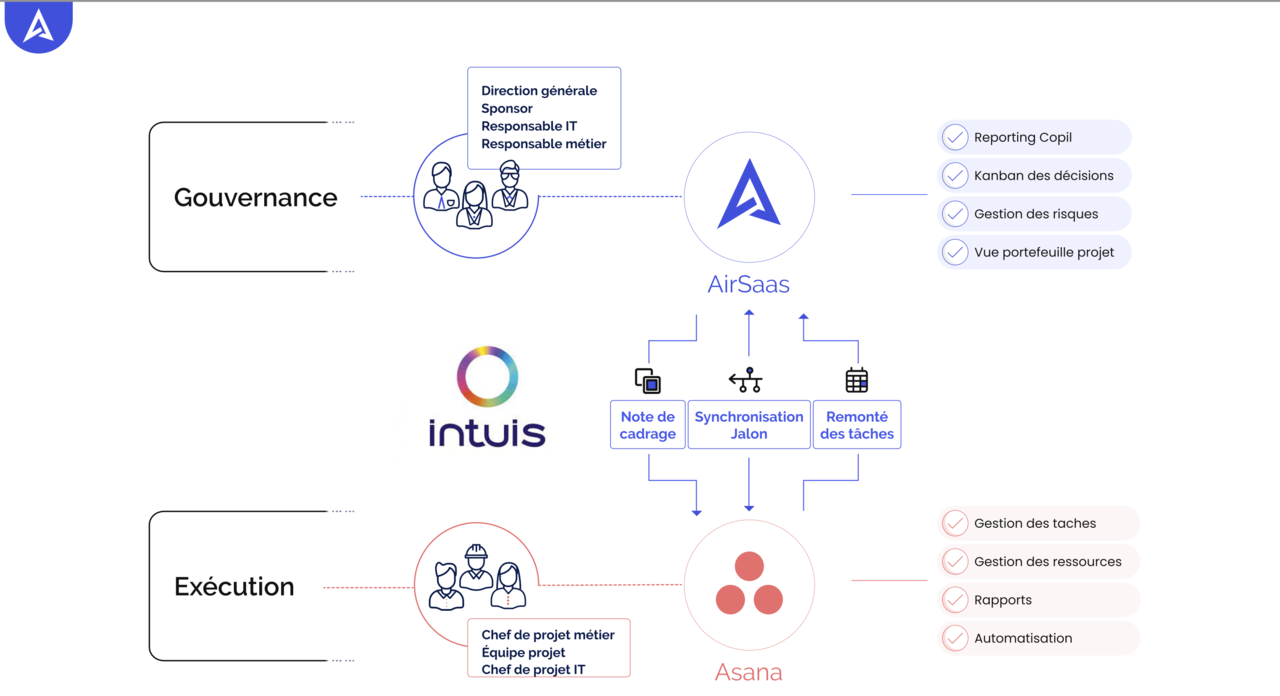
Diagram of governance / project-execution usage
Create a shared reference
Before this approach was set up, the dominant feeling among the business teams was: “If I ask IT it won't move forward, I won't get it on time and it won't be what I wanted”.
For the IT teams, the feeling was about framing failures and projects whose objectives shifted constantly on the business side.
With AirSaas it was fairly easy to show that if projects weren't delivered on time and on budget, it was for several reasons: lack of methodology, poor framing, waiting on approvals…
“When you get to the end of a project, if you can't trace that history and give those explanations, the result is a loss of credibility: people say it's IT, it's normal, they're late”.
Very quickly Aurore was able to bring the business teams into a “give and take” relationship based on more objectivity. “In exchange for transparency, projects had to be framed, without objectives that shift constantly,” Aurore explains
“AirSaas made it possible to list everything; the tool stays factual by keeping a record of what we're doing. I can only improve what I can measure!”.
After a month the company decided it would base itself on AirSaas to give itself a centralised, ordered, planned and shared framework for managing needs/requests and projects.
“We positioned the tool as the reference for projects. To centralise the project inbox, the key idea was to give trust and transparency across all the projects.”
What's more, “It also helped strengthen cross-functionality between marketing and technical projects and made it possible to bridge those two worlds. The objective was to bring the non-IT people on board and get to the essentials.
Syncing the shared governance tool with a complementary project-management solution like Asana
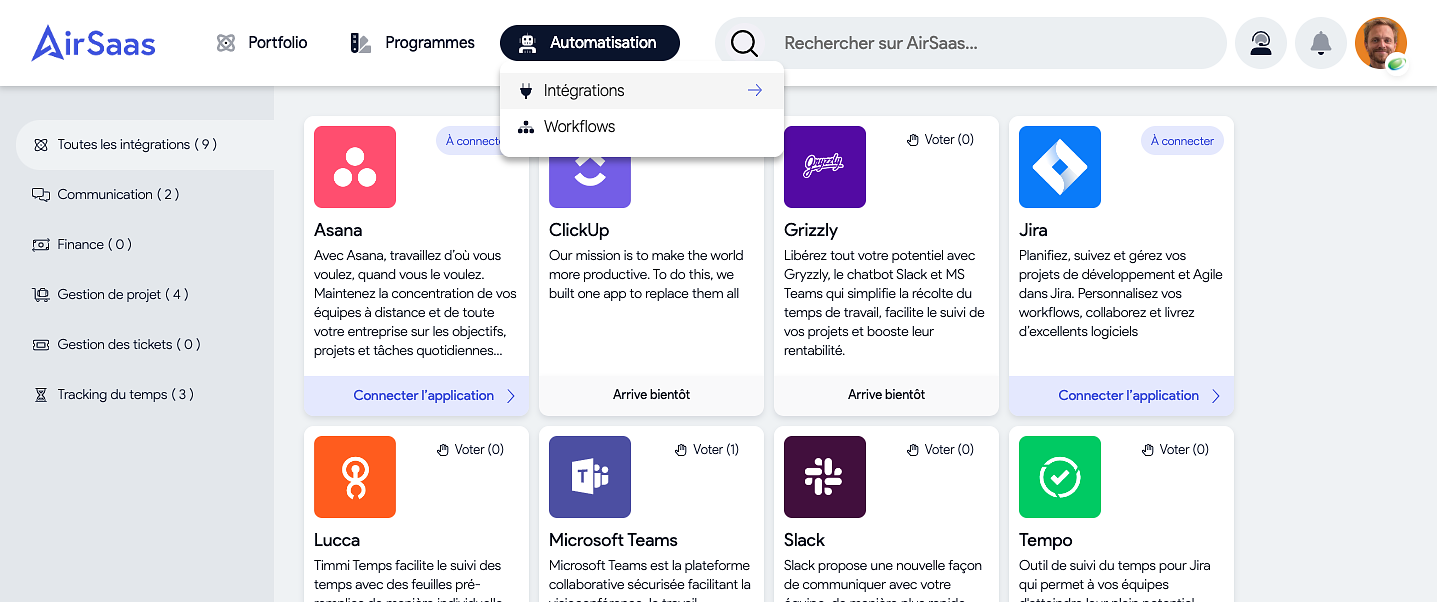
Syncing governance and project management, AirSaas Asana
After setting up the project-governance solution, Aurore quickly looked for a tool to help the business teams with their project and task management. “Once you break those silos, there's an organisation that has to adapt around it, and more suitable tools to put in place and get adopted.” What mattered to her: “favour tools that end users actually want to use, and with no re-keying of information”.
The first team this setup was rolled out with was marketing, with whom a Product Information Management (PIM) project was to be run. Over time, after the marketing teams, Aurore was able to bring other business leads on board for specific projects using this architecture: governance tracking with AirSaas + execution tracking with Asana.
Asked why she chose a best-of-breed Asana+AirSaas integration rather than an “all in one” tool, Aurore points out that she didn't find an all-in-one combining the operational and strategic views legibly for the different audiences.
«AirSaas is really oriented towards Sponsor / leadership committee / exec committee; it's ultra-synthetic and gives a high-level view.» Whereas in Asana she couldn't get that level of consolidation.
«When you're in execution, you need to go into detail, list every task, build your critical path, plan short term. Asana fits those needs. When you're in steering and governance, you need abstraction, to know how projects and decisions are progressing, without going into task detail. AirSaas is the solution we chose for those other uses».
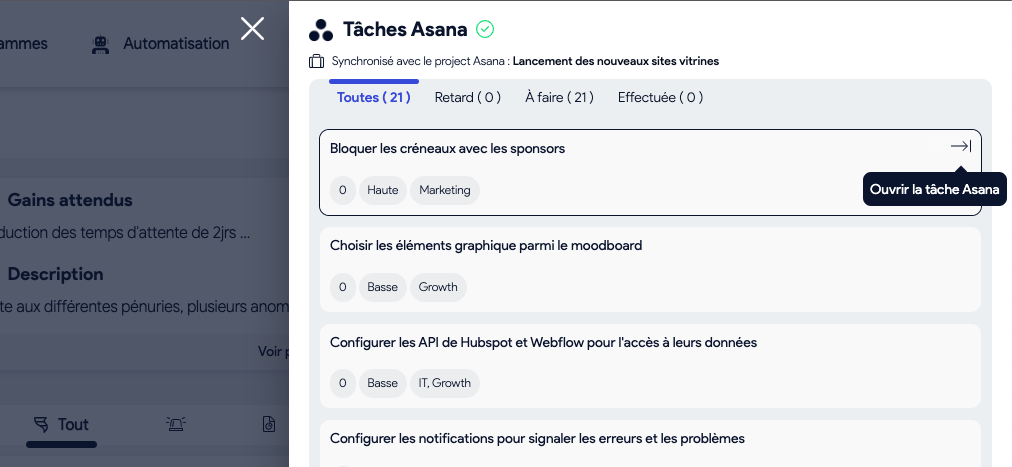
AirSaas view synced with Asana
That “best of breed” versus “all in one” choice was the key lever for bringing the business teams into these practices.
Bringing the exec committee on board, by approaching the transformation “from the top” of the portfolio
«General and finance management expect use cases and returns on investment. They need to understand a project's purpose, without drowning in technical detail, Aurore points out. And Excel isn't the best format to raise a flag or to get the leadership committee's attention.»
For our CIO, rather than an Excel file, showing the portfolio in a synthetic, ergonomic tool was a lever for simplification. «We managed to show the value and the scale of the team's work.»
After creating that shared transformation framework between IT and the business, faced with more financial, less technical audiences such as a leadership committee, Aurore made her steering and governance job simpler — by coming in not through overly detailed project and task management but “from the top”, through the value created. She managed to show the essentials and the purpose of the portfolio! That made it possible, for instance, to show the projects in “tamponade” that it made sense to postpone, and to keep the organisation focused on the priorities. «The more regularly you track things, the faster you can put them back on the right path», our CIO recalls.
She says she's fortunate to belong to an executive committee at the heart of the transformation. «Our tools are nothing without the approach that comes with them. That's where AirSaas brought a real plus. It made the governance / IT-relations side visible, where it was sometimes drowned in emails and Teams. The tool made it possible to show reality and to speed up decision-making.»
Bonus section:
What sets AirSaas apart from the other tools you considered?
For Aurore Butrot and her team, AirSaas is a synthetic, ergonomic solution to structure the governance of every project, in a simple, collaborative platform — and she recommends using it, combined with a “supercharged” project-management tool like Asana.
Your favourite feature?
The flash report in PowerPoint format. Aurore tells us: “We're very good technicians but not good PowerPoint makers! What works is the CEO's PowerPoint! AirSaas makes it possible to export that file in one click to send it to him the day before, so he has the information he needs to walk into the meeting without drowning! It contributes to IT's marketing”.
Quick bio - Aurore Butrot

Aurore started coding at the age of 8! She began her career in development, then project management, and finally team leadership. What drives her today is taking part in transforming companies — organisations that too often treat IT as the stone in their shoe! For Aurore, the IT team is on the contrary the one that sits at the crossroads of every project and can contribute to fine successes. Thank you to her for this story, which may help other leaders and managers looking for more effectiveness and more enjoyment!
Choose to gain time and control
Adopt an effective project-reporting solution today.
Building “processed trust” in the IT department with the Quarter Plan
Director of Digital Development and Information Systems at Mr. Bricolage
Structuring the project portfolio and making arbitrations more effective at Panzani
Project Portfolio Director & PMO
CIO roadmap: how to structure your project steering with the Quarter Plan?
Group CIO at Picoty