CIO roadmap: how to structure your project steering with the Quarter Plan?

Published by
Laurent Citton
in Group CIO at Picoty

Groupe Picoty
Sector
Energy & fuels
Number of employees
1300
Favourite feature
Quarter Plan
Quarter plan: align on your delivery capacity first
Being a CIO in a mid-market company in full transition often means navigating between a rock and a hard place. On one side, demanding business teams used to close proximity; on the other, technical teams whose resources aren't infinite.
How do you move from a culture of word-of-mouth and urgency to structured IT governance? Without friction, without a big bang — just by setting clear objectives and rules of engagement.
That's the challenge taken on by Laurent Citton, Managing Director of GAMAC, the in-house IT services company of the Picoty Group (energy distribution, 50 subsidiaries). In this case study, he explains how adopting a project portfolio management (PPM) tool and, above all, the Quarter Plan methodology allowed him to take back control of his roadmap.
“The first concrete result is showing that there's no point promising more than you can deliver. Today we've considerably narrowed the priority projects so we stand a chance of seeing them through.”
Laurent Citton — MD of GAMAC & CIO of the Picoty Group - AirSaas user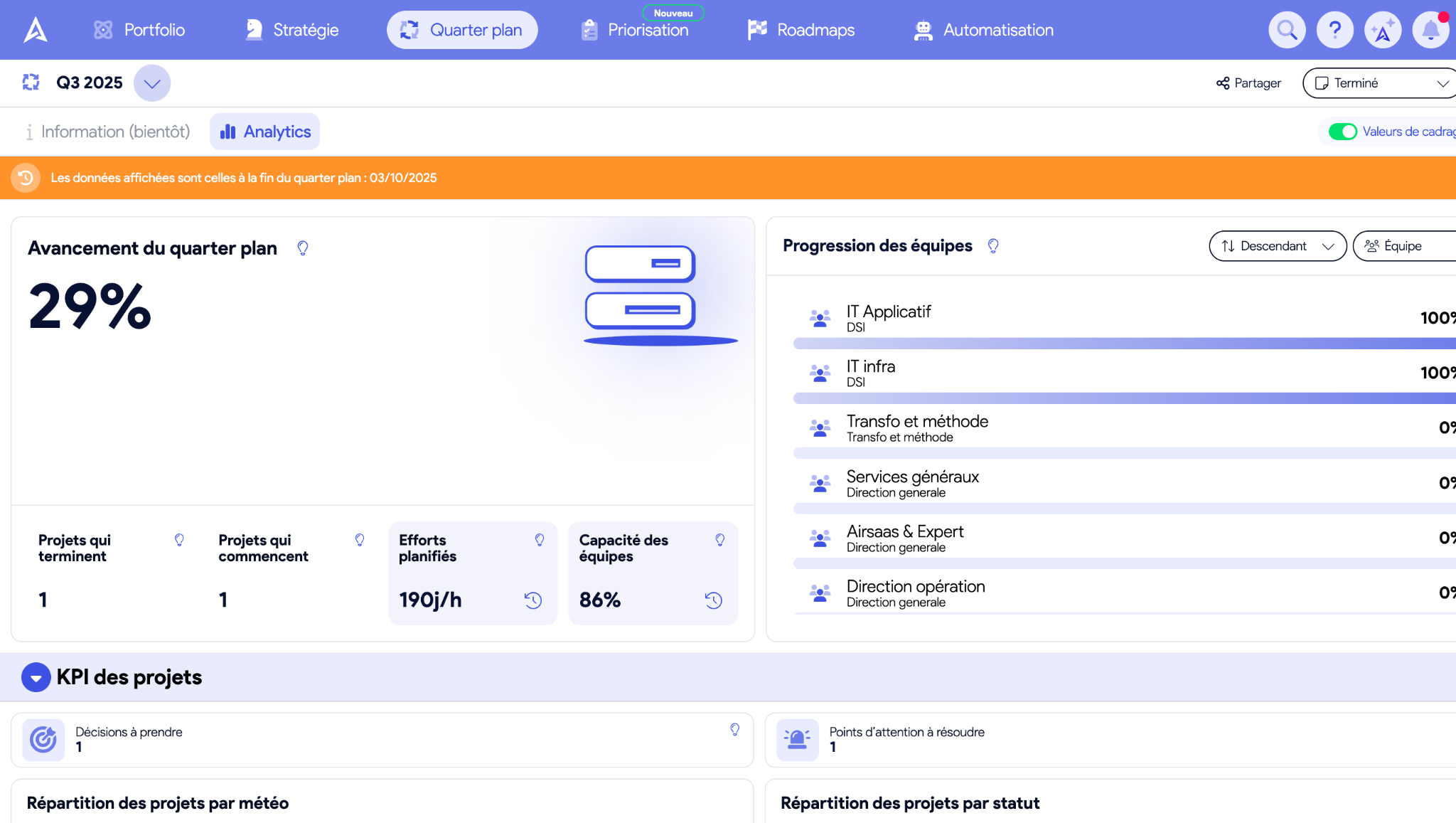
The starting context: strong growth with little method, and everything on energy
GAMAC has grown a lot in 10 years. A fine success that brought its share of complexity. Originally, the company's culture rested on very close proximity: users asked, IT delivered.
But as the group grew, that "on demand" model reached its limits, creating a typical deadlock:
- Prioritisation “by who's nicest”: "Whoever had the best relationship with the developers got their enhancements," Laurent admits.
- Congestion: Every project ended up stuck, for lack of genuine arbitration.
- Ill-fitting tooling: Laurent had tried very heavy tools in his previous roles (too long to implement), tools that were too light (task-management type) or the classic Excel/Jira/PowerPoint triptych — without success.
The IT department needed to get out of the fog and structure its approach.
The challenge: objectify in order to prioritise better
For Laurent Citton, the goal wasn't just to find software, but to implement a new philosophy of project management. He had three major imperatives to transform his organisation:
- Formalise delivery capacity: stop thinking you can do everything, and prove mathematically whether load and resources match.
- Make the business accountable: show stakeholders that asking for 40 projects with no prioritisation is counter-productive.
- Protect the "Run" teams: reduce untimely daily requests by clarifying the validated priorities.
The solution: AirSaas and the Quarter Plan methodology
It was while looking for a prioritisation method that Laurent discovered AirSaas. What convinced him? The Quarter Plan approach.
The principle GAMAC adopted is simple but radical: you plan over 3 years, but you commit to achievable objectives by the quarter.
1. Breaking work into milestones
No more 18-month tunnel projects. The IT department now breaks projects into verifiable intermediate milestones. "That's what we use to measure progress and what we present to stakeholders," Laurent explains. It also forces the teams to slice their User Stories more finely, thinking about the value generated for the business.
2. The ritual of tracking and refreshing the roadmap
Rather than freezing an annual plan that becomes obsolete in February, GAMAC practises a rolling roadmap — and has done for 2 years now. Steering happens in AirSaas and the rituals are run from the solution's smart views.
- Every month: a review of the milestones in the Quarter Plan to check everyone's commitments and adjust course if needed.
- Every quarter: a final "Planned vs Delivered" assessment (baseline) that makes it possible to build on experience and commit to deliverables for the coming quarter.
3. Capacity visualisation (capacity planning)
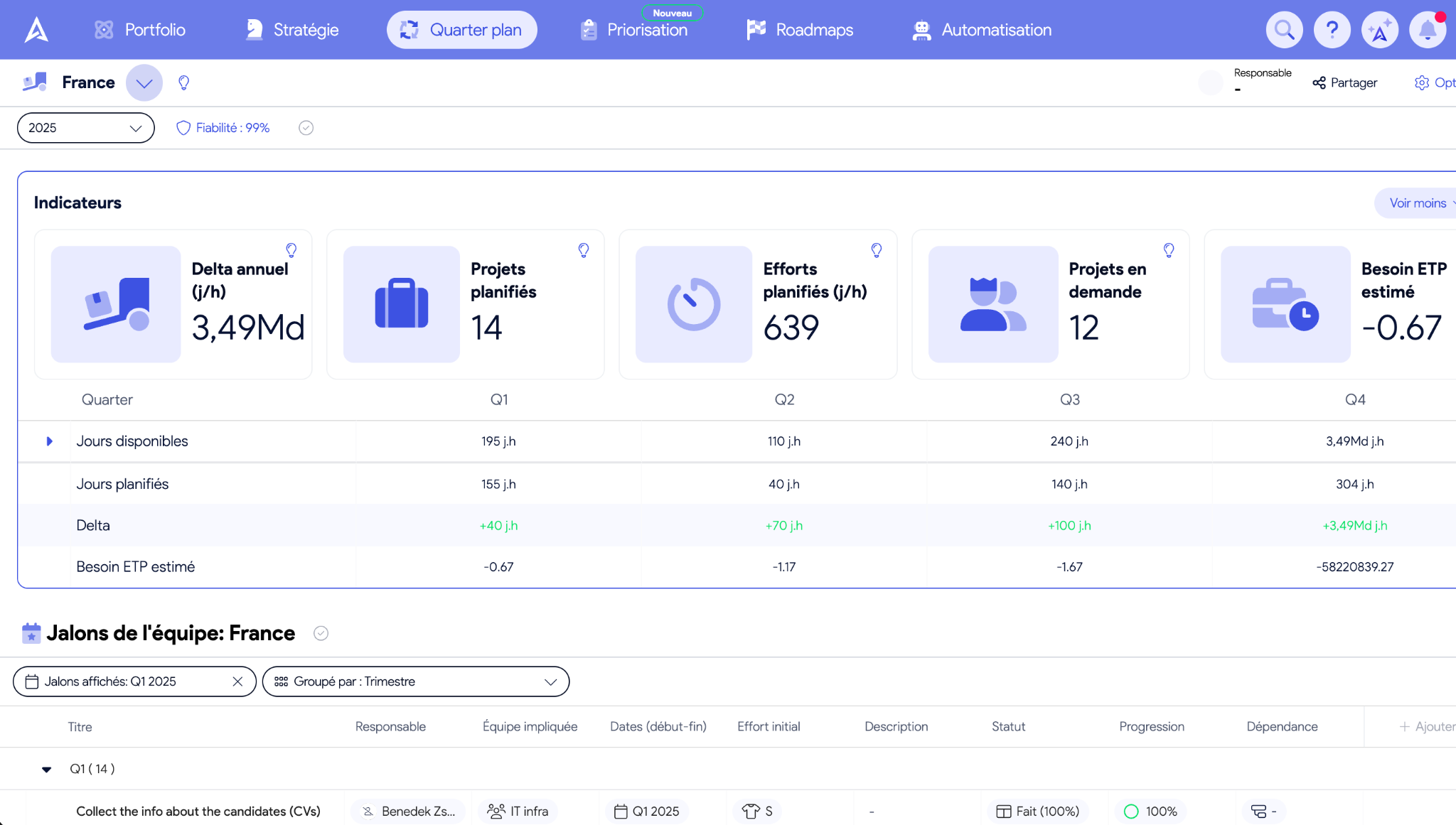
This is the pivot of the quarterly planning method. AirSaas makes it possible to see concretely that "80 milestones in the quarter means, for example, 800 days for the teams — and we don't have 800 days available in the team". That capability makes it possible to arbitrate factually between Run (maintenance) and Build (projects).
The results: a more focused and aligned IT department
The impact of rolling out AirSaas and the Quarter Plan goes beyond simple task management. It's a cultural change for the Picoty Group.
- Drastic prioritisation: the exec committee agreed to narrow the list to 3 top-priority projects and 2 secondary ones. The rest is postponed — not for lack of will, but out of capacity realism.
- Auditable credibility (validated by the ISO 9001 audit): during the certification audit — where ISO often sits awkwardly with Agile methods — AirSaas made it possible to prove delivery control and rigorous tracking of commitments.
- Calmer teams: "My teams aren't being pulled at day to day any more, because the priority projects are clear," Laurent notes. Fewer interruptions = more effectiveness.
"Just because we didn't do one project doesn't mean we did nothing else. AirSaas makes it possible to show stakeholders the load we actually spent and to give value to the work done."
Before / After AirSaas
Relationship-based prioritisation ("depending on who's asking")
"Tunnel" projects with no intermediate visibility
A feeling of being subjected to demand (IT as a bottleneck)
Scattered steering (Excel, Jira, word of mouth)
Rational prioritisation based on real capacity
Milestones sliced by quarter, clear, with commitments the teams keep
A conversation between equals with the business (IT as a partner)
A single source of truth for the project portfolio, and a shared steering rhythm with the quarter plan
The 3 keys to success for implementing AirSaas
If you're thinking of structuring your project approach like GAMAC, here is Laurent Citton's advice:
- Don't wait on capacity: GAMAC waited a year before fully switching on the Capacity Planning features. "It changed our lives when it arrived," Laurent admits. Start as early as possible to objectify your resources and create a capacity shock that forces prioritisation.
- Slice your projects into deliverables that carry value: don't create 6-month milestones. Granularity is the key to agility. Short milestones make progress visible and reassure the business and the exec committee.
- Use transparency as a shield: show your AirSaas screens to your leadership. When they see the load in the red, the conversation changes nature: you're no longer negotiating fanciful deadlines, you're arbitrating priorities.
About GAMAC (Picoty Group)
GAMAC is the in-house IT services company of the Picoty Group, a major player in energy distribution in France (station network, fuel-oil/wood distribution, etc.). Based in La Souterraine (Creuse), GAMAC centralises IT for around fifty subsidiaries, managing ERPs, infrastructure and the development of specific business applications.
Choose to gain time and control
Adopt an effective project-reporting solution today.
Building “processed trust” in the IT department with the Quarter Plan
Director of Digital Development and Information Systems at Mr. Bricolage
Structuring the project portfolio and making arbitrations more effective at Panzani
Project Portfolio Director & PMO
Bringing rhythm to the project roadmap with the Quarter Plan
CIO Office