Bringing rhythm to the project roadmap with the Quarter Plan

Published by
Émilie Lecart
in CIO Office
Sector
Hospitality & leisure
Number of employees
4750
Favourite feature
Capacity by team
“For me, AirSaas and the quarter plan mean structuring a shared project approach. IT is no longer seen as a unit you send requests to, that doesn't handle them fast enough, that doesn't do things well enough. We can now pass the ball back to the business, so that it owns prioritisation, based on our capacity to deliver. With AirSaas, we all share one plan: IT is no longer a black box that can't do anything and doesn't meet expectations.”
Emilie — CIO Office - AirSaas userHow do you manage the transformation of a large group's IT department? Without methodology, project culture and the right tools, the answer is: with difficulty.
That's why many CIOs turn to a pragmatic, structured approach: prioritising and planning by the quarter — also known as the Quarter Plan.
Here's a look back at the first quarter of a successful Quarter Plan, in a prestigious, fast-growing hospitality and leisure group, with Emilie, CIO Office, in charge of portfolio management, methodology and budget.
The starting context: a messy project culture and demand management
When she joined the company as CIO Office, Emilie discovered how the IT department had (very recently) been reorganised. Previously split between project studies on one side and design on the other, IT had reorganised to serve the business directly: hotels, restaurants, casino, plus support functions and marketing.
Despite a necessary reorganisation, Emilie found that, as things stood, steering the project portfolio was complex.
- On one side, she had to manage 60 to 65 projects a quarter… in Excel. Every CIO knows how much of a headache managing capacity and a roadmap in Excel can be!
- On the other, Emilie realised that demand management wasn't structured at all. As she puts it, IT was “a letterbox”, receiving barely structured project requests.
- Finally, she faced very heterogeneous project-management tooling across the IT teams: some used MS Project, others Excel, others Teams… The result: when requests reached her, the formats differed.
“Before AirSaas, we had a roadmap that was built, more or less. But there was no rhythm at all — that's part of what pushed us to set up the Quarter Plan approach.”
A heterogeneous project culture, and an absence of structure and rhythm, which made portfolio management very complex for Emilie.
The challenge: structure the project roadmap and give it rhythm
Emilie's objective? Steer the project portfolio better, by injecting methodology into demand management, capacity analysis and reporting.
Among the challenges she talks us through:
- Having a single source of truth for PPM — a wish that came from leadership itself.
- Giving top management visibility on project progress, to report better to the exec committee.
- Setting demand against delivery capacity, to accelerate the company's transformation and improve project deliverability.
The solution: a PPM tool as the single source of truth, and a quarterly methodology to plan the roadmap better
Good timing: when Emilie took up her post, the AirSaas solution had already been chosen by her manager, to steer the project portfolio at a macro, cross-functional level. Convinced that an approach that brings the business on board is crucial to that steering, she drove the Quarter Plan rollout.
First, Emilie worked hand in hand with the AirSaas experts to define a manifesto for the company's project culture. In workshops, the IT teams were invited to collaborate on a shared definition of “project”, “milestone”, and all the other terms needed to work together well.
That step was crucial to overhaul the organisation's entire project governance, and also all the teams' ways of working. A method that disrupts the established order — and therefore demands genuine change management.
“We felt we'd matured in project management when we validated the manifesto, when we delivered a copy stamped by everyone: it was quite a challenge. Now, when the teams step outside the frame, I can say: “remember what we defined together?” Setting that frame improved communication and collaboration. Without it, you're on quicksand.”
Once that manifesto was created, the AirSaas solution was rolled out to the IT teams. Emilie quickly took hold of the “Quarter Plan” capability and put the approach in place across the organisation.
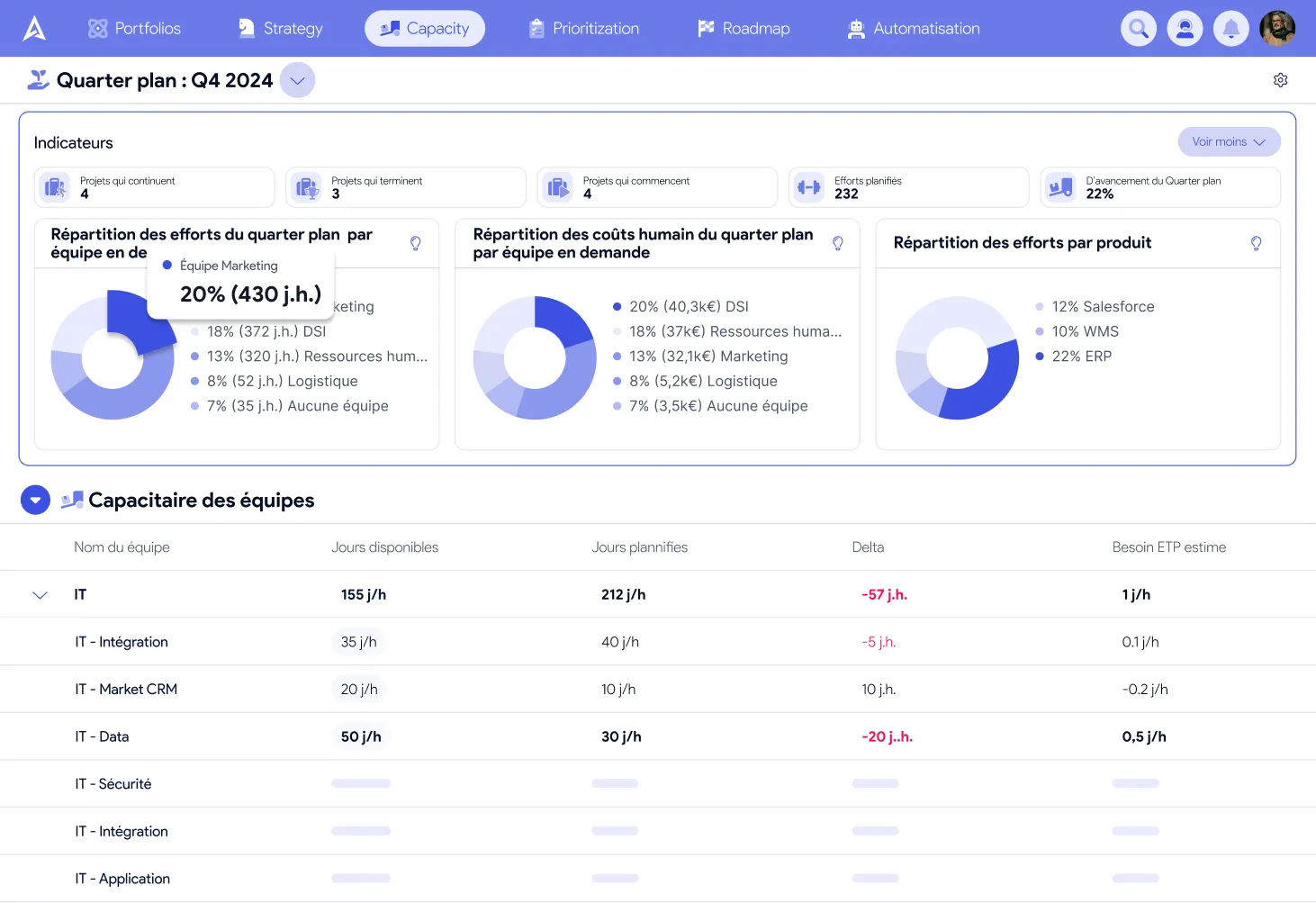
The idea: prioritise and plan projects at quarter scale, to align demand with real capacity.
Thanks to AirSaas:
- The teams declare their delivery capacity in the tool
- The CIO can arbitrate incoming requests against real capacity
- She can then continuously track delivery and project execution, and adjust priorities if needed
The results: a shared culture settling in around the Quarter Plan, and a new way of reporting
At the end of the first Quarter Plan quarter, Emilie is categorical:
“Today, the AirSaas methodology is my working base. And the platform itself is my source of truth, both on the projects and on the quarter's priorities.”
On top of steering at a macro, cross-functional level thanks to the Quarter Plan, Emilie arbitrates by setting business requests against the teams' real capacity, and reports more smoothly.
The CIO can now report to the whole IT department and the IT leadership committee simply, and also to each pod during team meetings. The platform saves her significant time.
On the Quarter Plan side, Emilie feels things starting to move — notably on project culture. Thanks to AirSaas and the Quarter Plan approach, IT is far better able to commit, hold its deadlines and be accountable inside and outside the department.
Next, Emilie wants to set up a demand-management ritual to structure the milestones further — which will positively affect her Quarter Planning. And beyond that? Rolling out AirSaas and the quarterly methodology to the business teams themselves:
“In future, AirSaas should let us have better conversations with the people in marketing and finance.”
Before / After AirSaas
A lack of structure in handling requests, which come from everywhere without being properly qualified
Business teams struggling to understand IT's constraints, leading to sometimes conflictual communication
Differing definitions in project management, making alignment hard between IT and the business, and between the IT teams themselves
Demand management under control, aligned with the organisation's real delivery capacity
Better communication between project managers and tech, thanks to a shared view of the portfolio
Governance completely overhauled, letting the organisation mature its project culture
Emilie's 3 keys to success for implementing AirSaas
- Have the choice of a tool or an approach like the Quarter Plan sponsored by the CIO. If your manager isn't convinced of the value of the methodology and the tool, they can't make it known internally to win everyone's buy-in. In short, the CIO has to lead by example!
- Don't underestimate the project-culture manifesto phase. It's an essential phase for framing projects — and therefore essential to any project, whatever it is.
- Put a lot of effort into change management, both with the teams and with the leadership. “You don't adopt a tool just like that” — especially when it carries a methodology different from the organisation's own. So multiply the training sessions, the Q&As, the exchanges with users.
About the company
Emilie's company is a group managing many assets in luxury hospitality and leisure, generating 700 million euros in revenue a year.
Choose to gain time and control
Adopt an effective project-reporting solution today.
Building “processed trust” in the IT department with the Quarter Plan
Director of Digital Development and Information Systems at Mr. Bricolage
Structuring the project portfolio and making arbitrations more effective at Panzani
Project Portfolio Director & PMO
CIO roadmap: how to structure your project steering with the Quarter Plan?
Group CIO at Picoty