Aligning delivery capacity and incoming demand with the Quarter Plan

Published by
Sébastien Louyot
in Group CIO
Altavia
Sector
Communication & marketing
Number of employees
2800
Favourite feature
Quarter Plan
“IT teams live in a mode where everything moves, all the time. In the past we did a lot of “stop and start”, and it's exhausting for everyone. Thanks to the AirSaas Quarter Plan, for one of the first times, we're giving them visibility — and that reassures them. They can plan what they're going to do over the next three months.”
Sébastien Louyot — Group CIO at Altavia, AirSaas userWhen Sébastien took up his post at Altavia, the company had set out a transformation plan through 2030 and its scope, broken down into nine main streams. Sébastien's role as Group CIO? Structure that plan into roadmaps of major IT projects.
But the CIO quickly ran into challenges around project prioritisation and capacity — not to mention the visibility and communication problems around that transformation plan.
It has to be said that the organisation's structure makes it fairly complex to execute. Sébastien can count on more than 40 people in Group IT, but he also has to work with other players:
- Local IT leads in each of the large business units, oriented more towards day-to-day user life
- Business counterparts in each of IT's major support functions (Finance, HR, Procurement…), oriented towards business process and applications
Faced with the organisation's transformation ambitions, Sébastien made a call: restructure his roadmaps quarterly, in a Quarter Plan approach. His objectives: make prioritisation easier for the departments, avoid overloading teams (and therefore project failure), and establish genuine transparency about what can and cannot be delivered in the coming periods.
Here's a look back at a first Quarter Plan that bodes well for the future.
The starting context: a large-scale transformation plan — but barely structured
“We come from a business (producing communication and marketing content) that's extremely reactive: we work a lot in response to tenders, with strong seasonality, and the teams are heavily paced by time. So Altavia has a real culture of reactivity, entrepreneurship and agility. On everything structural, though — project culture, processes — it's very weakly anchored. Originally the company is a federation of business units. For 95% of employees, their centre of gravity is therefore a BU with an SME culture. So the group ends up with the culture of a set of SMEs that came together and is now restructuring. That project and process culture doesn't exist yet — and it's what we're trying to bring in, notably through the transformation and all our technology topics.”
Altavia's transformation plan is mostly made up of long-running projects involving many external organisations (consultancies, integrators, suppliers…).
To track those projects, Sébastien first set up a fortnightly review where everyone prepared their PowerPoint. During the meeting, each participant presented their issues, their weather, their progress, their budget consumption… The result: those bi-weeklies lasted 2 hours, with everyone talking about their project for ten minutes.
At first, the ritual worked reasonably well.
And then, as in any company transformation, projects grew, overlapped, fell behind, got suspended for lack of resources. Sébastien and his team became aware of the many hidden inter-project dependencies.
The challenge: aligning delivery capacity with incoming demand
Sébastien then took the full measure of the challenge in front of him.
He observed:
- Heavy contention on the teams, who have a lot of run to manage on top of transformation projects. They absolutely had to stop over-committing in order to keep a sane pace.
- Requests arriving from everywhere. Strategic changes and business requests came from all sides, making it hard to plan IT activity.
- Hidden interdependencies that blow projects up.
Sébastien started by testing some first actions to tackle the problem.
On the infra, data and cybersecurity side, he set up Jira. The tool let him document run and sprints better, and also kick off a few transformation topics (notably infrastructure modernisation).
On the application side, he built a macro-plan to try to manage the dependencies and milestones of the various projects. That plan helped him gain a little visibility… but not for long. He quickly realised that the dependencies and links between teams make that kind of tool unmanageable, given how much the projects impact each other.
Sébastien needed more macro visibility on project progress, the ability to manage delivery capacity, and a more structured demand-management process. And that's where AirSaas came in.
The solution: the Quarter Plan to run the transformation plan at quarter granularity
Sébastien decided to slice Altavia's transformation plan more finely: he set up a Quarter Plan. He committed to an approach that gives him intermediate deliverables, on which he (and at the same time his top management) has more visibility, and which gives him the ability to re-arbitrate priorities over time.
That way he can visually show his peers capacity against demand, and therefore involve them far more easily in continuously prioritising projects on a capacity basis, and ensure more rigorous demand management.
He launched the Quarter Plan approach with the AirSaas teams. First, workshops were organised: they made it possible to understand the teams' pain points precisely.
Then the AirSaas Quarter Plan solution was deployed.
Thanks to the tool:
- Each team declares its delivery capacity for projects ahead of the quarterly planning meeting
- On the day, everyone can see the teams that are overloaded and how effort is distributed across requesting teams. The tool also makes the arbitrations and the commitments made by each team visible.
- Sébastien can continuously track the overall delivery and project-execution rate, and adjust priorities according to the realities the teams meet in the field.
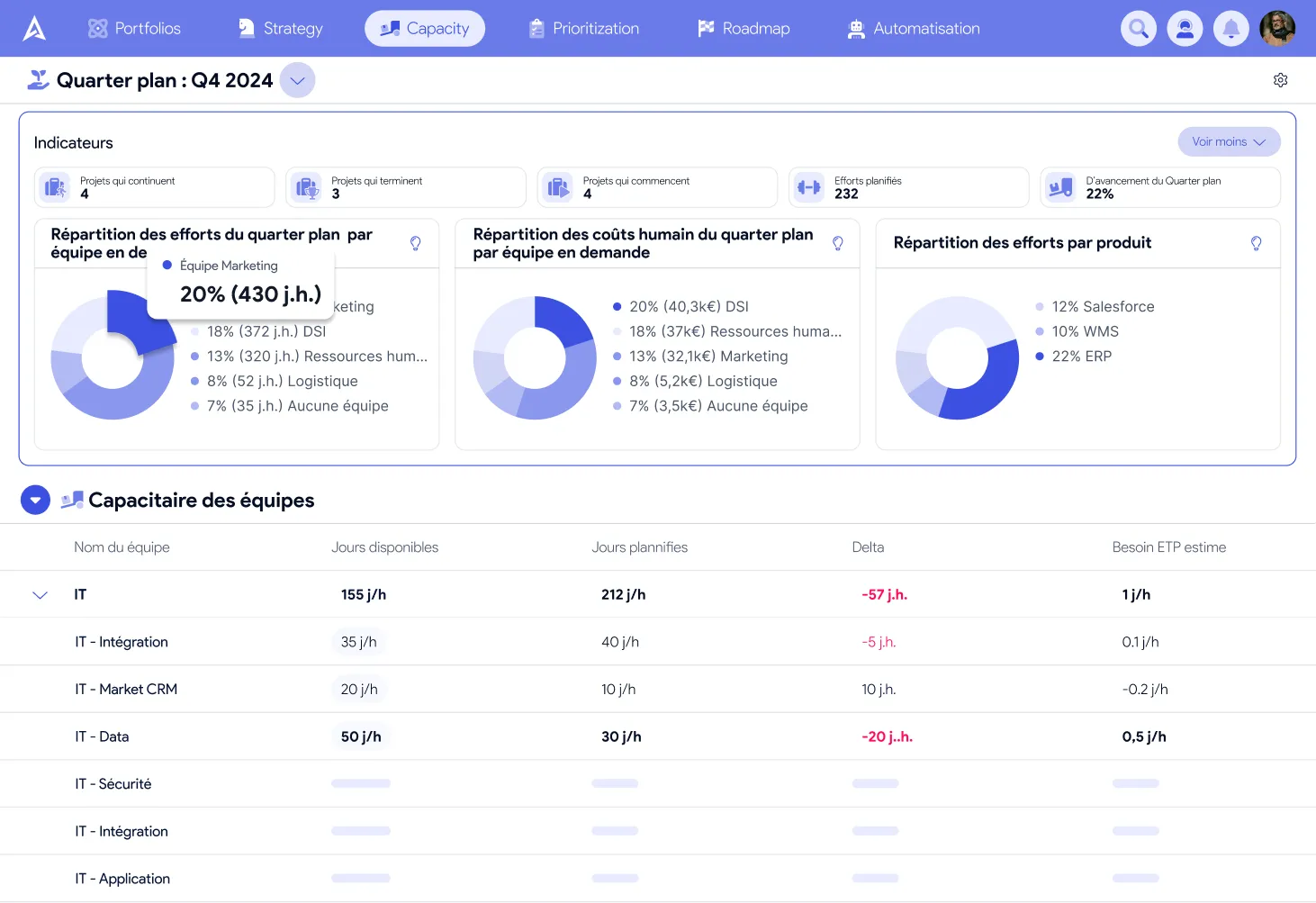
On 1 April, Altavia held its first Quarter Plan day. All the IT teams and every project owner collectively prioritised the deliverables for the quarter, minimised the risk of drift, and committed to their roadmap for the Quarter.
The results: increased visibility and improved communication
From that very first Quarter Plan day, the teams saw the benefits of the approach and of the AirSaas tool:
- Inter-team communication becomes more transparent. People discover projects they had no idea existed!
- The teams' real workload is revealed — and not without surprises! Some discover they're 300% over their real capacity.
“The teams knew perfectly well they were overloaded — but thanks to the Quarter Plan, they could put a number on it. The Quarter Plan makes it possible to materialise things people live with daily, and to become aware of the real problems.”
Following that first Quarter Plan, Sébastien warned his teams: from now on he only tracks projects in AirSaas. A smart way to create momentum around the tool and get the teams engaged with the platform. At the heart of the approach, AirSaas becomes the source of truth on a given project — and especially on cross-functional projects.
Now Sébastien is waiting to see next quarter's results.
“My main KPI is going to be the gap between what had been planned and delivery capacity. On the first Quarter we saw gaps of up to 300% — for the next one, I expect gaps below 150%. That we get a little better at planning.”
Enough to give IT more credibility with the business, and to improve Sébastien's reporting.
And for that, Altavia can count on AirSaas's support through to the end of 2025, over at least three Quarters.
Before / After AirSaas
Limited visibility on the teams' real delivery capacity
A fortnightly review that barely motivated the teams
IT teams overloaded by run, with regular “stop and go” on projects
Scattered demand management, hard to channel
Unclear cross-functional communication between group and BUs, based on time-consuming reporting
Optimal visibility on what each team can realistically take on
An engaging quarterly alignment meeting between the IT teams and the sponsors
IT teams motivated by the transparency of the transformation plan and the commitments they made themselves
Demand management centralised in a single tool, where every arbitration can be made
Cross-functional communication that is transparent and reassuring for every stakeholder
Sébastien's three pieces of advice for a successful Quarter Plan initiative
- Start from the team's pain points to set up the Quarter Plan and win buy-in. At Altavia, those were the capacity-management and demand-management problems.
- Take the time to anchor the Quarter Plan over time. Don't let the effort slacken after one quarter!
- Get support. If you try to do it alone, you never manage to make the time sacred. What's more, external support brings a fresh eye on the company's processes, and is more engaging for the teams.
About Altavia
Altavia is the leading independent group in communication and marketing for retailers and brands. Its activities include agency strategy, point-of-sale design and procurement strategy (supporting clients in buying print media, producing carbon assessments…).
Choose to gain time and control
Adopt an effective project-reporting solution today.
Building “processed trust” in the IT department with the Quarter Plan
Director of Digital Development and Information Systems at Mr. Bricolage
Structuring the project portfolio and making arbitrations more effective at Panzani
Project Portfolio Director & PMO
CIO roadmap: how to structure your project steering with the Quarter Plan?
Group CIO at Picoty