June 17, 202412 min readJérôme Dard
PPM software evaluation: how to run a successful RFP

Contents
The essentials in a nutshell…
Put yourself for a moment in the shoes of PPM software vendors when they receive a new RFP. These documents are often generic, full of consultants’ copy-paste, and based on barely edited past tenders. They almost always contain an endless laundry list of criteria, ranking features in Excel from “must-have” to “nice-to-have”. That’s often where failure begins.
For a committed vendor, responding to an RFP means answering a list of features where, more often than not, the underlying approach isn’t clearly defined — or is poorly thought out. Technical features matter, but they shouldn’t overshadow other crucial aspects such as the maturity of your current processes, top-management involvement, the solution’s ease of use, the strength of its community, customer support, scalability and integration with your existing tools. A solution that’s theoretically perfect on paper but hard to use or poorly supported can quickly become a burden — and simply not get adopted.
So the challenge isn’t just to fill in a feature scorecard, but to project yourself into a different paradigm. It’s about challenging the organization’s current maturity — and its people — on the practices tied to project governance. Where do they stand today in terms of maturity for each process at stake, and where do they want to go?
In a word, it’s about taking a fresh perspective on this project: not just as a software purchase, but as a socio-technical project focused on usage. That big-picture view is what we propose to develop in the article below. Our goal is to share our convictions to help you build your own “3D” view of a PPM RFP, with a reading grid oriented around People, Processes and Tools (PPT). And truly succeed in modernizing your project governance!
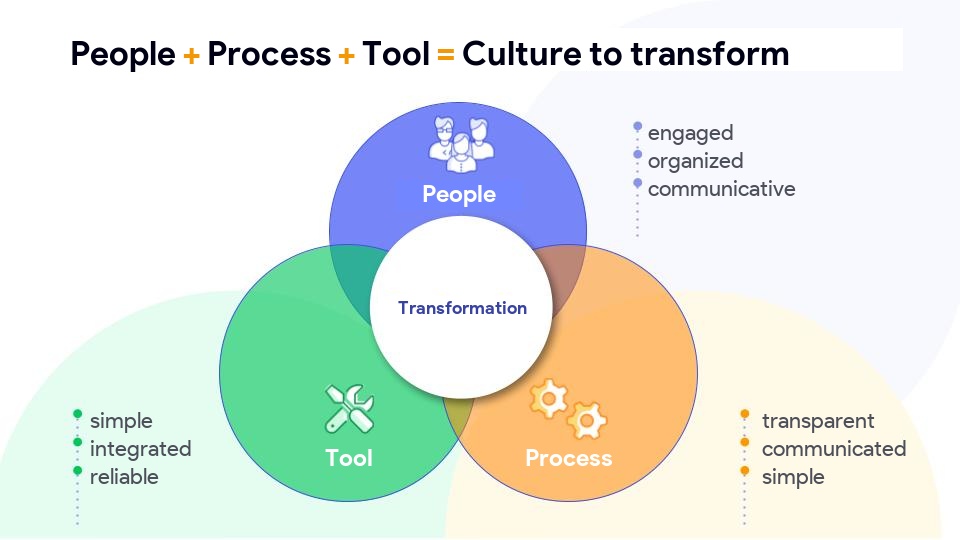
People + Process + Tools
Good news — you’re in the right place to grasp not only the letter but also the spirit of these approaches and tools. After a brief refresher on the academic fundamentals of the RFP process, we’ll debunk seven big misconceptions. Then, so nothing gets missed, we’ll walk through the nine steps of an RFP, with a summary of the key objectives and the resources to mobilize for each one.
Happy reading 👍
Seven misconceptions💡 to overcome to get your RFPs right
With a hundred or so PPM implementations behind us and our participation in many RFPs, we wanted to share our vision of the process by listing the seven big misconceptions we’ve sometimes run into. We wrote this article so we can hand it to whoever we talk to on the next PPM RFP! (Why not you!)
Disclaimer: of course we don’t claim to hold any absolute truth! We’re simply passionate about what we build with and for our clients, and we’ve been working on these questions for nearly five years!
❌ Misconception #1: This is about selecting a tool, not building an approach
Reality: A modern PPM is not some kind of “project ERP” for the IT department… No! Here we’re talking about governance and (effective) transformation of your entire organization!
Historically, it’s true, PPM was a tool centralizing all project data with more of a project-ERP mindset. These were tools with very little collaboration built in.
Yet, as you’ve seen, there are more and more projects, and those projects are tied to the organization’s transformation through cross-silo work (horizontal and vertical). And it’s become clear that more collaboration — and more commitment from top management — is needed.
A paradigm shift is needed! Top-management involvement is the foundational building block of the future implementation project.
Because behind the word PPM, what we’re really interested in is your organization’s project governance — the way your top management will embark (or not) on a different culture!
We’re interested in how your users will be able to see all the key information at a glance in a single collaborative platform, how to make decision-making easier, and how to save time on reporting.
Let’s keep this firmly in mind throughout the process: what are the key new practices that will move project governance forward, and how do we support the adoption of these new habits — continuously!
For each persona, what is their maturity level with regard to the process we want to put in place? Then we look at how the tool can support that process’s progression toward the adoption rates we’re targeting for each process.
Tools are usually siloed, verticalized for the people who were already doing project management. Here, it’s very different to have thought from day one about opening it up to executive leadership and the business units, so other departments get on board with the tool!
Top-management involvement really is the foundational building block of the ability to prioritize, but also to track, decide, communicate, de-risk projects… and all of that, continuously!
❌Misconception #2: all PPM-related processes are at the same maturity level across the organization
Reality: No — the (real) maturity level of each process must be taken into account before you dive in, and for each “persona”. The central question is how people will ramp up, and this is the moment to challenge the current processes.
You probably know the great computing principle of GIGO (“garbage in, garbage out”) — the idea that flawed or nonsensical input data produces nonsensical or “garbage” output.
The same principle applies to a PPM RFP. If you implement a solution on top of a low-maturity process, the new governance practices you’re expecting simply won’t materialize if their premises are wrong from the start!
Try handing a Formula 1 car to a learner driver… it might work… but it can also throw them off completely if there’s no specific coaching alongside!
Yes, not all your processes are equal, nor should they all be kept as they are. The RFP is also an opportunity to update your target operating model.
In short: for each target persona, it can be worth identifying and listing the key processes and their current / target maturity level — building a kind of maturity pyramid of the organization’s project governance.
It’s a bit of a chicken-and-egg story. With a less mature process, the tool will certainly help bring structure, but the solution and support needs won’t be the same.
On top of that, if the persona/process pair isn’t at peak maturity, you also have to accept — in our view — that the learning with the tool will happen on both sides.
We want to look at the adoption rate per process and per persona to better assess ROI and achieve a lasting transformation of governance.
❌Misconception #3: All-in-one solutions are always better
Reality: No tool will ever match your letter-to-Santa feature list! The key issue is that your PPM stays connected to the ecosystem of the best tools on the market.
An integrated solution may seem ideal, but it can also be too complex or too rigid to effectively address specific needs. Sometimes, a combination of several specialized tools offers superior flexibility and adaptability.
Time management, resource management, demand management, portfolio management, project and program management, financial management… for each of these seven big blocks of usage, if you set out to list every feature to analyze in order to cover everyone’s needs, you’ll still be at it in three months! And above all, no tool can satisfy every business team.
Yes, we’ll own it: there’s no point writing a detailed 100-page requirements document and preparing an Excel scoring card of must-haves / nice-to-haves comparing X weighted, (over-)rationalized criteria.
In the age of APIs, that’s no longer the main issue. If project management in Jira, Asana or Wrike works… let it work, and connect your cross-functional PPM solution to it.
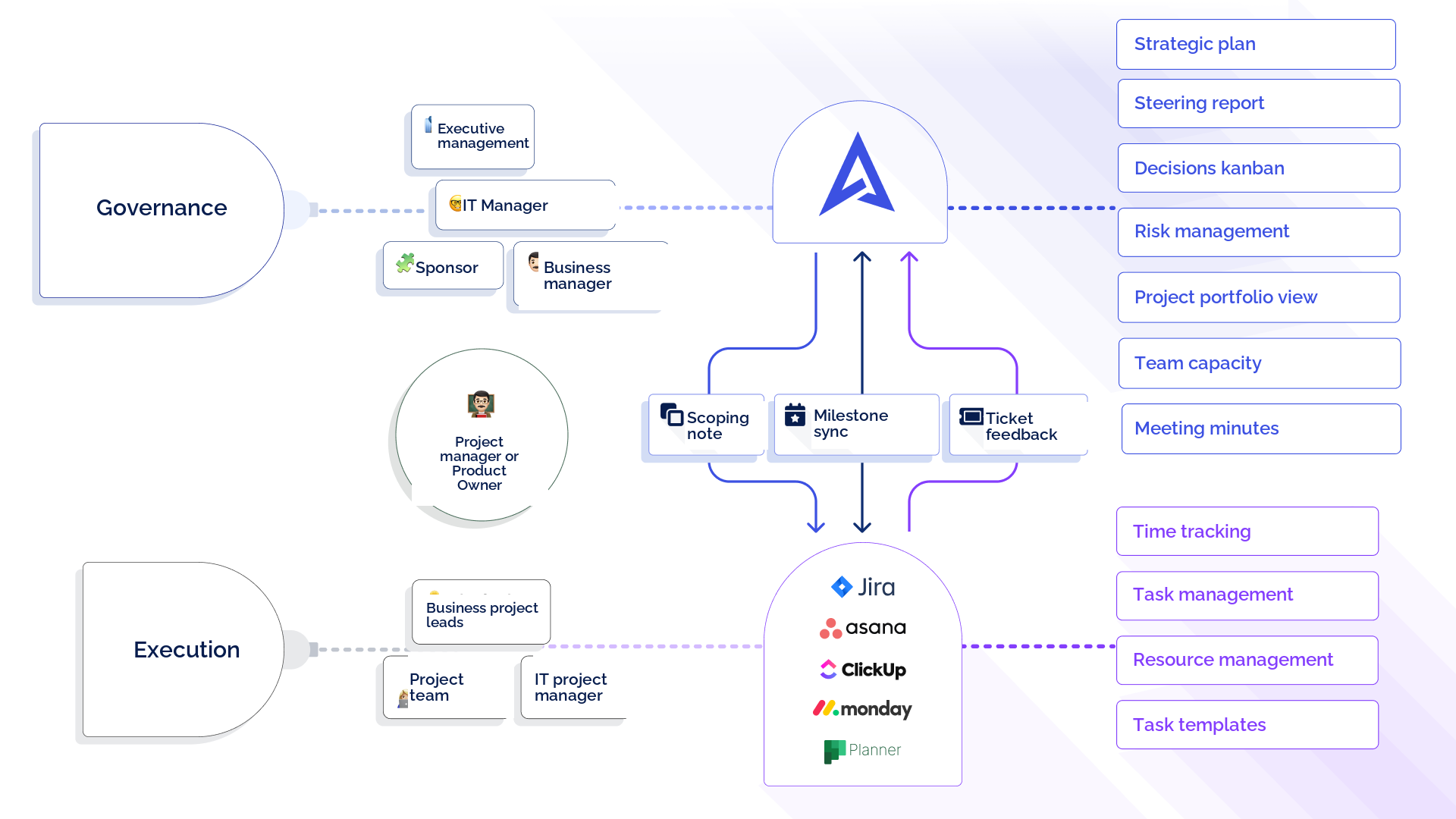
A PPM connected to the ecosystem of applications used in your context
In a world of ever-multiplying tools, it’s essential not to have to re-enter information from one tool to the next. AirSaas connects to your communication, finance and development tools to simplify daily life for everyone in the company.
Some PPMs, a bit like ERPs, aim to cover all of an organization’s needs in one single piece of software. Many of them are effective, but the lack of flexibility of such a solution once implemented makes it worth taking the time to think before you choose.
PPM "All in One" :-)
Choosing an integrated-tool strategy rather than “all-in-one” will make your PPM RFP easier
❌Misconception #4: You have to start with an RFP
Reality: No, not necessarily. At AirSaas, for example, we don’t always like working from an initial RFP. Why? Because RFP means big, big rollout, big project… We often offer our clients a first phase: a POC of the approach and a test of the tool for six months to a year.
Concretely, instead of stretching out the RFI then RFP study phase… the time budget of internal teams and consultants is used to take action. We start with a first workshop built around a hundred questions to assess the current organization’s maturity.
A workshop with you, with us, and with selected members of AirSaas’s Transformation Pros community (CIOs, PMOs, Transformation Directors, former CEOs, etc.) — in short, people who have been there before and know the problems and the solutions.
In a second workshop, we play back our findings. Behind each finding there are problems, and organizational tactics that are more or less aligned with the AirSaas approach — some are already very good, others are getting close.
Then comes the third workshop, where we define an organizational project manifesto. What is your shared vocabulary? I’d bet that the words project, program and milestone don’t even have shared definitions across the organization.
At the end of these three workshops, we’ll collectively be able to project ourselves into a realistic approach, given the context and the maturity of the organization and its people on the major processes supported by the companion tool.
Without this approach, the data you’ll be relying on will be continuously wrong. Your strategic data: would you rather have it roughly right, or precisely wrong?
❌ Misconception #5: A PPM tool is magic!
Reality: it’s essential to be more ambitious about buy-in to the facilitation approach around the tool, and to factor in the importance of the community behind it.
Ever heard the phrase “we’re very agile, we use post-its”? It’s the same for project governance… plugging in a governance solution, however ideal, isn’t enough to transform!
If we had to put a number on it (OK, it’s subjective), we’d say the tool accounts for only a third of the solution to the problems your organization is tackling!
Yes — beyond the tool, the community around the vendor is a guarantee of future adoption.
And yet, another third of successfully implementing a different project culture comes down to management and the sponsors, who will be asked to stay involved continuously. To change habits and rituals.
The last third belongs, of course, to your key users — especially the project managers across all the business units involved — who will see the tool not as yet another reporting chore but as real support to cut down the number of meetings, limit re-entering information, speed up decision-making, keep total transparency on project priorities, and say goodbye to micro-management.
❌ Misconception #6: Implementation isn’t a priority during selection
Reality: The complexity of implementing a PPM solution is often underestimated. A solution that’s easy to roll out and easy for teams to adopt can make all the difference. Involving stakeholders from the very start of the process is also fundamental.
If the user interface is complex and unintuitive, if it requires intensive training before employees can use it effectively, the steep learning curve will discourage widespread adoption — and most of the advanced features will go unused.
To maximize your chances of success, choose simplicity over a “project ERP”. AirSaas offers a simple, next-generation PPM tool.
Simple, because everyone can use it. Simple, because it comes with an ergonomic, intuitive interface. And simple because you’ll be up and running from day one.
If it’s more complicated than Instagram, we’ve lost
Yes, a PPM tool doesn’t have to be complex and costly to implement. A solution that’s easy to roll out and easy for teams to adopt can make all the difference. Involving stakeholders from the very start of the process is also fundamental.
Conclusions
A PPM shouldn’t just help you steer your projects better; it should bring more value to the company. AirSaas, for example, lets you track the essential indicators and measure the return on investment of your actions.
It’s because it was designed with a community of Transformation Pros that this focus on value sits at the heart of the AirSaas solution!
By questioning this misconception, organizations can adopt a more nuanced, better-informed approach when selecting PPM solutions, focusing on real value and strategic alignment.
By fighting these misconceptions, organizations can dramatically improve their chances of success in evaluating and selecting PPM solutions. A well-designed RFP process, based on objective criteria and hands-on evaluations, is essential to choose a solution that not only meets today’s needs but also adapts to the organization’s future evolutions.
This paradigm shift will therefore rest on five strong principles:
- Knowledge of the personas’ key processes AND of their current / target maturity level
- Testing the tool in real conditions with real data for a few months.
- Setting up transformation support with a Transformation Pro — Software with a Service (#SWAS).
- Continuous top-management involvement in the approach.
- Focusing on impact and value!
As you’ll have understood, there is no perfect PPM solution. Every tool has its strengths and weaknesses. Rather than sending over a cold Excel file, what matters is sensing which one will “click” — the one that will best align with your processes, your company culture and your strategic objectives.
More on our dedicated page: the next-generation PPM tool - PPM software
What if you took back control of your project portfolio?
Book a demo and discover the tool in 30 minutes.