September 22, 202311 min readJérôme Dard
Agile en Seine 2023 recap
Contents
Thanks to the whole Agile en Seine team for the organization: Amina Bourguiba, Franck Beulé, Farida Mellouk, Arnault Etouman, Caroline Castillo, Soun Banh, Couthaïer Farfra, Chrystelle Cogneville, Alain Sallon, Janro Pons, Mélina Cowsy, Badr Zeroual — and a special thank-you to 🙏 Couthaïer FARFRA 🙏 for making our participation possible on behalf of the Pro de la Transfo / CIO Révolution community.
7th edition, 940 attendees, 125 speakers!
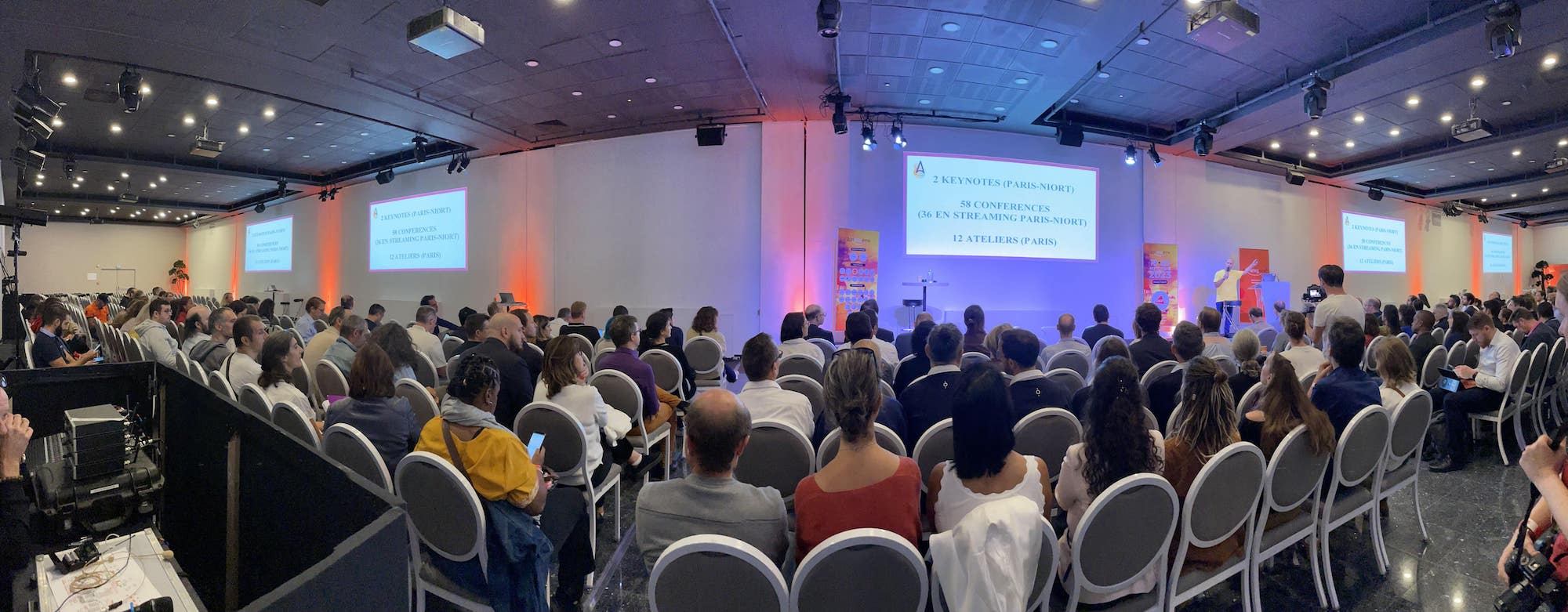
Photo credit: AES organizing team
We heard a lot about business agility, Lean Portfolio Management, OKRs, agile at scale, product-at-scale approaches, frameworks — and SAFe of course... on everyone's lips, for better or worse… ^^
In short, great real-world lessons for the #Pro2latransfo community.
The program was built around 4 tracks:
• SCALE: all about transformation at scale.
• THINK: toward new ideas!
• PRODUCT: keeping the essentials alive and evolving.
• BEYOND-IT: looking at non-IT sectors where agility is making its way in.
Here is our (inevitably subjective) selection of takeaways from the talks we attended, for AirSaas's #Pro2latransfo community and the CIO Révolution podcast.
Opening keynote by Julia de Funès on "meaning and responsibility in times of crisis"
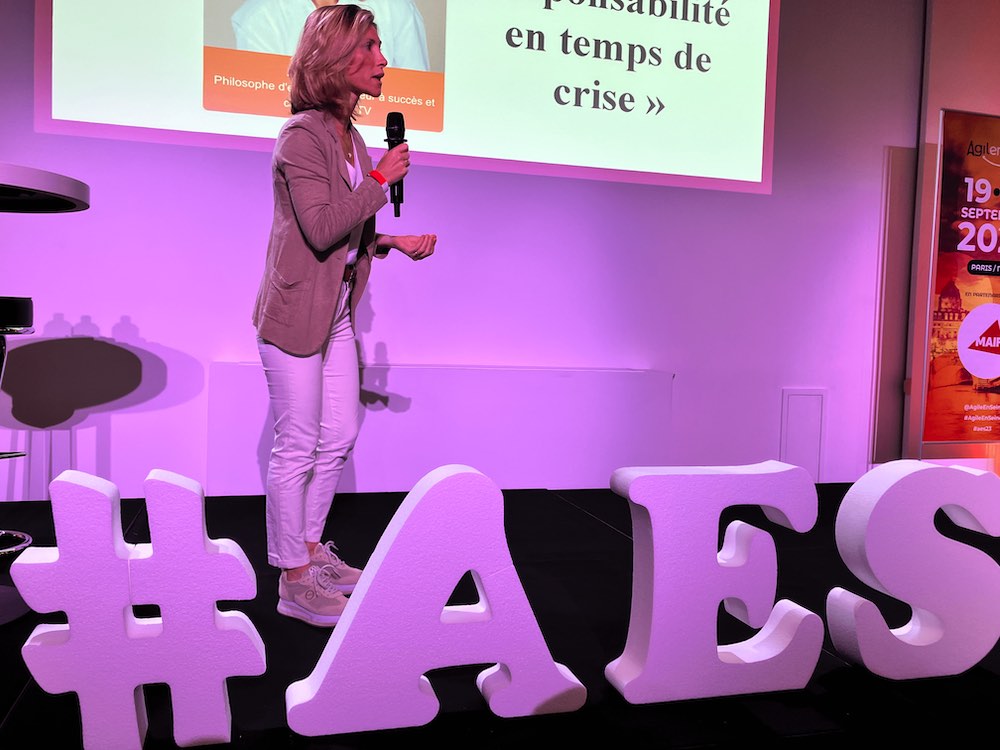
Julia de Funès at #AES23 on "meaning and responsibility in times of crisis"
Trust and transparency get conflated — when in fact trust is the opposite of transparency, which belongs to the realm of knowledge.
Trust is profitable!
Having a true "manager's posture" is an antidote to charisma.
We are elevated by the trust we receive.
Processes? The poison is in the dose! Beware of procedural overdose.
Companies rushed into well-being with "happiness gimmicks — candy, foosball tables… but it doesn't work!"
Kindness: there is nothing more violent than not confronting each other (not to be confused with conflict).
Work is not an end in itself but a means, because it is always something else that justifies work. Not everything that has a price is a moral value.
Fear is now a sign of maturity.
Manager's posture/impostures = the antidote to charisma.
Leadership is a matter of authenticity more than technique.
The key value is courage.
It's important to strike the right balance with processes. Of course you need processes, but you must avoid the overdose — and avoid rolling out processes in areas where they bring no value (proceduralized well-being, for instance?).
Sometimes you also need to know how to take risks (practical intelligence, in Aristotle's sense).
And of course you also have to create meaning in a company. Technique is only the means.
Agile transformation: pick your battles with OKRs (RATP case study)
Anne Gabrillagues (coach) and Florence Lyon (Transformation Director) shared the behind-the-scenes story of their transformation... in a context where the team is drowning in direct and indirect requests!
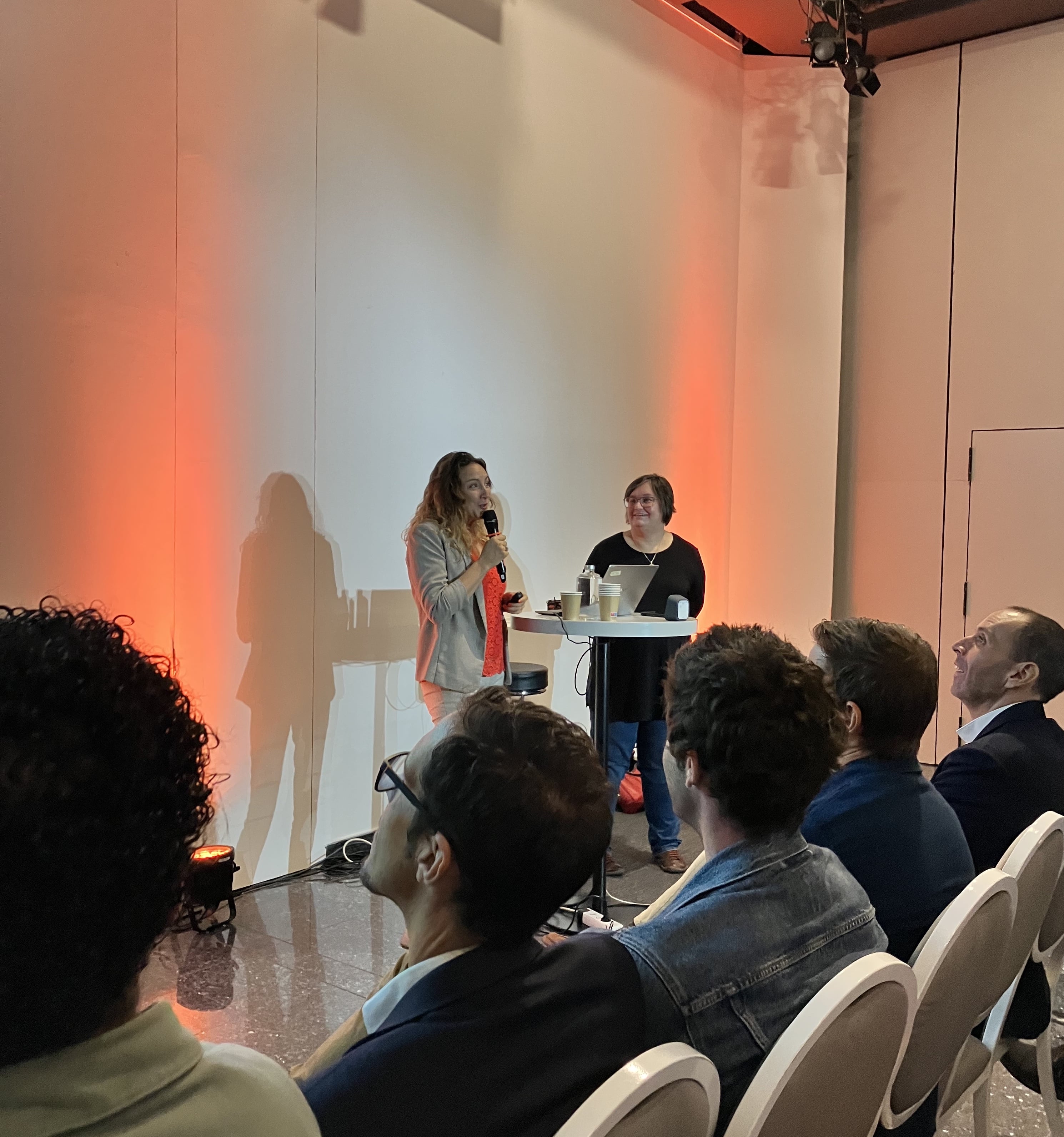
Florence Lyon (Transformation Director) and Anne Gabrillagues (Agile Coach)
The essence of their story: prioritizing and steering is the key!
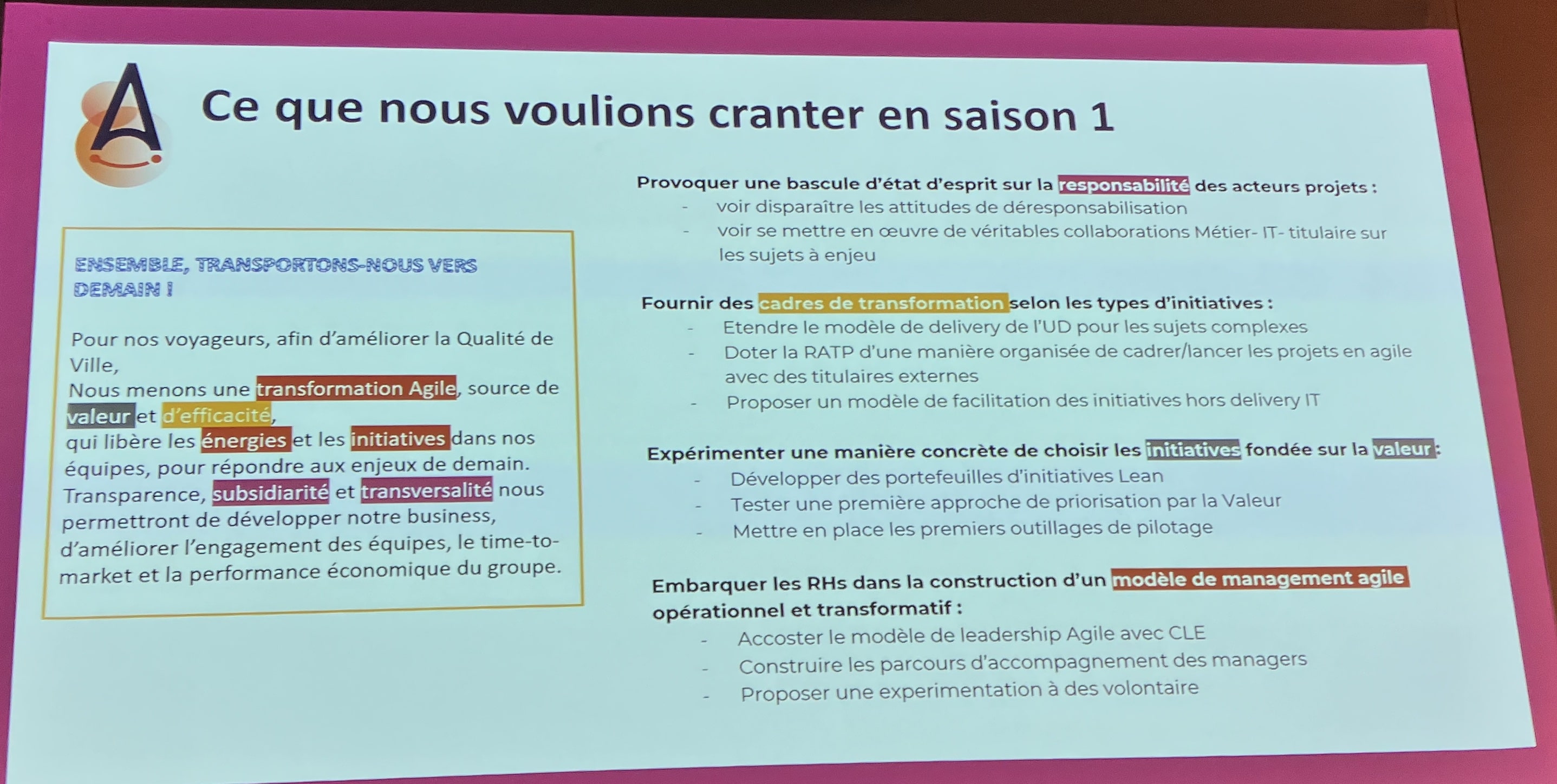
Our transformation manifesto, co-written with the sponsors, served as our compass.
We did deep work on the notion of ownership versus the external-vendor culture.
Don't forget that transformation activities come on top of the teams' regular work.
Our goal was to find the right degree of process: enough framework to secure things — and to set people free.
Prioritizing by value is the key!
Among the lessons learned, we ran into a lack of data that we hadn't sufficiently anticipated. We developed an obsession with regular measurement ^^
Too many tools kill the tool — agile coaches always have plenty of tools!
PMU tells the story of its (long) road to becoming a tech company!
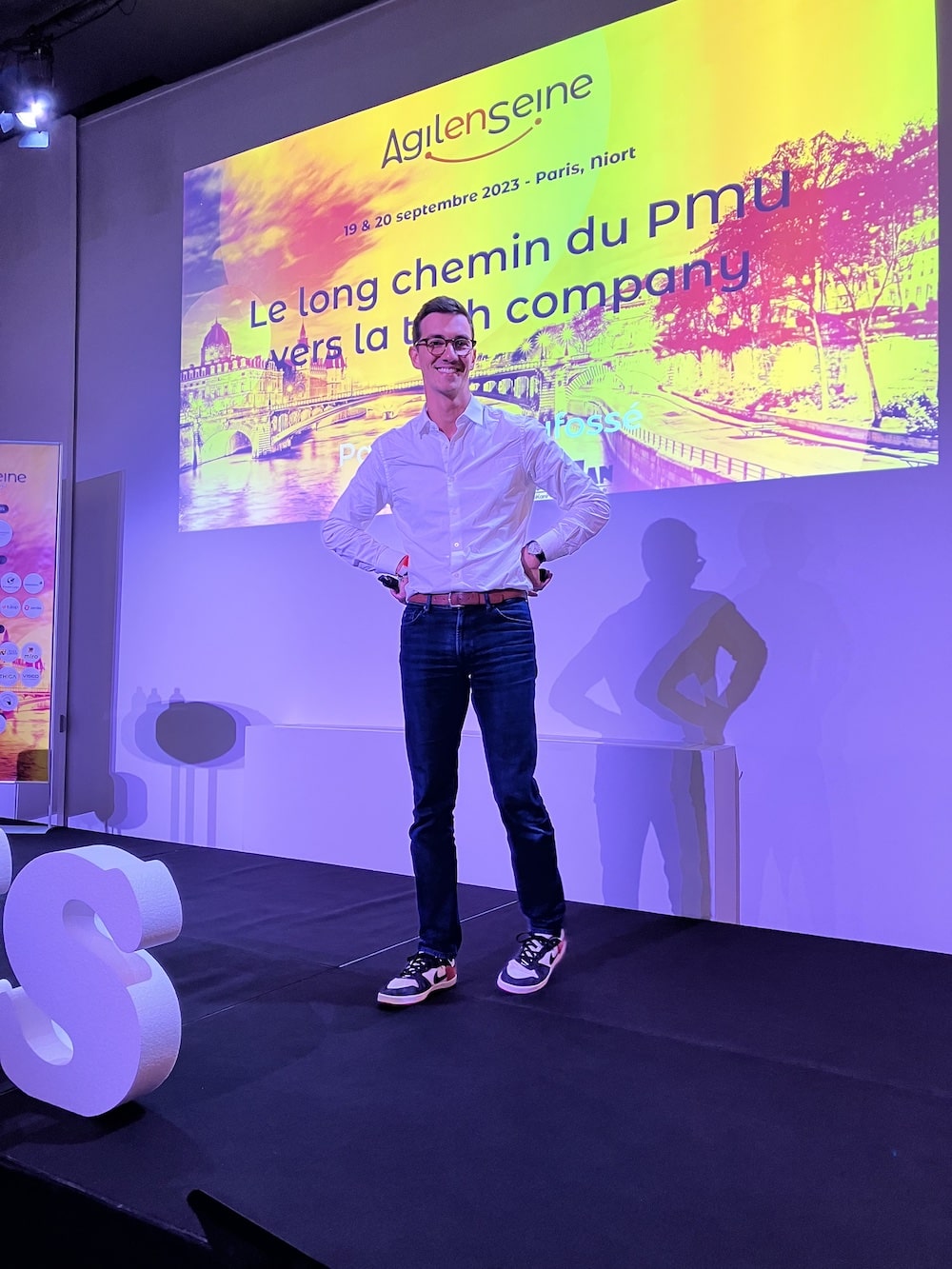
Nelson Dufossé, Release Train Engineer
While many people only see the horse-race betting and the PMU bars... the hidden side — and the demands placed on the IT systems — are colossal! 2,000 transactions per second, odds recalculated every 5 seconds, production releases every day… an IT department of 400 people out of 1,200 employees.
Nelson Dufossé, Release Train Engineer, presented a focus on the last 4 years... life as a tech company, its multitude of parallel ambitions (recruitment, structuring the management, AWS migration, new product creation, hardware overhaul…) and how they make it all possible with SAFe trains.
For 20 years, every tech company has been facing more or less the same challenges: managing to scale, working on robustness and quality, people problems...
Organizing agility at scale
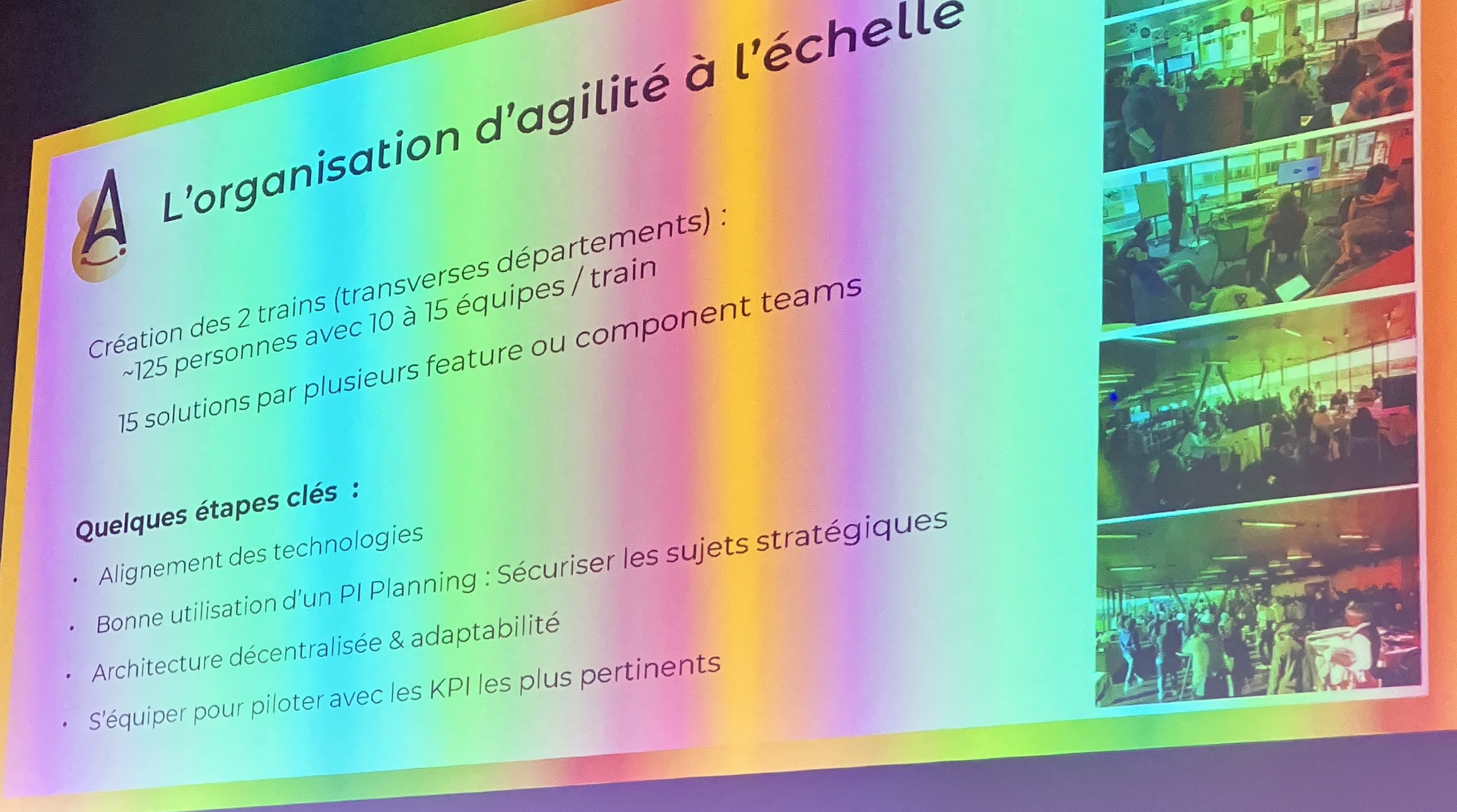
PMU: organizing agility at scale
To launch agility at scale we created two trains cutting across departments, with 125 people... 10 to 15 teams and 7 solutions per train!
On the obstacles side:
- Heterogeneous practices
- Not enough communities
- Little cooperation
Their overall approach relies in particular on making inspection part of their culture, building on "authentic feedback + attempts".
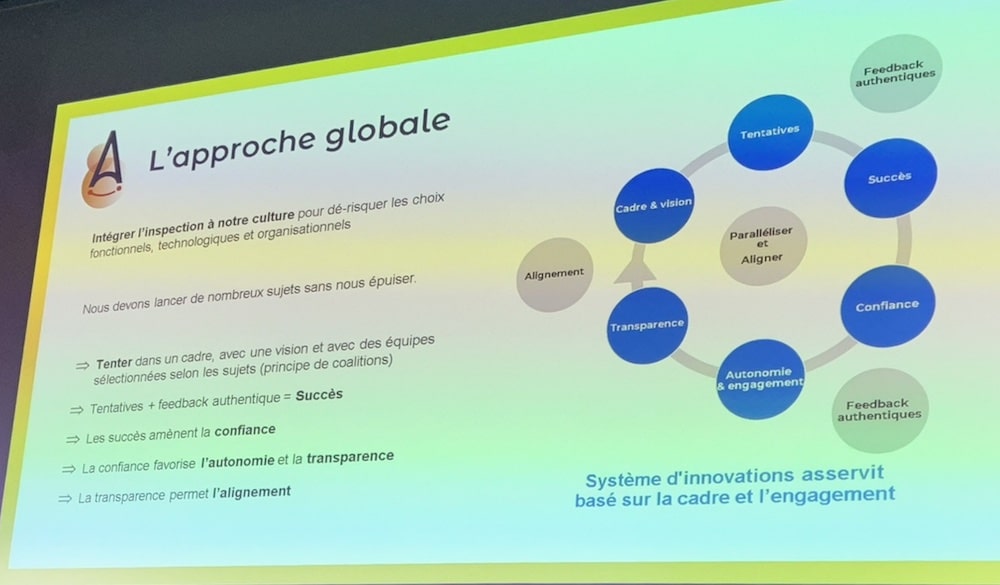
Innovation approach @ PMU
They say the first step of a transformation is to throw people into the deep end.
PMU, on the contrary, built an innovation system — from a tech, organizational and functional standpoint — that makes it safe to experiment and de-risks the choices. A system based on trial, error and readjustment...
Success builds trust. Trust fosters autonomy and transparency. Transparency enables alignment.
Today we own our delivery end to end, from the initial idea with the business all the way to production.
We transformed our PI planning... our real challenge is to secure the most important topics!
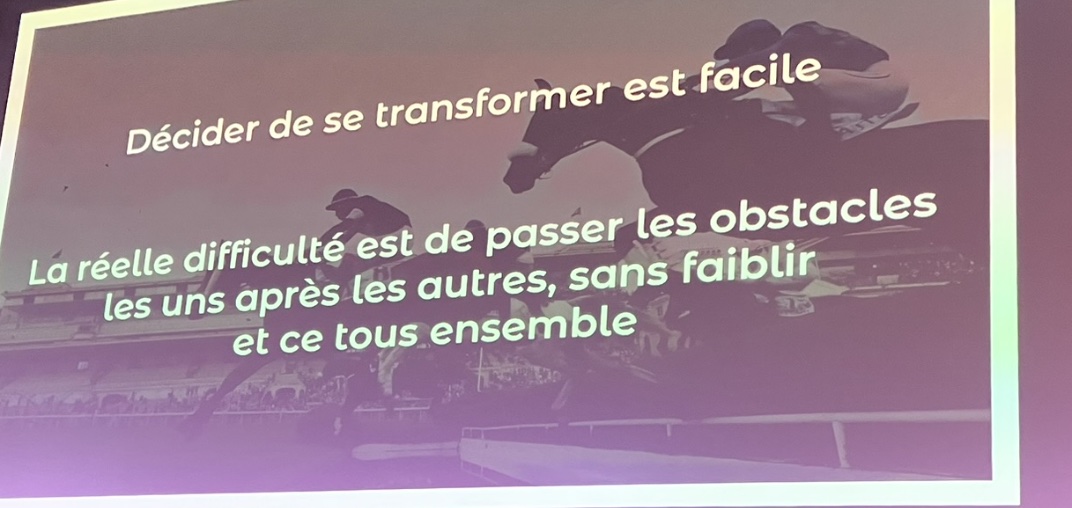
On skills and alignment
As soon as we belong to a system, a minimum of alignment is needed to really make progress.
Training is part of the strategic plan, with a budget > 100K.
PMU also made maintaining skills a strategic priority, notably by setting up communities. Six communities were created: Scrum, Product, QA, Ops, Back, Front.
By bringing people closer together... you see that all the problems naturally get simpler... when there are dependency problems, for example, it works better because people actually talk to each other!
Note that contributing is part of individual objectives, and that communities account for about 20 hours per month in people's schedules.
A longer recruitment process
PMU has ambitious recruitment targets for its IT department — around 70 people.
On the recruitment side, we realized that most of the expertise was external. The right solution is a mix of external consulting and internal teams.
And if we want to be a tech company, we need the best! Against the grain of fast-track processes... To get the best, we put candidates through a fairly long process: a take-home coding exercise, a review by someone from our team, interviews with HR and with operational staff. All of this to assess whether, beyond being a good developer, they will be a good element within a system. Because today, hard skills without soft skills are useless.
(They estimate the recruitment time at 10 hours.)
What's next
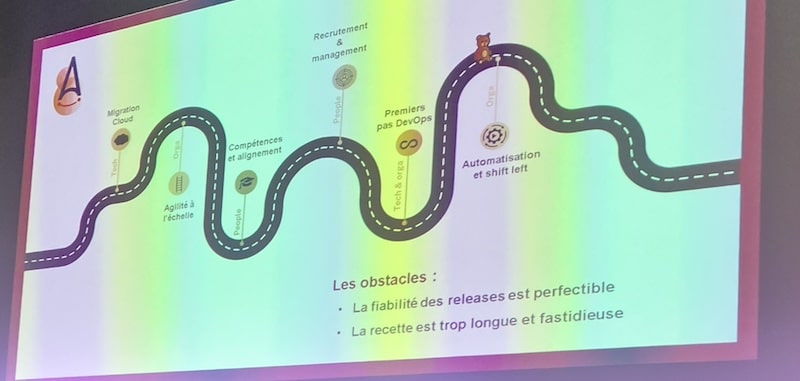
PMU's long transformation journey
Today we've started a product department and a data department to put data at the center, and to bring IT and product together so we can make decisions at the leadership-team level on truly strategic topics instead of going off in all directions. There's a real need at that level; we're going to strengthen the SECOPS side and other areas.
Agile Lean Portfolio at the Renault Group
The IS/IT & digital teams looked back on their rollout of Lean Portfolio Management (inspired by SAFe).
They shared their Digital Portfolio governance, seen as a lever to strengthen the group's strategic plan.
aka "Managing transversality in an enterprise portfolio".
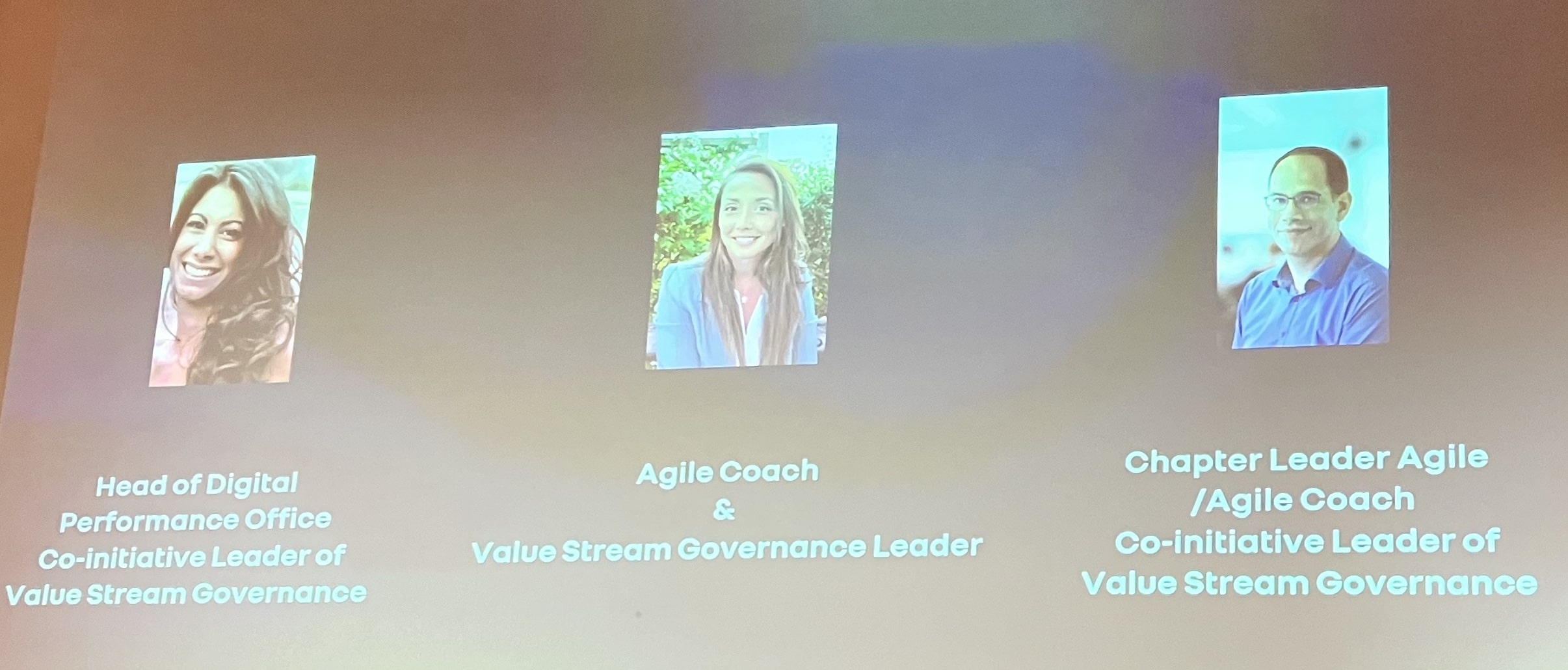
Esra Soner, Aurelie Sale and Mehdi Balza
The deployment teams — made up of the Performance Office, the Agile Pole, the PMOs and the Enterprise Architects — roll out governance and tools that maximize value-creation and growth opportunities, from the Group's OKRs down to the operational level.
Renault's LPM addresses the challenges of steering across value streams — in particular how it helps executives and directors align on managing cross-cutting programs, calculating value and steering budgets.
Helped by a group-level OKR rollout, the deployment of LPM from products out to the whole strategy is under way.
Toward a different governance?
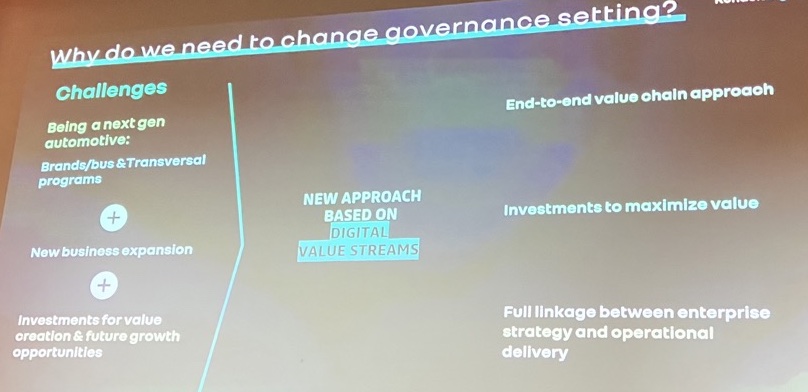
Toward a different governance
On the governance side, the setup was based on governance driven by the business lines.
The agile teams were so business-oriented… that it was hard to know their contribution to the company's overall strategy.
The challenge: a new governance to bring transversality.
The decision was made to set up governance driven by the group's value chains. A digital value stream.
This governance allowed us to manage the complexity of the business.
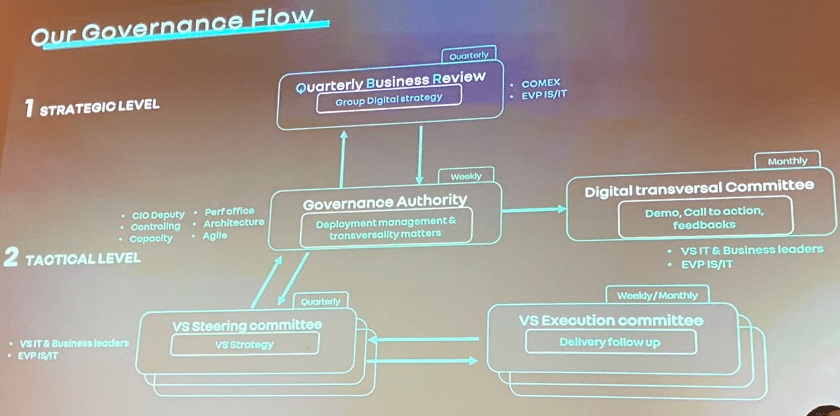
The governance flow
The governance authority is the owner of the what and the how.
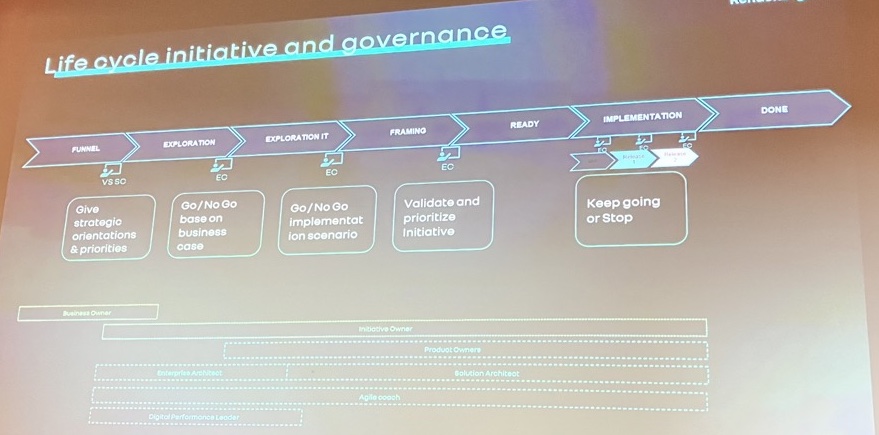
Lifecycle of initiatives and governance
"Value driven": a prioritization matrix
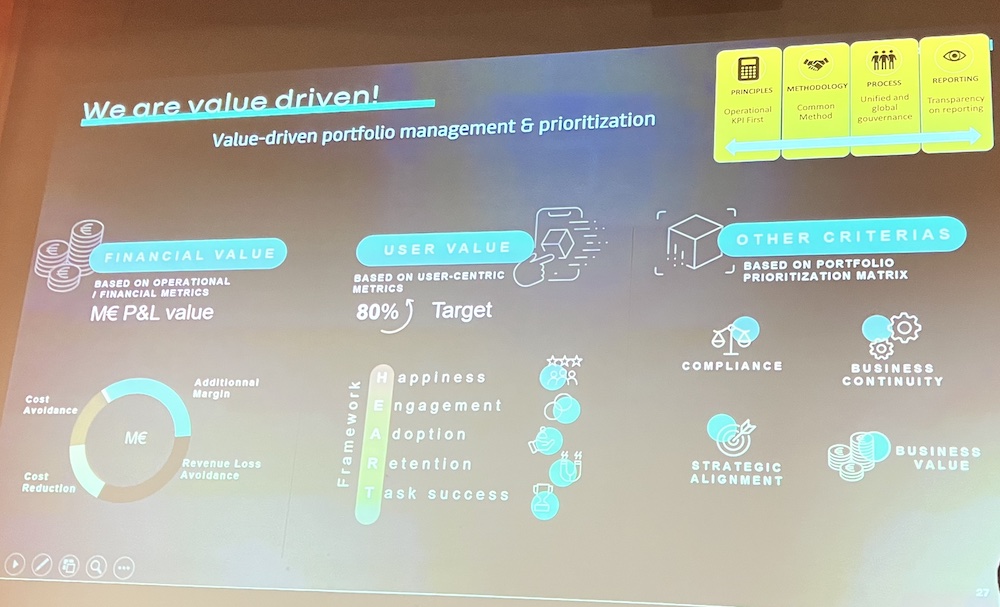
The LPM prioritization criteria
The matrix's various criteria were presented:
- Financial criteria
- User-value criteria (based on Google's HEART framework)
- Strategic alignment
- Business continuity
- Compliance
- Business value, continuity...
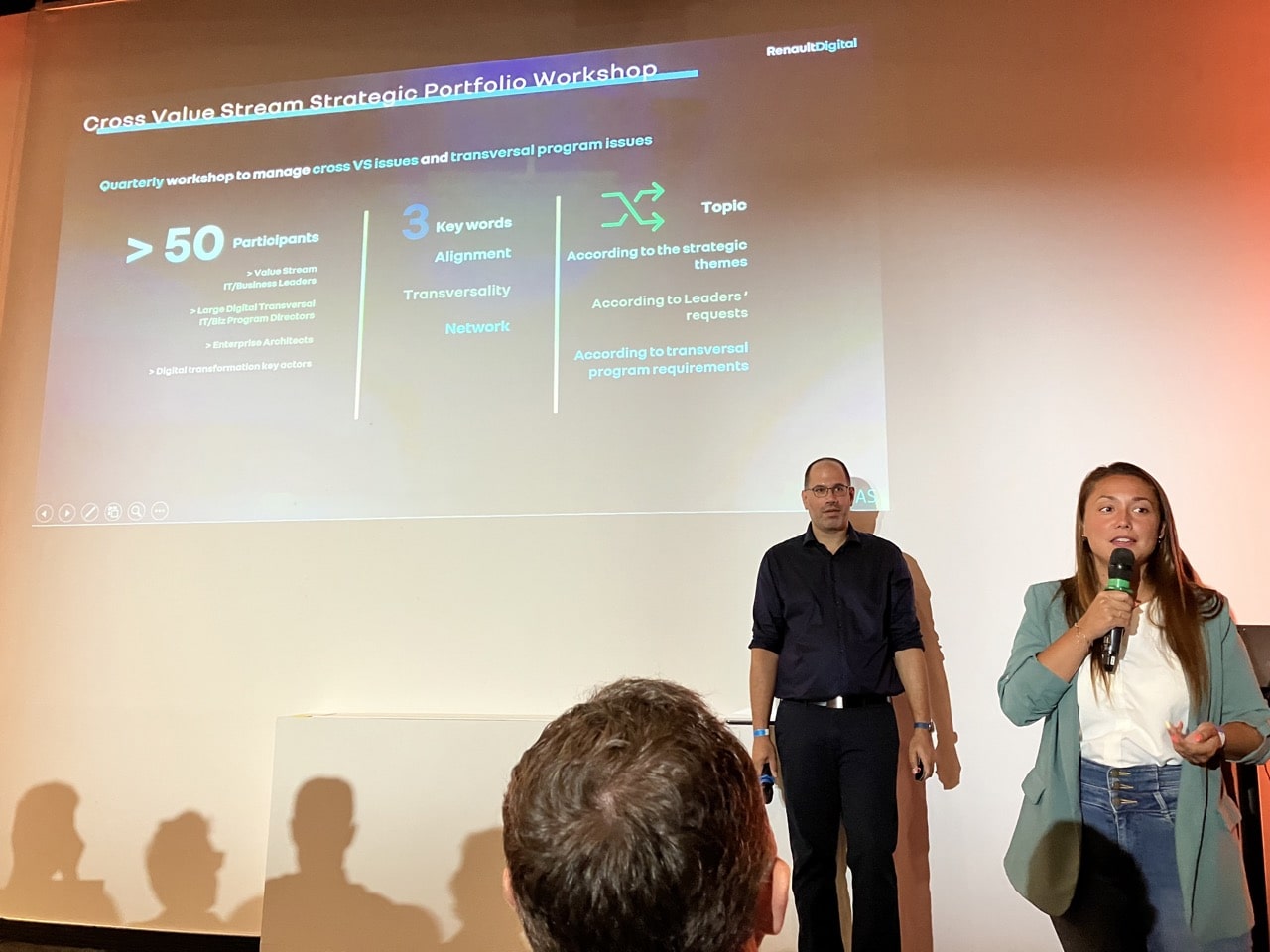
Aurélie Sale
La Poste / Thiga: Product Portfolio Management beyond digital products
Renaud CHEVALIER, Product Organization Consultant at Thiga / La Poste Group, brought the notion of enterprise architecture — more precisely, business architecture — back into the spotlight!
For him, product management has moved beyond the borders of digital pure players.
He rethinks our approaches to portfolio management. Explore the specific challenges companies face when they need to develop new capabilities and evolve their value chains. Discover how business architecture and change management play an essential role in product portfolio management, steering strategic initiatives well beyond IT.
However, he points out that despite scaling up, two operating modes still coexist around the marketing product: one managed in project mode "on the business side" and one managed in product mode "on the IT side".
He presented a representation of what the company must be able to do to deliver a complex service:
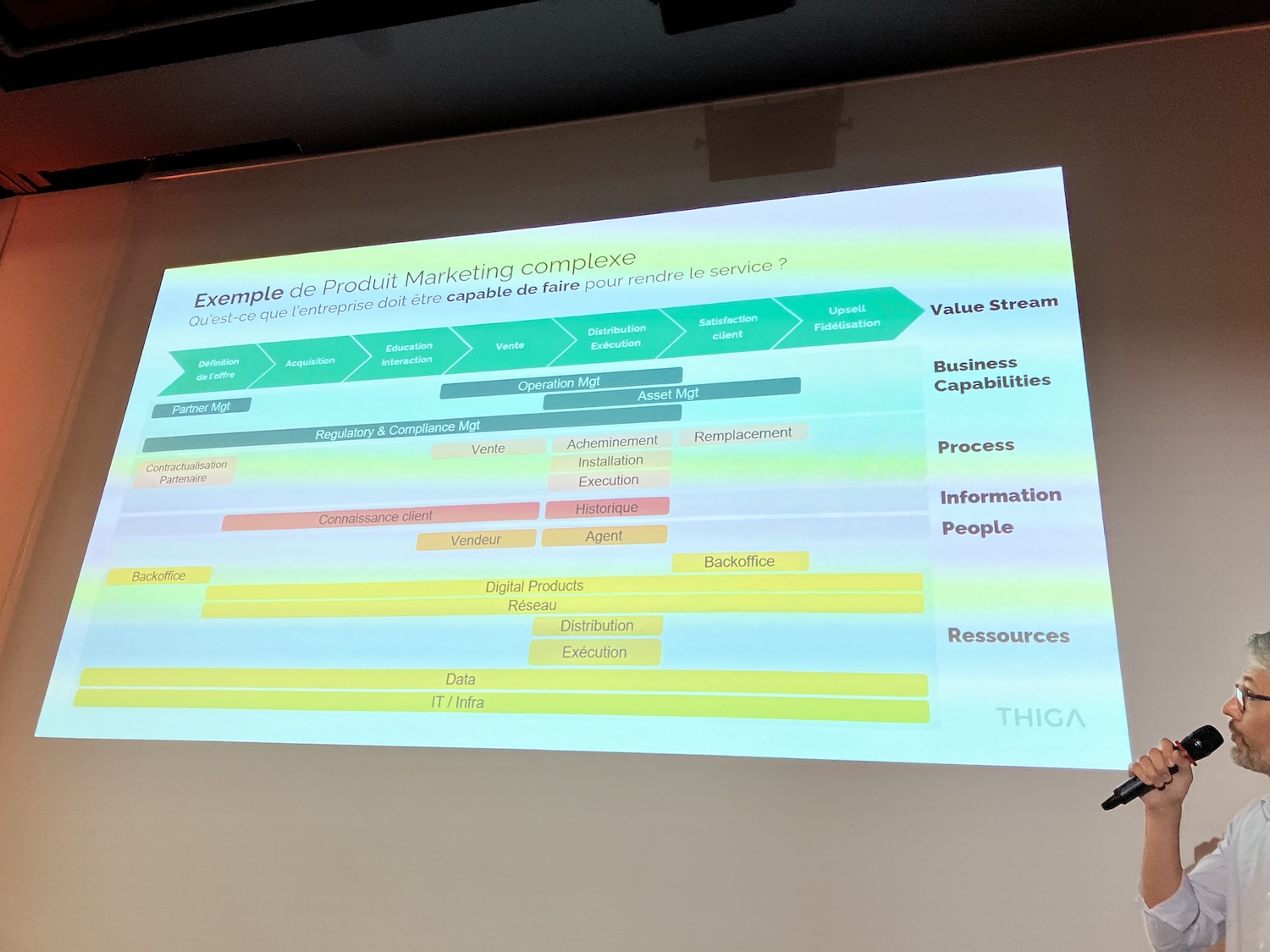
Example flow for a complex marketing product (Renaud CHEVALIER / credit: Thiga)
Product management is scaling up.
Product mode is becoming the norm for tech products.
Beware of the word "product" and of applying practices at the wrong level.
Applied to the complex marketing product, product mode makes strategy execution easier.
5 enablers are needed, including business architecture.
Business capability management makes it possible to step outside IT by making product mode holistic.
The 5 enablers are:
- Business architecture
- The business train tribe > bringing the open value stream on board
- The combined portfolio > aka one single budget
- Team topology > platformization
- The enterprise portfolio > strategic coherence in managing a portfolio of portfolios, lean startup cycle
And in a nutshell, business architecture is...
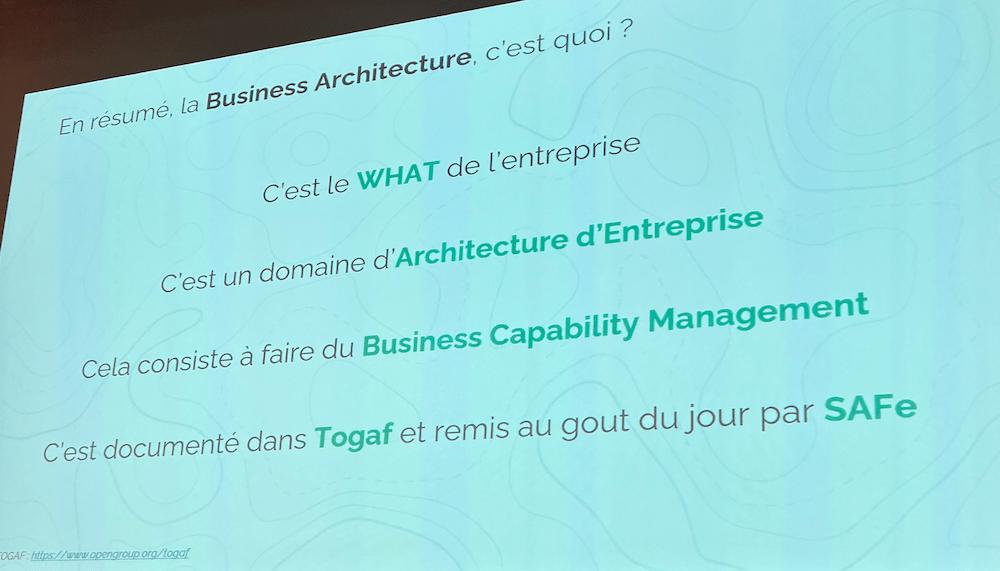
Business architecture (credit: Thiga)
Two examples of LPM implementation at ENGIE
The lessons learned from two ENGIE entities were presented by Sophie Montet, Agile Coach at the Agile Center — the practice serving the ENGIE Group — and Laurence Bago, Head of Agile Transformation, whose missions include implementing LPM and facilitating the SAFe train.
The key challenge presented: strengthening the ability to deliver more value.
Indeed, within the ENGIE group, more and more entities want to implement LPM to optimize investments, absorb the unexpected and get the most out of it thanks to agile delivery.
Between the lines: how can you help accelerate LPM adoption? Laurence and Sophie Montet presented a complete experience report on the implementation steps, the difficulties encountered and the results to date.
One of the most enriching talks!
Engie Pro in 2020... before agility
Too many topics in parallel, none prioritized
Ambitions beyond the available budget
A lack of shared roadmap vision
Overloaded, misaligned teams
Few projects delivered...
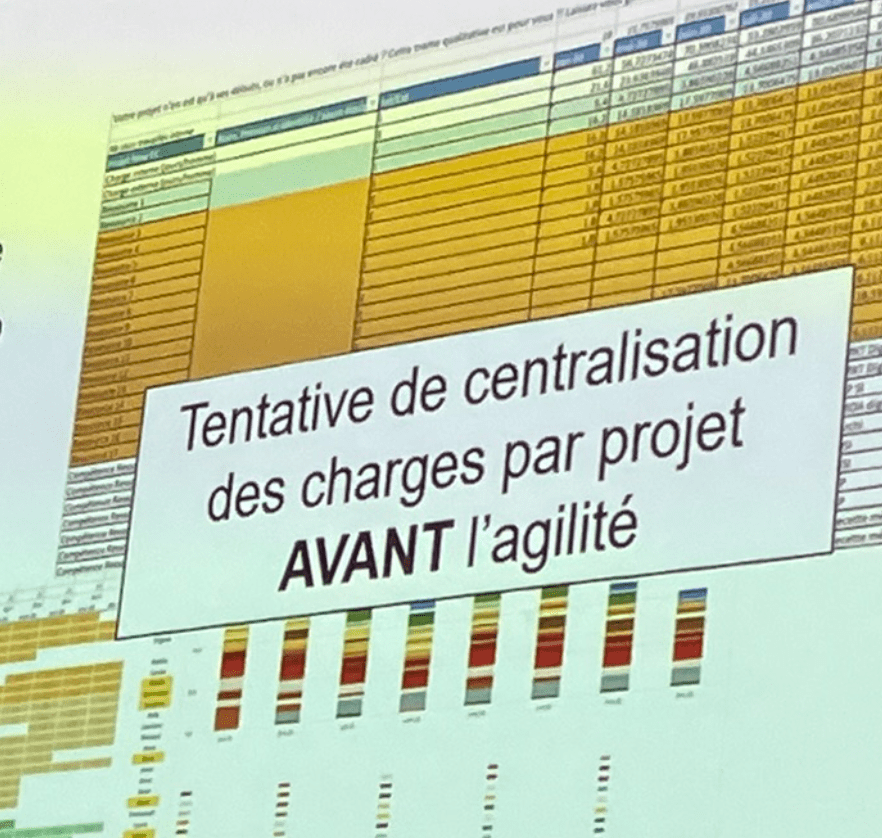
Before ^^
Gradual adoption across the group
Entities choose how to scale (or not)
Today, SAFe for 6 entities
Spotify model for 1 entity
Hybrid model for 1 entity
8 SAFe trains launched in 4 years across the group
The LACE (Lean-Agile Center of Excellence) in support
An activator of communities of practice
More than 45 Leading SAFe certification training sessions
Support for agile transformations (trains, LPM, specific workshops such as pitch, MVP, prioritization or value chains)
Toward a different way of working combining several mechanisms: OKRs / value / LPM and PI
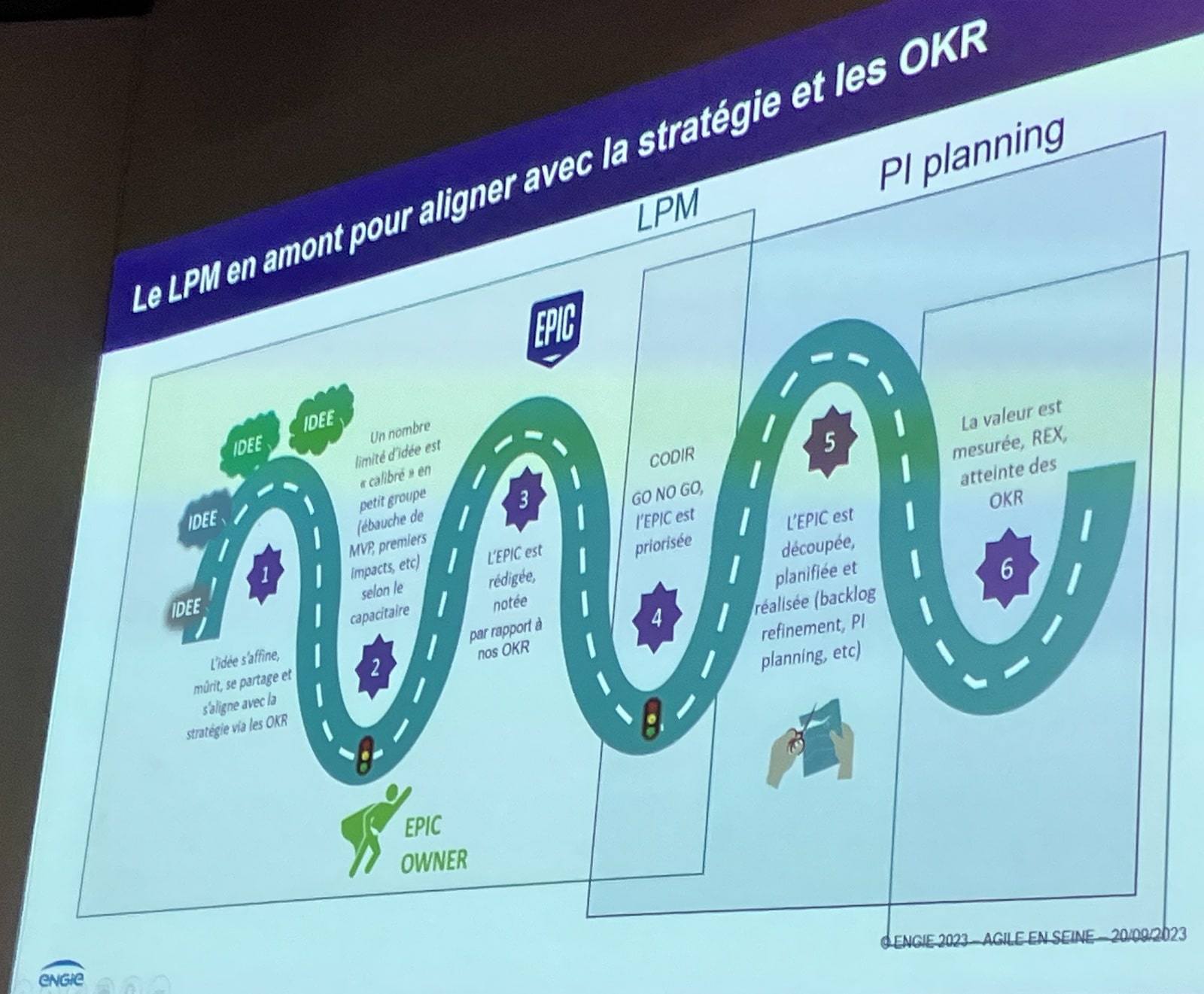
The EPIC at the center and Lean Portfolio Management upstream
Prioritization: what do you do when all you have is "100 grand"?
More than 45 projects in the entity, an overloaded team... The first move was to align everyone with an OKR session.
Then start rolling out LPM with EPICs and prioritization.
Then implement horizons to make sure you keep capacity for the future.
PI planning: "we put everyone on a train"!
Four steps to help accelerate LPM adoption in the Engie Group
The first step to master was the vocabulary...
The second was putting roles in place and shifting the mindset between IT and the business.
Third point, on everything governance > quarterly strategic review + funding review.
And the fourth step: continuous improvement — working on measured value.
Prioritizing initiatives
Each initiative gets a score. On the Fibonacci sequence, based on value.
1.5 hours to do all the scoring: 10 min per topic.
3 min for the initiative owner to pitch the benefits and how it addresses/contributes to the strategic priorities.
Observed benefits of implementing Lean Portfolio Management at Engie Home Service
- Everyone knows and owns the topics
- Better involvement of business teams and business owners
- Better strategic alignment
- Improved delivery
The new challenges
- Smoothing the flow / identifying WIP limits
- Quantifying expected benefits and better measuring ROI
- Steering by expected outcomes
What if you took back control of your project portfolio?
Book a demo and discover the tool in 30 minutes.