September 17, 20257 min readAirSaas
Why your transformation millions are evaporating: the real power is in the tempo

Contents
Why your 18 million transformation investments only produce 30% of the expected results
September 2025. You come out of your annual budget review with an observation that chills your blood.
18 million euros invested in business transformation, process optimization, and IS modernization. Three years of strategic projects. Mobilized teams. Consultants paid a high price.
The result? 30% of goals achieved. 70% organized waste.
You are not alone. In the corridors of French mid-sized companies, the same admission circulates off the record: “Our transformations never really succeed.”
Yet it is not for lack of vision. Nor of budget. Nor even of talent.
The problem lies elsewhere. Deeper. More structural.
It is nestled in this collective inability to synchronize strategic ambition with operational reality. In this chronic desynchronization between what the COMEX decides in January and what the teams can really deliver in December.
We manage our strategic projects as if we were still running a 50-person small business. Same tools, same reflexes, same tempo. Except we do 500 million in revenue and have 3,000 employees.
Mid-sized businesses are now navigating a world that even the best dashboards didn't anticipate. A world where margins are shrinking faster than trade-offs, where digital and environmental transitions converge without coordination, where policy cycles are shortening and regulations are multiplying.
This op-ed is not a plea for one more tool. It is an observation shared by lucid leaders: the problem is not the vision, it is the rhythm.
The illusion of strategic management
In many mid-sized companies, governance is based on a reassuring but dangerous conviction: following six strategic projects means managing the organization.
The CEO presents his matrix. The CFO details their monthly points. The CIO exposes their backlog. The Chief of Staff summarizes. Everything seems to be under control.
I thought I had a handle on our transformations. In reality, I was only managing a showcase, not the operational reality.
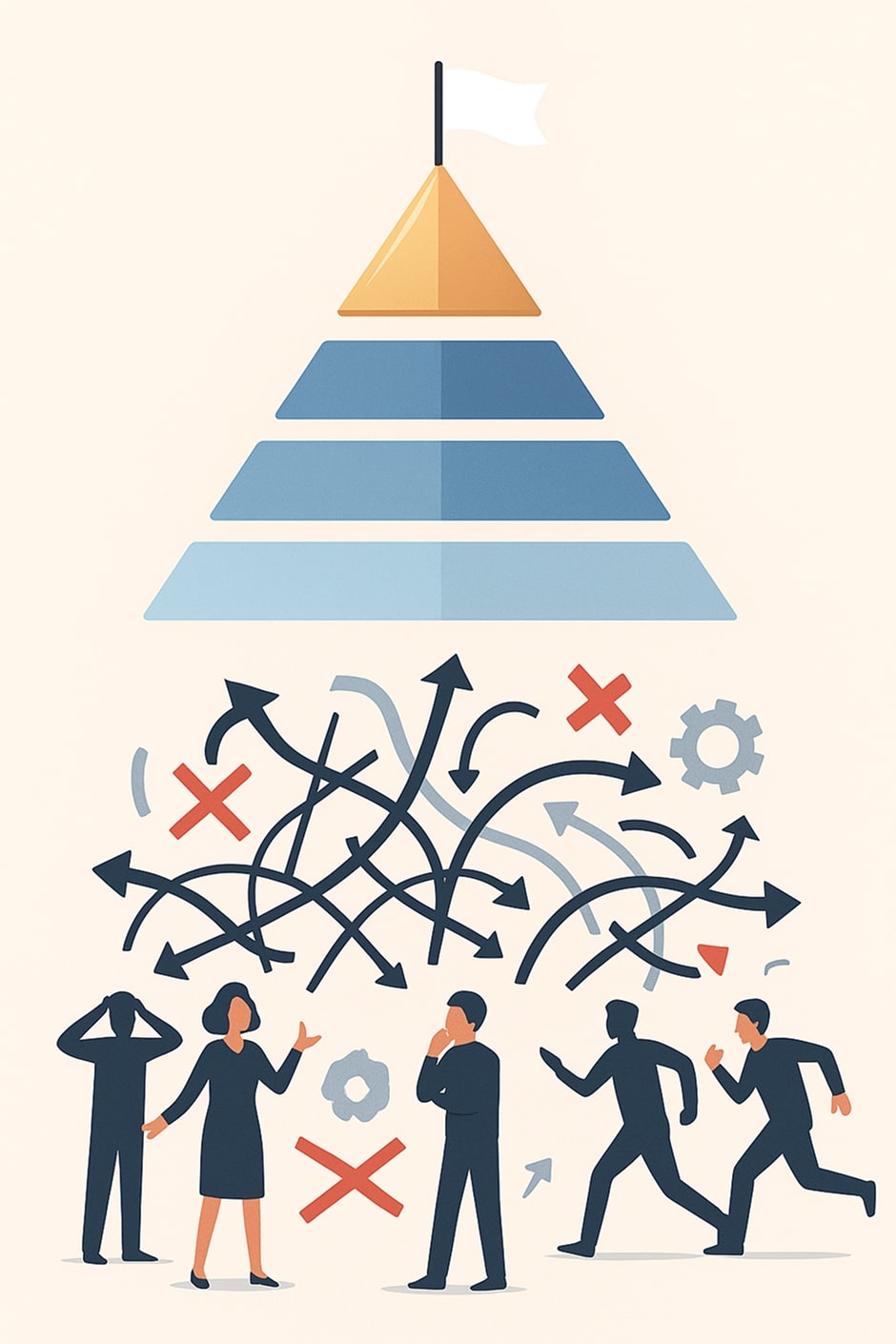
Because behind these few “visible” projects lies a completely different reality:
- 40 to 80 initiatives that are really active in the organization
- Interdependencies between departments that are completely invisible to the COMEX
- Trade-offs that are systematically postponed or circumvented
- A collective inability to assess the real cost of the portfolio
When I wanted to know the exact number of ongoing projects, it took 3 weeks to establish a reliable list. Three weeks, in an organization of 2,100 people.
CRM, finance, data... why project governance has remained in the PowerPoint age
Take a step back from your management tools.
For your sales, you have a modern CRM: real-time pipelines, conversion rates, forecasts updated daily.
For your finances, you manage with consolidated BI, automated reporting, reliable KPIs that give the pulse of the company.
And for your transformation projects — the ones that determine your future competitiveness? You have shared PowerPoints and Excel tables.
We manage our strategic projects with the same methods as in 2004. PowerPoint to present, Excel to calculate, meetings to arbitrate. It's absurd.
While all support functions have operated their digital revolution, project governance has remained artisanal:
- No centralized view of the real portfolio
- No shared capacity or load monitoring
- Approximate estimates of deliverables, often disconnected from field realities
The contrast is striking: these same companies that track every euro in turnover and analyze each customer conversion are flying blind on their most structural investments.
The invisible evil of COMEXs: when everyone lives in their own temporality
Another scourge is eating away at mid-sized companies' leadership teams: asynchronous decision-making.
Around the same table, four temporal worlds coexist without ever meeting:
- The CEO projects his vision for 2028: markets, capital, disruptions
- The CFO reasons by the quarter: margins, budgets, financial trade-offs
- IT oscillates between weekly emergencies: incidents, bugs, maintenance
- The field is experiencing daily immediacy: customers, orders, complaints
We share the same strategy, but we don't live at the same pace. As a result, we never really move forward together.
Faced with blockages, reflexes are predictable:
- Formation of a “critical project” task force
- Establishment of “reinforced management”
- Passive expectation that the next crisis will force decisions
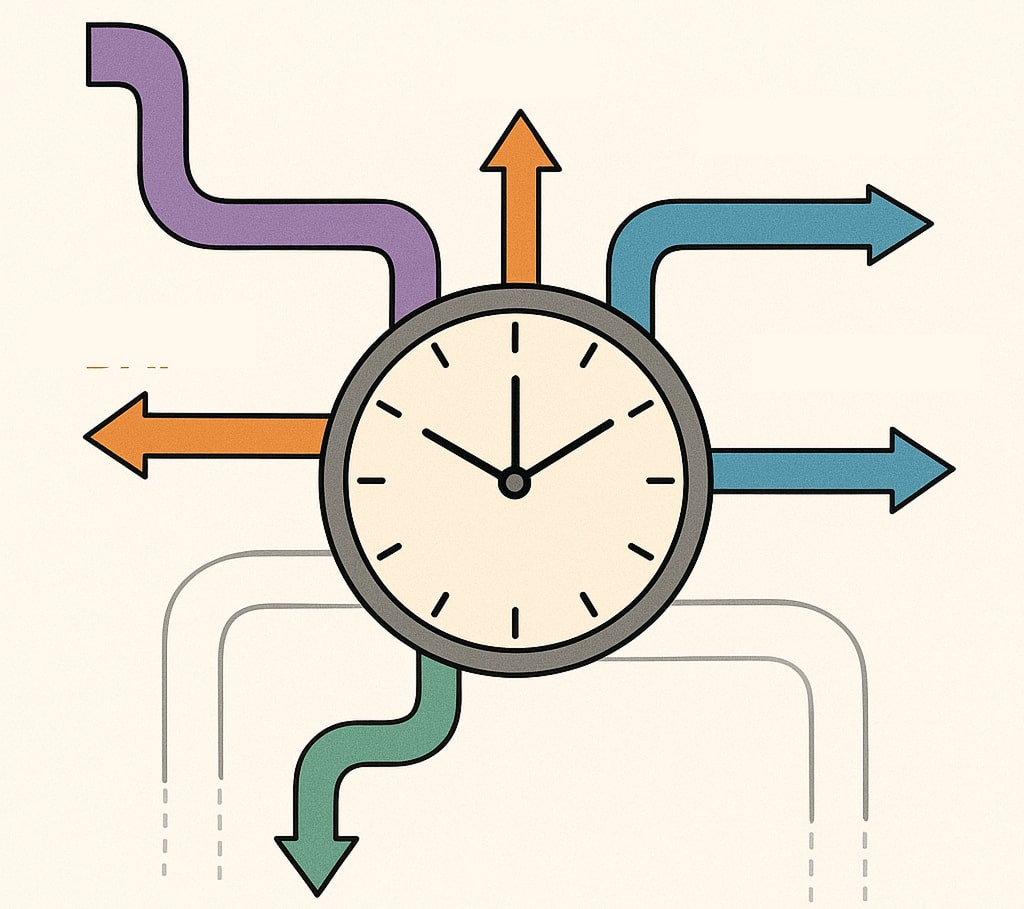
This temporal cacophony explains why so many transformations are getting bogged down. Not because of a lack of vision or resources, but because of the inability to create a common tempo of execution.
Teams run in aligned directions, but at incompatible speeds.
The quarter plan: the solution that reconciles vision and execution
Faced with this chronic desynchronization, a practice is gaining ground in the most mature COMEXs: the quarter plan.
Careful: this is not just another quarterly steering committee. The difference is fundamental.
A classic steering committee looks in the rearview mirror: “Where are we? Why the delay?”
The quarter plan looks to the horizon: “What can we actually achieve in the next 90 days with our current resources?”
It is a governance discipline that imposes a new organizational rhythm, centered on two pillars:
- Capacity vision: honest assessment of how much work each department can absorb
- Prospective trade-offs: deliberate choices about what enters the quarter and what leaves it
The principle: every 90 days, three non-negotiable exercises: ✅ Comprehensive review of the real portfolio of projects ✅ Assessment of available capacities by department ✅ Deliberate trade-offs: what moves forward, what slows down, what stops
Our first quarter plan was an electroshock. 30% of our projects were dropped on the spot. Projects nobody had dared to question for months.
We no longer align only on what needs to be done, but on what we can actually accomplish in the next 90 days.
What changes for COMEXs that switch to 90 days
Executive teams that have switched to the quarter plan observe three profound changes in the way they operate:
Revolution in prioritization: no more endless debates on “medium priority” projects. The time constraint forces decisions. A project is either in the quarter or it is not.
Transformation of trade-offs: the scope of projects now adapts to the resources available, and not the other way around. Scope creep — this natural drift that makes projects grow — finally becomes manageable.
Organizational synchronization: all departments work at the same cadence. A single calendar replaces the cacophony of individual schedules.
We didn't eliminate our steering committees. We finally made them useful: they're there to decide, no longer just to take stock.
Since adopting this quarterly rhythm, our projects suffer less scope drift and generate more business impact. Our business units acknowledge it.
The quarter plan reveals a managerial truth: the time constraint frees the decision.
The real power of COMEXs in 2026? The tempo.
The era of formal governance is over.
Three-year strategic plans, ambitious roadmaps and the CEO's six flagship projects are no longer enough to navigate the current complexity.
What will separate successful mid-sized companies tomorrow from those that stagnate will be neither their investment capacity nor their technological sophistication, but their mastery of the organizational rhythm.
The difference lies in this collective ability to synchronize strategic vision and operational execution, to adjust continuously without losing course.
A COMEX that doesn't master its tempo is like a symphony orchestra where every musician plays from their own score. Individually, everyone excels. Collectively, it's cacophony.
The mid-sized companies that will win in the years to come will be those that have understood this obvious truth: in a volatile environment, the real strategic skill is not predicting the unpredictable, but adapting quickly when the unexpected occurs.
What if you took back control of your project portfolio?
Book a demo and discover the tool in 30 minutes.