


.jpg)
La project portfolio management (GPP), also called Project Portfolio Management (PPM), is a strategic discipline that consists in selecting, prioritizing and managing all of an organization's projects to maximize value creation.
Unlike project management, which aims to”Do projects well“(operational domain), project portfolio management seeks to”do the right projects“(decision-making area).
The Project Management Institute (PMI) defines it as centralized management of processes, methods and technologies for a set of projects, making it possible to optimize arbitrations and their planning, while assessing the level of risk and the financial viability of projects.
Concretely, a project portfolio brings together all the projects, programs and operations of a company. Like a stock market portfolio, it's about deciding where to invest your budget, resources, and time to get the best return on investment.
The PPM works like a strategic funnel : at the entrance, a massive flow of ideas from strategy, customers or regulations; at the exit, a careful selection of coordinated and executable initiatives. Without this filter, the organization exhausts itself in carrying out everything at the same time and condemns its projects to mediocre results.

What project portfolio management allows
Project portfolio management is based on a truth that many organizations refuse to face: The capacity of the teams is finite. And it is this constraint — not scoring matrices, not progress percentages — that should structure all decisions.
Concretely, capacity can be measured By team and In the quarter. It is the scale of Quarter Plan : each team (infrastructure, development, data, security, etc.) has a real number of man-days over the coming quarter, once absences, maintenance, runs and unforeseen events have been deducted. This quarterly capacity is the real budget of your portfolio — much more structured than the financial budget.
⚠️ Let's be wary of empty words. The terms “prioritize” and “pilot” are among the most overused in project vocabulary. To say that a portfolio is “prioritized” is often to say nothing at all if no capacity constraints have been faced with the commitments. Likewise, “managing” a portfolio via a Percentage of progress is misleading: a project can show 70% progress and be months away from delivering any usable deliverables. The percentage of progress measures load consumption, rarely the proximity of a tangible result. The real question is never “where are we?” , but “What are we going to deliver this quarter, and does the team have the bandwidth to do it?”
Capacity planning is the strategic guardrail of your portfolio: without it, you validate projects that your teams will never be able to absorb.
💡 Did you know that? According to a PMI study, 70% of projects tend to fail. The first cause? A change in business priorities (39%), followed by a change in project goals (37%). Project portfolio management exists precisely to anticipate and manage these trade-offs rather than subject to them.
Confusion between these three concepts is common. Here's what sets them apart.
One project is a temporary initiative to produce a single deliverable. It has a start, an end, a budget and SMART goals (Specific, Measurable, Achievable, Realistic, Timely) goals. Project management focuses on the successful delivery of this initiative.
Example: Deploy a new CRM tool for the sales team.
One syllabus is a set of interdependent projects that share common goals. Projects within a program are linked: they collectively contribute to a strategic outcome.
Example: The “Digital transformation of customer relationships” program, which includes the CRM project, the website redesign project and the chatbot implementation project.
One project portfolio is not a hierarchical level above the program. It is a lentil — a way of looking at a group of projects from a given angle, in order to make decisions adapted to this perimeter.
In practice, the same organization handles several portfolios simultaneously: the portfolio ofIT infrastructure team, that of thebusiness application team, the portfolio of vital projects, that of the projects of regulatory compliance, or the global portfolio as seen by the General Management. Each view answers a different question: “Is my team overloaded?” , “Are our vital projects progressing?” , “Are we aligned with the strategy?”.
This is what makes project portfolio management so powerful: it does not impose a single framework, but offers the possibility of filter, group, and compare projects according to the needs of each stakeholder — team, business management, CIO or Management Committee.
Example: The IT department manages a global portfolio, but each team (infrastructure, dev, data) has its own portfolio view with its capacity constraints. The Management Committee, for its part, looks at the portfolio by strategic axis.
📌 To remember: The portfolio is not “above” the project and the program in a pyramid. It is a Reading grid which makes it possible to compare, arbitrate and allocate resources between projects competing for the same capacity. There can be as many portfolio views as there are decision needs in the organization.

In most businesses, the number of projects far exceeds the capacity to carry them out. It is a universal law of transformation: demand will always be greater than the supply of available resources.
The numbers confirm it: according to the IBM Institute for Business Value, organizations that are leaders in project portfolio management have a 46% more predictable revenue performance que leurs concurrentes moins matures. L'excellence en PPM n'est pas un luxe organisationnel — c'est un avantage concurrentiel mesurable.
Sans gestion de portefeuille de projets, les organisations subissent un phénomène bien connu : l'urgence chasse l'urgence. Les équipes fonctionnent en "best effort", les arbitrages se font au fil de l'eau (ou au "fait du prince"), et personne n'a de visibilité sur ce qui est réellement prioritaire.
1. Alignement stratégique
La GPP garantit que chaque projet contribue à la stratégie de l'entreprise. Fini les projets "orphelins" qui consomment des ressources sans créer de valeur mesurable. Chaque euro investi est tracé jusqu'à un objectif stratégique. Une vérité trop souvent ignorée : succès technique ≠ succès business. Une exécution parfaite d'un projet sans alignement stratégique reste un gaspillage de ressources.
2. Priorisation objective et transparente
En rendant visible la règle du jeu et l'ensemble des sujets en revue de portefeuille, la démarche instaure une relation de confiance et de transparence entre la DSI, les métiers et la direction générale. Les décisions de priorisation sont fondées sur des données probantes, pas sur le rapport de force politique ou la voix la plus forte en comité de direction.
3. Optimisation de la capacité — la vraie valeur ajoutée
C'est ici que la gestion de portefeuille de projets prend tout son sens. La capacité ne se mesure pas à l'échelle de l'organisation entière — elle se mesure équipe par équipe, trimestre par trimestre. L'approche du Quarter Plan consiste à confronter, chaque trimestre, les engagements projet à la bande passante réelle de chaque équipe. Les organisations qui maîtrisent cette planification augmentent de 68 % leurs chances de livrer leurs projets à temps. Le secret : identifier les goulots sur les compétences critiques (architectes IT, experts métiers, ingénieurs spécialisés) et accepter de reporter ce qui ne rentre pas dans le trimestre. Résultat : moins de surcharge, moins de retards en cascade, des engagements crédibles.
4. Gestion proactive des risques
En ayant une vue consolidée du portefeuille, les risques sont identifiés à l'échelle de l'organisation, pas uniquement projet par projet. Un risque sur un projet structurant peut impacter tout le portefeuille : la GPP permet de l'anticiper.
5. Meilleure communication avec les parties prenantes
Le reporting consolidé du portefeuille (tableau de bord, rapport flash, revue de portefeuille) offre aux dirigeants les données nécessaires pour prendre des décisions éclairées, sans avoir à plonger dans le détail de chaque projet.
6. Agilité décisionnelle
Les roadmaps de SI à 3-5 ans figées appartiennent au passé. Avec une GPP moderne, la priorisation se fait en continu, à un rythme adapté aux changements de contexte de l'entreprise. Les données terrain remontent en temps réel, permettant des réajustements rapides.
🏢 Idée reçue : "La gestion de portefeuille de projets est réservée aux grandes entreprises." Faux. Les PME et ETI peuvent parfois en tirer encore plus de bénéfices, car elles ont plus d'agilité et la capacité de mettre en œuvre la démarche plus rapidement. L'enjeu est d'adapter le niveau de formalisme à la taille de l'organisation.


Tout commence par la boussole. Sans clarté sur la stratégie, votre portefeuille ne sera qu'un inventaire de projets sans cohérence.
Trois actions concrètes pour cette étape :
Créez un inventaire exhaustif de toutes les initiatives en cours et à venir : projets validés, projets en attente, idées en gestation. Centralisez toutes les demandes — qu'elles soient stratégiques, réglementaires, issues des métiers ou des clients — dans un processus unique d'intake (capture). C'est le meilleur moyen d'éliminer les redondances et d'identifier les opportunités de mutualisation.
Chaque projet doit être documenté avec une fiche standardisée comprenant au minimum : objectif, sponsor, budget estimé, ressources nécessaires, échéance et contribution stratégique.
Catégorisez ensuite vos projets par type (transformation, run, réglementaire, innovation...) et par programme si applicable.
C'est le cœur de la démarche. Appliquez vos critères de sélection pour noter et classer chaque projet. Les méthodes de priorisation sont détaillées dans la section suivante, mais l'essentiel est d'avoir une approche multicritère qui combine valeur business, faisabilité, risques et alignement stratégique.
C'est l'étape la plus décisive — et la plus souvent bâclée. Pour chaque équipe, évaluez sa capacité réelle sur le trimestre à venir : jours-homme disponibles, une fois déduites les absences, le run, la maintenance et la marge d'imprévu. Puis confrontez cette capacité aux engagements projet.
C'est souvent le moment de vérité : ce qui semblait prioritaire peut se révéler irréaliste si l'équipe concernée est déjà saturée. L'exercice doit être concret : non pas "a-t-on les moyens au global ?", mais "l'équipe Data peut-elle absorber ce projet en Q2, ou faut-il le décaler en Q3 ?"
L'objectif n'est pas de tout planifier au jour près. C'est de s'assurer que les engagements sont crédibles. Mieux vaut 5 projets livrés ce trimestre que 15 projets "en cours" dont aucun ne délivre de résultat tangible. Attention au piège du pourcentage d'avancement : un projet à "60 %" ne signifie pas qu'il est proche de livrer quoi que ce soit d'exploitable — c'est souvent juste un ratio de charge consommée.
Mettez en place les instances de décision et les rituels récurrents qui feront vivre votre portefeuille :
Le PMI distingue trois types de PMO (Bureau de Gestion de Projets), selon le niveau de contrôle exercé :
Le choix du type de PMO dépend de la maturité de votre organisation et de votre culture managériale. La tendance actuelle est au PMO "facilitateur" (entre Support et Contrôle), qui structure sans bureaucratiser. Plus largement, le succès en 2026 exige une métamorphose du PMO : il doit évoluer d'un rôle de support administratif vers celui de partenaire stratégique. Le pilotage stratégique ne consiste pas à surveiller des calendriers, mais à garantir que chaque euro et chaque heure investis servent la croissance de l'entreprise.
Sans rituels réguliers, votre portefeuille deviendra vite obsolète. C'est la fréquence et la discipline de ces rituels qui créent la valeur.
Suivre un portefeuille de projets dans Excel n'est plus viable au-delà de 10 projets. Un outil PPM (Project Portfolio Management) dédié permet de centraliser les informations, automatiser le reporting et offrir une visibilité en temps réel à toutes les parties prenantes.
Les critères clés pour choisir votre outil PPM sont détaillés dans la section dédiée ci-dessous.
La gestion de portefeuille de projets n'est pas un exercice ponctuel, c'est un processus continu. À chaque revue de portefeuille, posez-vous trois questions :
🎯 Conseil pragmatique : Ne cherchez pas la perfection au démarrage. Commencez avec un périmètre restreint (10-15 projets clés), des rituels simples et un outil adapté. Faites "tache d'huile" ensuite. La maturité se construit progressivement, comme un sachet de thé qui infuse.
La priorisation est l'exercice le plus complexe et le plus politique de la gestion de portefeuille de projets. Voici les méthodes les plus utilisées.
Chaque projet est évalué sur une grille de critères pondérés. Les critères se répartissent généralement en trois familles :
Each criterion is given a score (for example from 1 to 5) and a relative weight. The total weighted score makes it possible to classify projects objectively and to establish a borderline (cut-line): the projects above pass, those below are postponed or abandoned. Applying the cut-line is the ultimate management act: once resources are consumed by the highest-rated projects, anything below the line should be postponed or cancelled, without exception. This is the only way to ensure that high-impact initiatives receive the oxygen they need to succeed — and to protect the portfolio of “pet projects” that lack real value.
Advantage: Transparency, reproducibility, ease of explanation to stakeholders.Limit: The quality of the scoring depends on the quality of the input data. As Robert Cooper, an expert in portfolio management, points out: “The sophistication of financial methods often exceeds the quality of the data. Purely accounting methods sometimes produce the poorest results if they are not complemented by strategic judgment.”
This simple and visual approach positions each project on two axes: the expected value (business impact) and the effort required (cost, complexity, duration). Projects with high value and low effort (“quick wins”) are priority.
A commonly used variant is the risk-return matrix, which makes it possible to balance the portfolio between four quadrants: “Quick Wins” (low risk, high return), strategic projects (high risk, high return), optimization projects (low risk, low return) and projects to avoid (high risk, low return) and projects to avoid (high risk, low return).
Advantage: Visual, quick to set up, excellent for prioritization workshops.Limit: Reducer for complex projects with a long term impact
Organize projects into four categories: Must have (vital), Should have (important), Could have (desirable), Won't have (not now). This method, which comes from the agile world, is particularly suitable when decisions need to be made quickly.
Based on the SAFe framework, the WSJF prioritizes by dividing the value (Cost of delay — Cost of Delay) by the size of the effort. The cost of delay combines three components: business/user value, temporal criticality (window of opportunity) and risk reduction or learning opportunity. Projects that are costly to delay and that are small in size come first. It is the most used method in organizations that have adopted agility at scale.
RICE is a rapid scoring model that evaluates each project according to 4 dimensions: Reach (scope/number of people impacted), Impact (degree of impact per person), Confidence (level of confidence in the estimates) and Effort (workload required). The RICE score = (Reach × Impact × Confidence)/Effort. Projects with the highest score are prioritized.
The Lean Portfolio Management (LPM) goes further by integrating prioritization into a continuous flow, aligned with strategic goals (OKRs or strategic Epics). Capacity is allocated by “value stream” rather than by project, which allows for greater agility in trade-offs.
The switch to LPM marks the end of rigid annual planning, which is often obsolete as early as the first quarter. We no longer fund isolated projects (“Fire and Forget” approach), but continuous value chains. This agility is secured by three guardrails (Guardrails):
Scenario analysis is a powerful tool for extracting yourself from permanent crisis management and trading intuition forpredictive impact analysis. A rigorous simulation is based on three steps:
For example: simulate the addition of an urgent project to measure the delay in the delivery dates of ongoing initiatives, or assess the impact of a 15% budget reduction on the composition of the portfolio. Modern PPM tools incorporate these simulation capabilities to inform steering committee arbitration decisions — ending the reign of “the loudest voice” in management committees.
⚡ AirSaaS best practice: Portfolios that were prioritized after 2-3 years were fixed before. Today, continuous prioritization is standard practice. An AirSaaS survey (2022) shows that the majority of CIOs reprioritize their portfolio at least every quarter, and often every month.
Managing a portfolio of projects without indicators is managing without a dashboard. Here are the essential KPIs, organized into 4 categories.
📊 Advice: Do not multiply the indicators. 5 to 8 well-chosen and regularly updated KPIs are better than 18 indicators that have never been consulted. Select the ones that match your maturity level and gradually enrich. The challenge is for your portfolio dashboard to tell a clear story in 30 seconds.
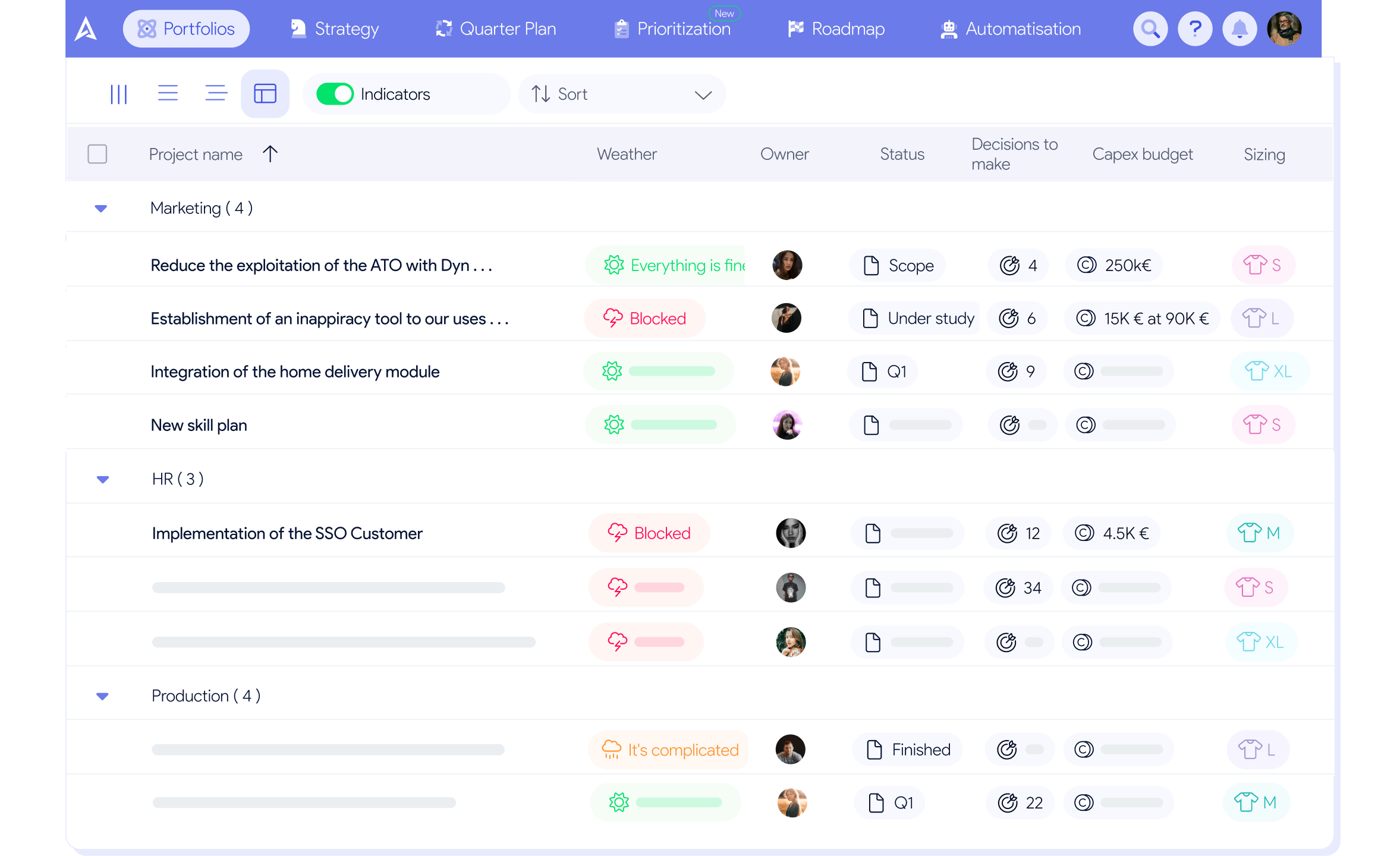
The market for project portfolio management tools has evolved considerably. No more ERP/PPM gas factories of the 2010s. Modern solutions focus on simplicity, collaboration, and automation.
Simplicity of adoption : The tool must be usable by project managers, trades AND management, without complex training. If no one uses it, it is useless.
Consolidated portfolio view : Visual dashboards with filters (by program, by strategic axis, by project weather, by manager). The macro view is what the tool is all about.
Automated reporting : Automatic generation of flash reports (PPT, PDF, URL) for the Steering Committee, without spending 4 days compiling data manually.
Ritual Management : The tool must structure your portfolio reviews, your project points and your Copil with adapted workflows.
Integration with the existing ecosystem : Native connection with task management tools (Jira, Asana, Asana, Monday, Azure DevOps) to report operational data without double entry.
Real-time collaboration : All stakeholders (CIO, business, management) contribute on the same platform. No more “I didn't know.”
A tool, no matter how good, cannot compensate for unclear governance, undefined strategic goals, or indecisive management. The tool is a catalyst: it amplifies good practices, but does not create them.
🚀 AirSaaS is the project portfolio management tool designed for CIOs, PMOs, and transformation managers who want to combine simplicity and efficiency. Visual dashboard, automatic flash report, native integrations, and real-time collaboration. Discover AirSaas →
After hundreds of discussions with CIOs, PMOs, and transformation managers, here are the most common mistakes we see.
[IMAGE 8 — Chart “Project success rate by size — Standish Group”] Type: Bar graph/data viz (taken from the Chaos Report)Brief: Resume and update the Standish Group Chaos Report chart already on the current page, which shows the correlation between project size and success rate. Small projects are much more successful than big ones. Key message: “cut out your projects.” Cite Standish Group source. Medium size (800×500px).Alt text: “Project success rates by size — Source: Standish Group Chaos Report”
The portfolio is not used to micro-manage the tasks of each project. It is used to make strategic decisions: which projects to launch, stop, accelerate or postpone. Mixing levels creates confusion and burdens governance.
A portfolio that never “kills” a project is a sick portfolio. If a project no longer creates value, has seen its context change or mobilizes critical resources, you must know how to stop it. It's a sign of maturity, not failure.
Validating 20 projects when you have the capacity to carry out 8 correctly is a recipe for collective failure. And capacity cannot be managed “globally” — it can be managed. team by team, quarter by quarter. An organization may have available budget and resources “on paper”, but if the Data team is saturated in Q2, no Data project will deliver. The chronic inability to say “no” is the most common symptom of immature organizations in PPM. Project portfolio management requires comparing demand with the reality of each team's capacity — and assuming the resulting trade-offs.
The percentage of progress is one of the most misleading indicators of portfolio management. A 70% project may be months away from delivering any usable deliverable. This figure most often measures the load consumption (how many days have passed) and not the proximity to a tangible result. Mature organizations in PPM replace the% of progress with concrete indicators: milestones reached, deliverables accepted, functionalities delivered in production. The question to ask when reviewing a portfolio is never “how much% are we at?” , but “What will be delivered and usable at the end of the term?”
If each project manager produces his reports in a different format, at a random frequency, the Steering Committee will never be able to have a clear vision of the portfolio. Standardize the format, automate the collection, set a regular rhythm.
Project portfolio management involves budgets, priorities, and sometimes power games. Without a sponsor at the level of General Management or CIO, the approach runs out of steam as soon as the first difficult decisions are made.
Choose a gradual approach: start on a limited scope, with simple rituals and a small number of pilot projects. Show initial results, then extend. Adoption is achieved by proof, not by decree.
A project portfolio is the set of projects, programs, and operations of an organization, managed collectively to achieve strategic goals. Wikipedia defines it as “the discipline dealing with projects taken from a global point of view for the purpose of selection and arbitration” (Fernez-Walch, 2004).
La multi-project management is operational: it aims to effectively manage several projects in parallel (planning, resources, dependencies). La portfolio management is strategic: it decides which projects to launch and in what order, based on their contribution to the strategy. In summary, the multi-project takes care of the “how”, the portfolio takes care of the “what”.
In general, it is the PMO (Project Management Office), the DSI Or the Transformation director who drives portfolio management. But arbitration decisions involve General Management and Business Departments. Project portfolio management is by nature transversal and collaborative.
One project management tool (Jira, Asana, Monday, Trello) allows you to manage the tasks, schedule, and resources of an individual project. One PPM tool makes it possible to manage the entire portfolio: consolidated view, trade-offs, strategic reporting, alignment with objectives. The two are complementary and should ideally be connected.
Absolutely. The size of the business does not determine the need; it's the number of projects competing for the same resources that matters. As soon as an SME manages more than 5-10 transversal projects in parallel, a portfolio approach — even a light one — brings considerable value. Moreover, SMEs often have more agility to implement it.
Ongoing prioritization has become the dominant practice. Most mature organizations conduct a formal portfolio review every month, with ad hoc arbitration points if the context requires it. Roadmaps frozen at 2-3 years have given way to agile and adaptive management.
The most recognized frameworks are: the PMI Standard for Portfolio Management, MoP (Management of Portfolios) by AXELOS, the Lean Portfolio Management (LPM) of the SAFe framework, and approaches inspired by OKR (Objectives and Key Results). The choice depends on the culture and maturity of your organization.


